
非雀形目鸟类的粪便微生物组与饮食的共变关系。
Covariation of the Fecal Microbiome with Diet in Nonpasserine Birds.
机构信息
Guangdong Laboratory for Lingnan Modern Agriculture, Guangzhou, China.
College of Veterinary Medicine, South China Agricultural University, Guangzhou, China.
出版信息
mSphere. 2021 May 12;6(3):e00308-21. doi: 10.1128/mSphere.00308-21.
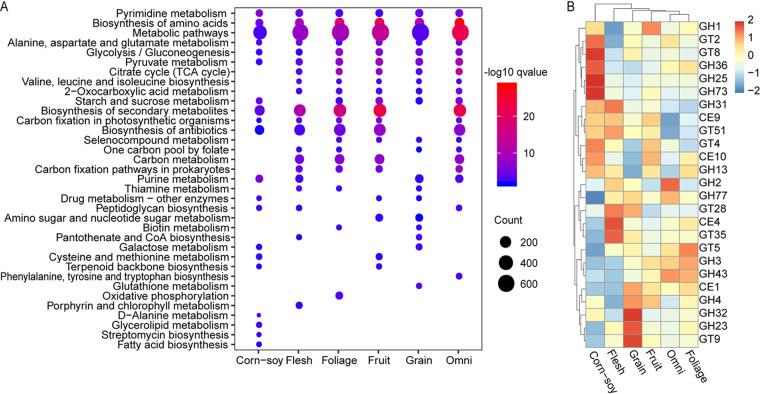
Opportunistic feeding and multiple other environment factors can modulate the gut microbiome, and bias conclusions, when wild animals are used for studying the influence of phylogeny and diet on their gut microbiomes. Here, we controlled for these other confounding factors in our investigation of the magnitude of the effect of diet on the gut microbiome assemblies of nonpasserine birds. We collected fecal samples, at one point in time, from 35 species of birds in a single zoo as well as 6 species of domestic poultry from farms in Guangzhou city to minimize the influences from interfering factors. Specifically, we describe 16S rRNA amplicon data from 129 fecal samples obtained from 41 species of birds, with additional shotgun metagenomic sequencing data generated from 16 of these individuals. Our data show that diets containing native starch increase the abundance of in the gut microbiome, while those containing plant-derived fiber mainly enrich the level of Greater numbers of and are detected in carnivorous birds, while in birds fed a commercial corn-soybean basal diet, a stronger inner-connected microbial community containing and was enriched. Furthermore, the metagenome functions of the microbes (such as lipid metabolism and amino acid synthesis) were adapted to the different food types to achieve a beneficial state for the host. In conclusion, the covariation of diet and gut microbiome identified in our study demonstrates a modulation of the gut microbiome by dietary diversity and helps us better understand how birds live based on diet-microbiome-host interactions. Our study identified food source, rather than host phylogeny, as the main factor modulating the gut microbiome diversity of nonpasserine birds, after minimizing the effects of other complex interfering factors such as weather, season, and geography. Adaptive evolution of microbes to food types formed a dietary-microbiome-host interaction reciprocal state. The covariation of diet and gut microbiome, including the response of microbiota assembly to diet in structure and function, is important for health and nutrition in animals. Our findings help resolve the major modulators of gut microbiome diversity in nonpasserine birds, which had not previously been well studied. The diet-microbe interactions and cooccurrence patterns identified in our study may be of special interest for future health assessment and conservation in birds.
机会性进食和其他多种环境因素会调节肠道微生物组,并且当野生动物被用于研究系统发育和饮食对其肠道微生物组的影响时,会产生偏差结论。在这里,我们控制了这些其他混杂因素,以调查饮食对非雀形目鸟类肠道微生物组组成的影响程度。我们在一个动物园中一次性收集了 35 种鸟类的粪便样本,以及广州市农场中的 6 种家禽的粪便样本,以最大程度地减少干扰因素的影响。具体来说,我们描述了从 41 种鸟类的 129 个粪便样本中获得的 16S rRNA 扩增子数据,其中 16 个个体还生成了 shotgun 宏基因组测序数据。我们的数据表明,含有天然淀粉的饮食会增加肠道微生物组中 的丰度,而含有植物来源纤维的饮食则主要富集 的水平。肉食性鸟类中检测到更多的 和 ,而在以商业玉米-大豆为基础饲料喂养的鸟类中,含有 和 的微生物群落的内部连接性更强,得到了富集。此外,微生物的宏基因组功能(如脂质代谢和氨基酸合成)适应了不同的食物类型,以达到对宿主有益的状态。总之,我们的研究中确定的饮食和肠道微生物组的共变表明,饮食多样性会调节肠道微生物组,并帮助我们更好地理解鸟类如何基于饮食-微生物组-宿主相互作用来生活。我们的研究确定了食物来源,而不是宿主系统发育,作为调节非雀形目鸟类肠道微生物组多样性的主要因素,在最小化其他复杂干扰因素(如天气、季节和地理位置)的影响后。微生物对食物类型的适应性进化形成了饮食-微生物组-宿主相互作用的互惠状态。饮食和肠道微生物组的共变,包括微生物群落对饮食在结构和功能上的反应,对动物的健康和营养很重要。我们的研究结果有助于确定非雀形目鸟类肠道微生物组多样性的主要调节因素,这在以前的研究中并没有得到很好的研究。我们研究中确定的饮食-微生物相互作用和共现模式可能对未来鸟类的健康评估和保护特别感兴趣。


 Zotero 插件