Department of Pharmacy, Sixth Affiliated Hospital of Guangxi Medical University, Yulin, 537000, Guangxi, China.
BMC Infect Dis. 2021 May 17;21(1):444. doi: 10.1186/s12879-021-06140-5.
To investigate the trends and correlation between antibacterial consumption and carbapenem resistance in Gram-negative bacteria from 2012 to 2019 in a tertiary-care teaching hospital in southern China.
This retrospective study included data from hospital-wide inpatients collected between January 2012 and December 2019. Data on antibacterial consumption were expressed as defined daily doses (DDDs)/1000 patient-days. Antibacterials were classified according to the Anatomical Therapeutic Chemical (ATC) classification system. The trends in antimicrobial usage and resistance were analyzed by linear regression, while Pearson correlation analysis was used for assessing correlations.
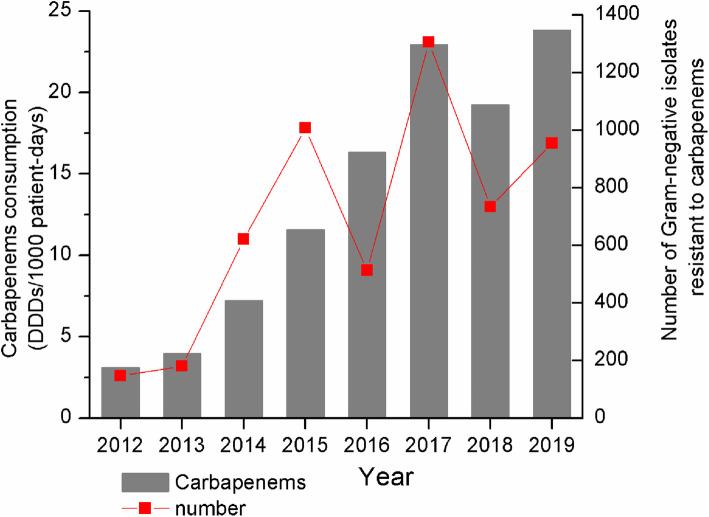
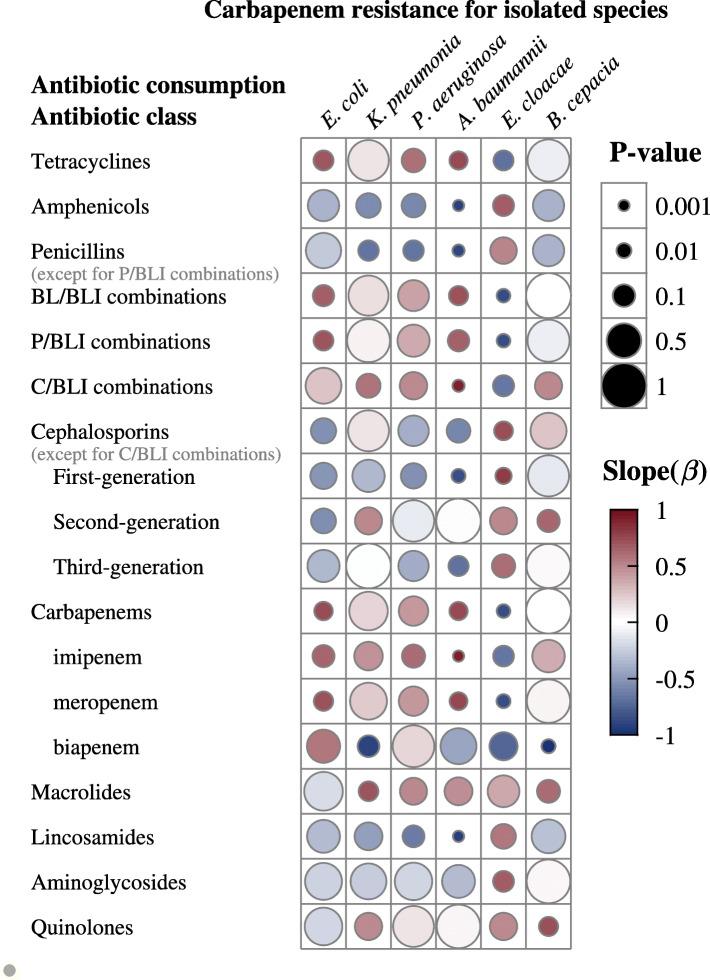
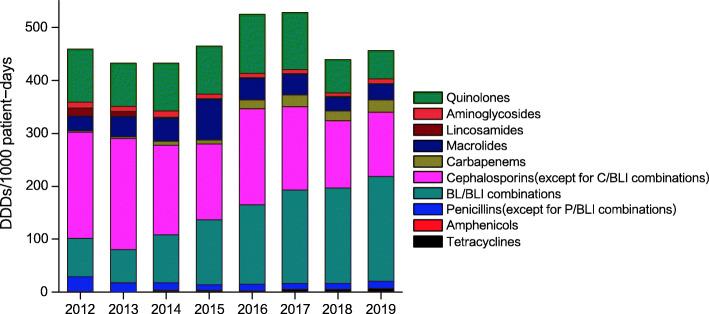
An increasing trend in the annual consumption of tetracyclines, β-lactam/β-lactamase inhibitor (BL/BLI) combinations, and carbapenems was observed (P < 0.05). Carbapenem resistance in Acinetobacter baumannii (A. baumannii) significantly increased (P < 0.05) from 18% in 2012 to 60% in 2019. Moreover, significant positive correlations were found between resistance to carbapenems in A. baumannii (P < 0.05) and Escherichia coli (E. coli; P < 0.05) and consumption of carbapenems, while the resistance rate of A. baumannii to carbapenems was positively correlated with cephalosporin/β-lactamase inhibitor (C/BLI) combinations (P < 0.01) and tetracyclines usage (P < 0.05). We also found that use of quinolones was positively correlated with the resistance rate of Burkholderia cepacia (B. cepacia) to carbapenems (P < 0.05), and increasing uses of carbapenems (P < 0.01) and penicillin/β-Lactamase inhibitor (P/BLI) combinations (P < 0.01) were significantly correlated with reduced resistance of Enterobacter cloacae (E. cloacae) to carbapenems.
These results revealed significant correlations between consumption of antibiotics and carbapenem resistance rates in Gram-negative bacteria. Implementing proper management strategies and reducing the unreasonable use of antibacterial drugs may be an effective measure to reduce the spread of carbapenem-resistant Gram-negative bacteria (CRGN), which should be confirmed by further studies.
本研究旨在调查 2012 年至 2019 年期间中国南方一家三级教学医院革兰氏阴性菌中抗菌药物消耗与碳青霉烯类耐药性之间的趋势和相关性。
本回顾性研究纳入了 2012 年 1 月至 2019 年 12 月期间全院住院患者的数据。抗菌药物的使用量以限定日剂量(DDD)/1000 患者日表示。抗菌药物根据解剖治疗化学(ATC)分类系统进行分类。采用线性回归分析抗菌药物使用和耐药性的趋势,采用皮尔逊相关分析评估相关性。
观察到 2012 年至 2019 年期间,四环素类、β-内酰胺/β-内酰胺酶抑制剂(BL/BLI)组合和碳青霉烯类的年消耗量呈上升趋势(P<0.05)。鲍曼不动杆菌(A.baumannii)对碳青霉烯类的耐药率显著增加(P<0.05),从 2012 年的 18%增加到 2019 年的 60%。此外,还发现 A.baumannii 对碳青霉烯类的耐药性(P<0.05)与大肠埃希菌(E.coli;P<0.05)与碳青霉烯类药物的消耗呈显著正相关,而 A.baumannii 对碳青霉烯类药物的耐药率与头孢菌素/β-内酰胺酶抑制剂(C/BLI)组合(P<0.01)和四环素类药物的使用呈正相关(P<0.05)。我们还发现,使用喹诺酮类药物与洋葱伯克霍尔德菌(B.cepacia)对碳青霉烯类的耐药率呈正相关(P<0.05),而碳青霉烯类药物(P<0.01)和青霉素/β-内酰胺酶抑制剂(P/BLI)组合(P<0.01)的使用量增加与阴沟肠杆菌(E.cloacae)对碳青霉烯类药物的耐药性降低呈显著相关。
这些结果表明,抗生素的使用与革兰氏阴性菌中碳青霉烯类耐药率之间存在显著相关性。实施适当的管理策略和减少抗菌药物的不合理使用可能是减少碳青霉烯类耐药革兰氏阴性菌(CRGN)传播的有效措施,这需要进一步研究来证实。

 Zotero 插件