
术后循环肿瘤 DNA 作为 II 期至 III 期结直肠癌复发风险的标志物。
Postoperative circulating tumor DNA as markers of recurrence risk in stages II to III colorectal cancer.
机构信息
Department of Colorectal Surgery, State Key Laboratory of Oncology in South China, Collaborative Innovation Center for Cancer Medicine, Sun Yat-Sen University Cancer Center, Guangzhou, 510060, China.
Research Unit of Precision Diagnosis and Treatment for Gastrointestinal Cancer, Chinese Academy of Medical Sciences, Guangzhou, 510060, China.
出版信息
J Hematol Oncol. 2021 May 17;14(1):80. doi: 10.1186/s13045-021-01089-z.
BACKGROUND
Precise methods for postoperative risk stratification to guide the administration of adjuvant chemotherapy (ACT) in localized colorectal cancer (CRC) are still lacking. Here, we conducted a prospective, observational, and multicenter study to investigate the utility of circulating tumor DNA (ctDNA) in predicting the recurrence risk.
METHODS
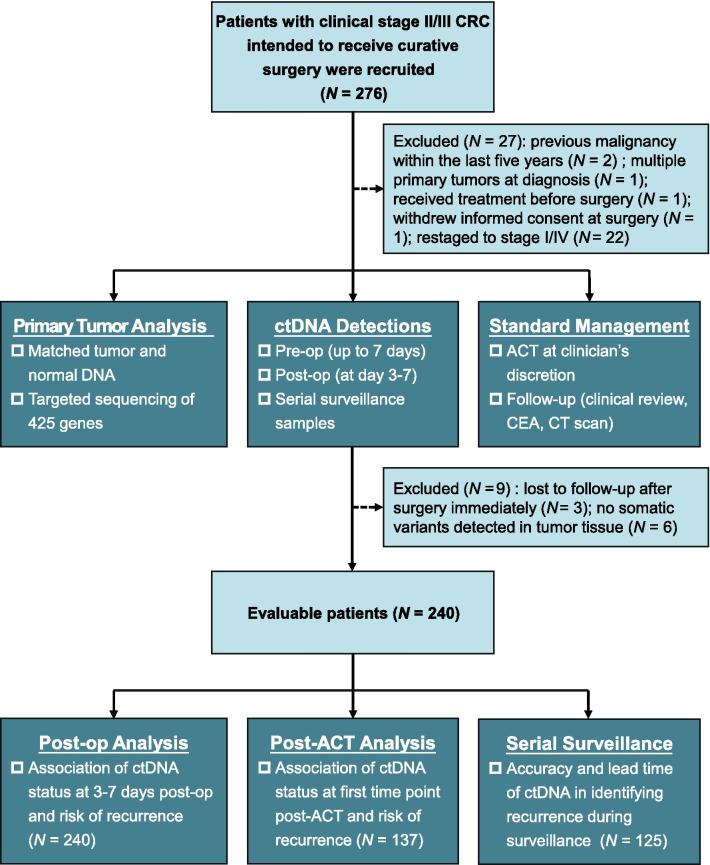
From September 2017 to March 2020, 276 patients with stage II/III CRC were prospectively recruited in this study and 240 evaluable patients were retained for analysis, of which 1290 serial plasma samples were collected. Somatic variants in both the primary tumor and plasma were detected via a targeted sequencing panel of 425 cancer-related genes. Patients were treated and followed up per standard of care.
RESULTS
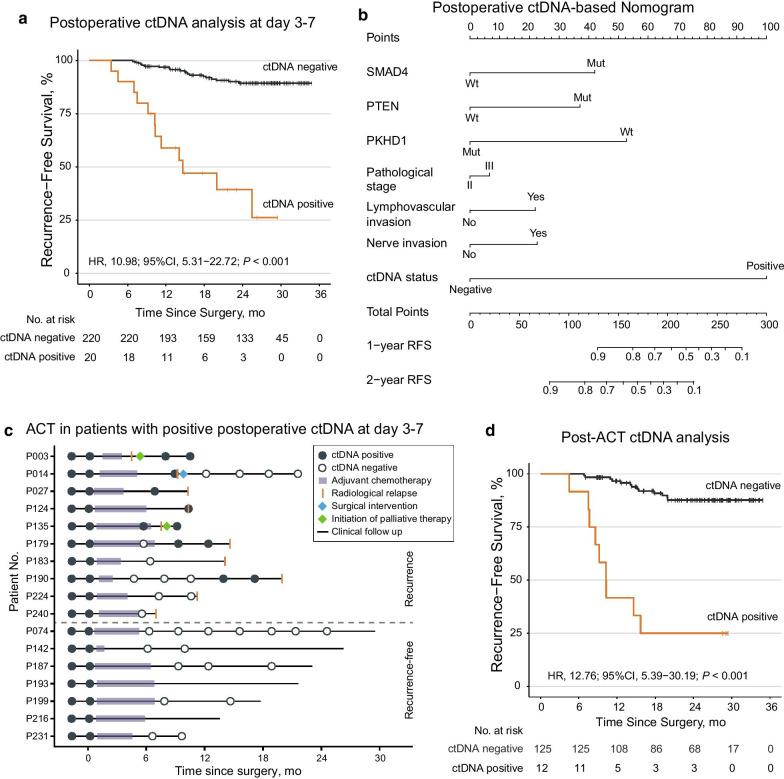
Preoperatively, ctDNA was detectable in 154 of 240 patients (64.2%). At day 3-7 postoperation, ctDNA positivity was associated with remarkably high recurrence risk (hazard ratio [HR], 10.98; 95%CI, 5.31-22.72; P < 0.001). ctDNA clearance and recurrence-free status was achieved in 5 out of 17 ctDNA-positive patients who were subjected to ACT. Likewise, at the first sampling point after ACT, ctDNA-positive patients were 12 times more likely to experience recurrence (HR, 12.76; 95%CI, 5.39-30.19; P < 0.001). During surveillance after definitive therapy, ctDNA positivity was also associated with extremely high recurrence risk (HR, 32.02; 95%CI, 10.79-95.08; P < 0.001). In all multivariate analyses, ctDNA positivity remained the most significant and independent predictor of recurrence-free survival after adjusting for known clinicopathological risk factors. Serial ctDNA analyses identified recurrence with an overall accuracy of 92.0% and could detect disease recurrence ahead of radiological imaging with a mean lead time of 5.01 months.
CONCLUSIONS
Postoperative serial ctDNA detection predicted high relapse risk and identified disease recurrence ahead of radiological imaging in patients with stage II/III CRC. ctDNA may be used to guide the decision-making in postsurgical management.
背景
对于局部结直肠癌(CRC)患者,仍然缺乏用于术后风险分层以指导辅助化疗(ACT)管理的精确方法。在此,我们进行了一项前瞻性、观察性和多中心研究,以调查循环肿瘤 DNA(ctDNA)预测复发风险的效用。
方法
2017 年 9 月至 2020 年 3 月,前瞻性招募了 276 例 II/III 期 CRC 患者,其中 240 例可评估患者被保留用于分析,共采集了 1290 份连续血浆样本。通过 425 个癌症相关基因的靶向测序panel 检测原发肿瘤和血浆中的体细胞变异。患者按照标准治疗进行治疗和随访。
结果
术前,240 例患者中有 154 例(64.2%)可检测到 ctDNA。术后 3-7 天,ctDNA 阳性与明显的高复发风险相关(风险比 [HR],10.98;95%CI,5.31-22.72;P<0.001)。17 例 ctDNA 阳性患者中有 5 例接受 ACT 治疗后 ctDNA 清除并保持无复发状态。同样,在 ACT 后的第一个采样点,ctDNA 阳性患者复发的可能性是 12 倍(HR,12.76;95%CI,5.39-30.19;P<0.001)。在明确治疗后的监测期间,ctDNA 阳性也与极高的复发风险相关(HR,32.02;95%CI,10.79-95.08;P<0.001)。在所有多变量分析中,在调整已知临床病理危险因素后,ctDNA 阳性仍然是无复发生存的最显著和独立预测因素。连续 ctDNA 分析总体准确率为 92.0%,可在影像学检查之前检测到疾病复发,平均提前时间为 5.01 个月。
结论
术后连续 ctDNA 检测可预测 II/III 期 CRC 患者的高复发风险,并在影像学检查之前识别疾病复发。ctDNA 可能用于指导术后管理中的决策。

 Zotero 插件