
一线免疫检查点抑制剂与医疗保险覆盖的晚期非小细胞肺癌患者生存的关联。
Association Between First-Line Immune Checkpoint Inhibition and Survival for Medicare-Insured Patients With Advanced Non-Small Cell Lung Cancer.
机构信息
Division of Population Sciences, Department of Medical Oncology, Dana-Farber Cancer Institute, Harvard Medical School, Boston, Massachusetts.
Health Data Analytics Institute, Dedham, Massachusetts.
出版信息
JAMA Netw Open. 2021 May 3;4(5):e2111113. doi: 10.1001/jamanetworkopen.2021.11113.
IMPORTANCE
Immunotherapy is now a cornerstone of treatment for advanced non-small cell lung cancer (NSCLC), but its uptake and effectiveness among older patients outside clinical trials remain poorly understood.
OBJECTIVE
To understand treatment patterns and evaluate the overall survival associated with checkpoint inhibitor immunotherapy, cytotoxic chemotherapy, and combined chemoimmunotherapy for older patients who have advanced NSCLC and Medicare coverage.
DESIGN, SETTING, AND PARTICIPANTS: This retrospective cohort study included Medicare-insured patients in the US aged 66 to 89 years who initiated first palliative-intent systemic therapy for lung cancer between January 1, 2016, and December 31, 2018. Survival follow-up continued through March 31, 2020. A total of 19 529 patients who had advanced lung cancer and were insured by a Medicare fee-for-service plan were included in the analysis.
EXPOSURES
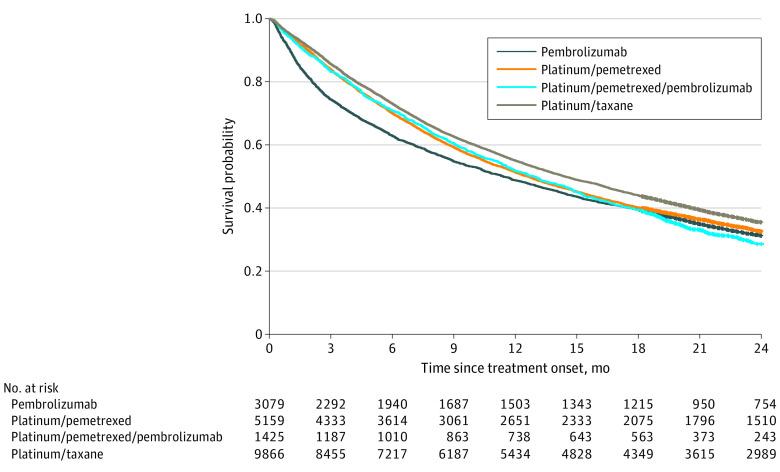
Regimens included pembrolizumab monotherapy (n = 3079), combined platinum-based drug (ie, cisplatin or carboplatin [hereinafter, platinum]) and pemetrexed disodium (n = 5159), combined platinum and a taxane (ie, paclitaxel, nab-paclitaxel, or docetaxel) (n = 9866), and combined platinum, pemetrexed, and pembrolizumab (n = 1425), as ascertained using Medicare claims from the Centers for Medicare & Medicaid Services.
MAIN OUTCOMES AND MEASURES
The primary outcome was overall survival, which was measured using the restricted mean survival time (RMST) with propensity score adjustment for clinical and sociodemographic characteristics. Median survival was also reported for comparison with outcomes from registrational trials.
RESULTS
A total of 19 529 patients (54% male, 46% female; median age, 73.8 [interquartile range, 69.9-78.4] years) were identified for analysis. The uptake of pembrolizumab-containing regimens in the Medicare population was rapid, increasing from 0.7% of first-line treatments in the second quarter of 2016 to 42.4% in the third quarter of 2018. Patients who were older (≥70 years, 2484 [81%]), were female (1577 [51%]), and/or had higher Risk Stratification Index scores (highest quintile, 922 [30%]) were more likely to receive single-agent pembrolizumab than chemotherapy. After propensity score adjustment, pembrolizumab was associated with survival similar to platinum/pemetrexed (RMST difference, -0.2 [95% CI, -0.5 to 0.2] months) or platinum/taxane (RMST difference, -0.7 [95% CI, -1.0 to -0.4] months). Patients receiving platinum/pemetrexed/pembrolizumab chemoimmunotherapy also had adjusted survival similar to those receiving platinum/pemetrexed chemotherapy (RMST difference, 0.5 [95% CI, 0.1-0.9] months). The unadjusted median survival was 11.4 (95% CI, 10.5-12.3) months among patients receiving single-agent pembrolizumab, approximately 15 months shorter than observed among pembrolizumab-treated participants in the KEYNOTE-024 trial. The unadjusted median survival was 12.9 (95% CI, 11.8-14.0) months among patients receiving platinum/pemetrexed/pembrolizumab chemoimmunotherapy, approximately 10 months shorter than observed among platinum/pemetrexed/pembrolizumab-treated participants in the KEYNOTE-189 trial.
CONCLUSIONS AND RELEVANCE
Immunotherapy has been incorporated rapidly into treatment for patients with advanced NSCLC. However, survival estimates in the Medicare population are much shorter than those reported in registrational trials. These results provide contemporary estimates of survival for older patients with advanced NSCLC treated in routine practice, facilitating patient-centered decision-making.
重要性
免疫疗法现在是治疗晚期非小细胞肺癌(NSCLC)的基石,但在临床试验之外,年龄较大的患者对其的接受程度和有效性仍知之甚少。
目的
了解晚期 NSCLC 且有医疗保险的老年患者中,接受检查点抑制剂免疫疗法、细胞毒性化疗和联合化疗免疫治疗的治疗模式,并评估其与总生存期的相关性。
设计、设置和参与者:本回顾性队列研究纳入了美国年龄在 66 岁至 89 岁之间、在 2016 年 1 月 1 日至 2018 年 12 月 31 日期间首次接受姑息性全身治疗肺癌的医疗保险患者。生存随访一直持续到 2020 年 3 月 31 日。共纳入了 19529 名患有晚期肺癌且由医疗保险按服务付费计划承保的患者进行分析。
暴露情况
方案包括帕博利珠单抗单药治疗(n=3079)、联合铂类药物(顺铂或卡铂,以下简称铂类)和培美曲塞二钠(n=5159)、联合铂类和紫杉醇(紫杉醇、nab-紫杉醇或多西紫杉醇)(n=9866)以及联合铂类、培美曲塞和帕博利珠单抗(n=1425),这是通过医疗保险中心的医疗保险和医疗补助服务中心的医疗保险索赔来确定的。
主要结果和测量
主要结局是总生存期,使用倾向评分调整后的限制平均生存时间(RMST)进行测量,并结合了临床和社会人口统计学特征。还报告了中位生存期,以便与注册试验的结果进行比较。
结果
共纳入了 19529 名患者(54%为男性,46%为女性;中位年龄为 73.8[四分位间距,69.9-78.4]岁)进行分析。在 Medicare 人群中,帕博利珠单抗联合治疗方案的应用迅速增加,从 2016 年第二季度的一线治疗的 0.7%增加到 2018 年第三季度的 42.4%。年龄较大(≥70 岁,2484[81%])、女性(1577[51%])和/或风险分层指数评分较高(最高五分位数,922[30%])的患者更有可能接受单药帕博利珠单抗治疗而不是化疗。在倾向评分调整后,帕博利珠单抗与化疗相比,与生存相关(RMST 差异,-0.2[95%CI,-0.5 至 0.2]个月)或与铂类/紫杉醇(RMST 差异,-0.7[95%CI,-1.0 至-0.4]个月)。接受铂类/培美曲塞/帕博利珠单抗化疗免疫治疗的患者的调整生存也与接受铂类/培美曲塞化疗的患者相似(RMST 差异,0.5[95%CI,0.1-0.9]个月)。接受单药帕博利珠单抗治疗的患者未经调整的中位生存期为 11.4(95%CI,10.5-12.3)个月,比 KEYNOTE-024 试验中接受帕博利珠单抗治疗的患者观察到的中位生存期短约 15 个月。接受铂类/培美曲塞/帕博利珠单抗化疗免疫治疗的患者未经调整的中位生存期为 12.9(95%CI,11.8-14.0)个月,比 KEYNOTE-189 试验中接受铂类/培美曲塞/帕博利珠单抗治疗的患者观察到的中位生存期短约 10 个月。
结论和相关性
免疫疗法已迅速纳入晚期 NSCLC 患者的治疗中。然而,医疗保险人群的生存估计值远短于注册试验中报告的结果。这些结果提供了在常规实践中治疗晚期 NSCLC 的老年患者的生存的最新估计值,有助于做出以患者为中心的决策。

 Zotero 插件