
人类肺部血管内皮细胞的综合单细胞图谱
Integrated Single-Cell Atlas of Endothelial Cells of the Human Lung.
机构信息
Pulmonary, Critical Care and Sleep Medicine (J.C.S., T.S.A., C.C., N.O., M.C., K.-A.R., E.P.M., M.S., G.D., F.A., N.N., X.Y., N.K.), Yale University School of Medicine, New Haven, CT.
Department of Biomedical Engineering (M.S.B.R., L.E.N.), Yale University, New Haven, CT.
出版信息
Circulation. 2021 Jul 27;144(4):286-302. doi: 10.1161/CIRCULATIONAHA.120.052318. Epub 2021 May 25.
BACKGROUND
Cellular diversity of the lung endothelium has not been systematically characterized in humans. We provide a reference atlas of human lung endothelial cells (ECs) to facilitate a better understanding of the phenotypic diversity and composition of cells comprising the lung endothelium.
METHODS
We reprocessed human control single-cell RNA sequencing (scRNAseq) data from 6 datasets. EC populations were characterized through iterative clustering with subsequent differential expression analysis. Marker genes were validated by fluorescent microscopy and in situ hybridization. scRNAseq of primary lung ECs cultured in vitro was performed. The signaling network between different lung cell types was studied. For cross-species analysis or disease relevance, we applied the same methods to scRNAseq data obtained from mouse lungs or from human lungs with pulmonary hypertension.
RESULTS
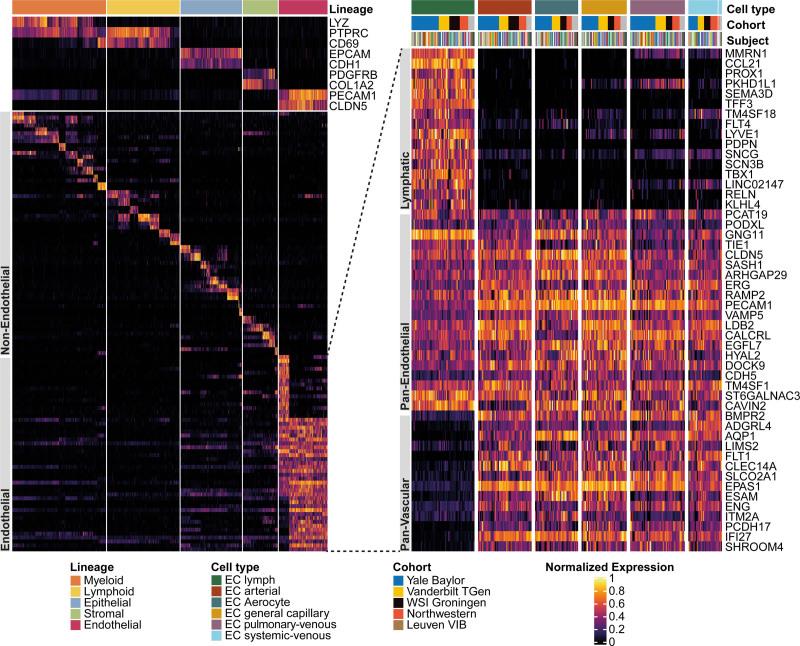
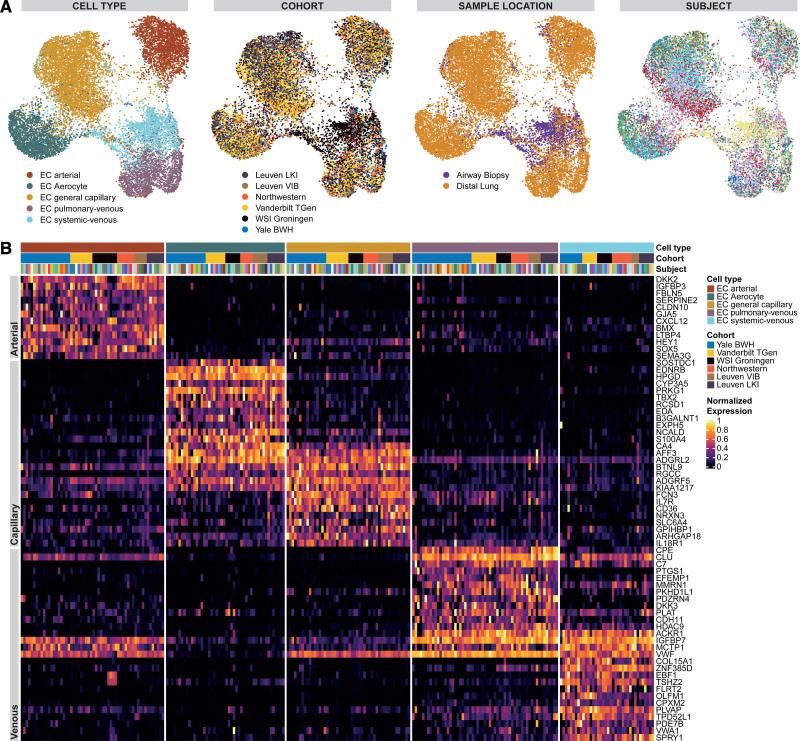
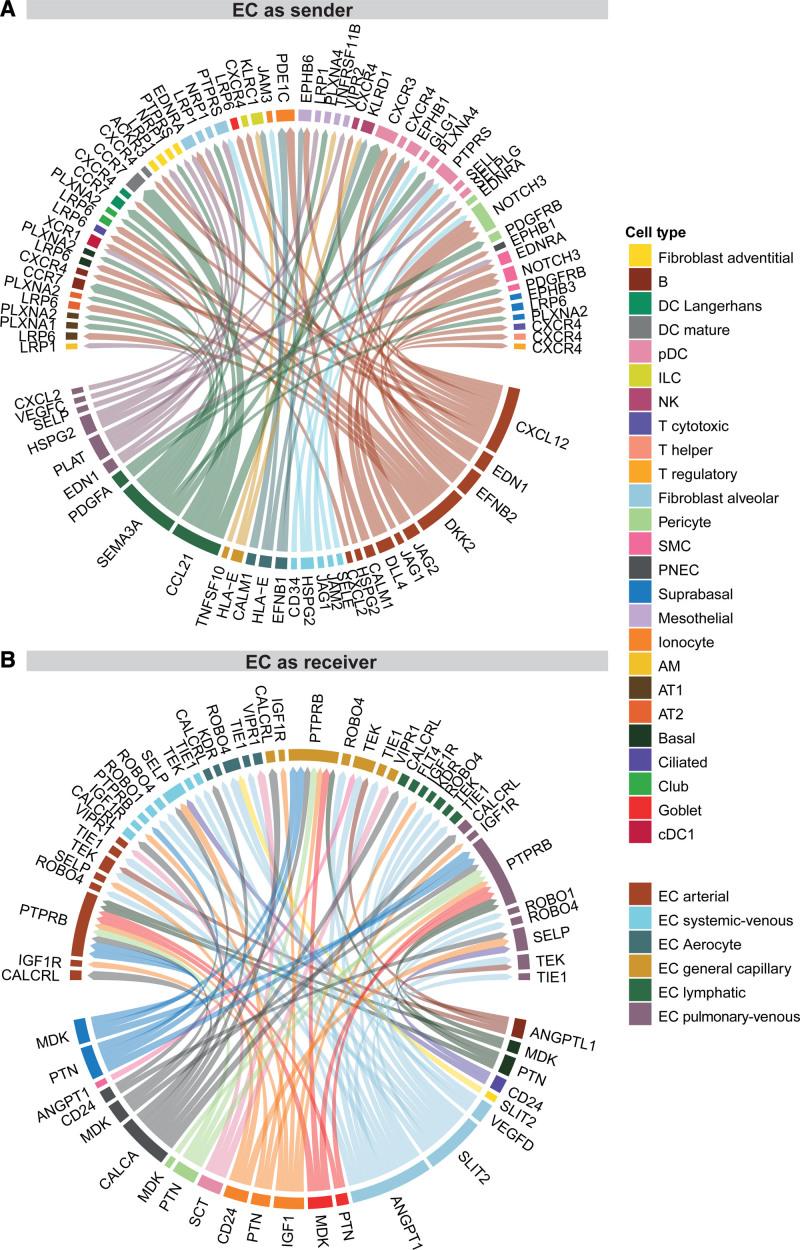
Six lung scRNAseq datasets were reanalyzed and annotated to identify >15 000 vascular EC cells from 73 individuals. Differential expression analysis of EC revealed signatures corresponding to endothelial lineage, including panendothelial, panvascular, and subpopulation-specific marker gene sets. Beyond the broad cellular categories of lymphatic, capillary, arterial, and venous ECs, we found previously indistinguishable subpopulations; among venous EC, we identified 2 previously indistinguishable populations: pulmonary-venous ECs (COL15A1) localized to the lung parenchyma and systemic-venous ECs (COL15A1) localized to the airways and the visceral pleura; among capillary ECs, we confirmed their subclassification into recently discovered aerocytes characterized by , , and and general capillary EC. We confirmed that all 6 endothelial cell types, including the systemic-venous ECs and aerocytes, are present in mice and identified endothelial marker genes conserved in humans and mice. Ligand-receptor connectome analysis revealed important homeostatic crosstalk of EC with other lung resident cell types. scRNAseq of commercially available primary lung ECs demonstrated a loss of their native lung phenotype in culture. scRNAseq revealed that endothelial diversity is maintained in pulmonary hypertension. Our article is accompanied by an online data mining tool (www.LungEndothelialCellAtlas.com).
CONCLUSIONS
Our integrated analysis provides a comprehensive and well-crafted reference atlas of ECs in the normal lung and confirms and describes in detail previously unrecognized endothelial populations across a large number of humans and mice.
背景
肺内皮细胞的多样性尚未在人类中得到系统描述。我们提供了人类肺内皮细胞 (EC) 的参考图谱,以促进更好地理解构成肺内皮的细胞的表型多样性和组成。
方法
我们重新处理了来自 6 个数据集的人类对照单细胞 RNA 测序 (scRNAseq) 数据。通过迭代聚类和随后的差异表达分析来描述 EC 群体。通过荧光显微镜和原位杂交验证标记基因。进行了体外培养的原代肺 EC 的 scRNAseq。研究了不同肺细胞类型之间的信号网络。对于跨物种分析或疾病相关性,我们将相同的方法应用于从小鼠肺或患有肺动脉高压的人类肺获得的 scRNAseq 数据。
结果
重新分析和注释了 6 个肺 scRNAseq 数据集,以从 73 个人中鉴定出 >15000 个血管 EC 细胞。EC 的差异表达分析揭示了与内皮谱系相对应的特征,包括泛内皮、全血管和亚群特异性标记基因集。除了淋巴管、毛细血管、动脉和静脉 EC 的广泛细胞分类外,我们还发现了以前无法区分的亚群;在静脉 EC 中,我们鉴定出 2 个以前无法区分的群体:定位于肺实质的肺静脉 EC(COL15A1)和定位于气道和内脏胸膜的系统性静脉 EC(COL15A1);在毛细血管 EC 中,我们证实了它们的细分,分为最近发现的以 、 和 为特征的 Aerocytes 和一般毛细血管 EC。我们证实了所有 6 种内皮细胞类型,包括系统性静脉 EC 和 Aerocytes,在小鼠中均存在,并鉴定出在人类和小鼠中保守的内皮标记基因。配体-受体连接组学分析揭示了 EC 与其他肺驻留细胞类型之间重要的稳态相互作用。商业上可获得的原代肺 EC 的 scRNAseq 表明其在培养中失去了其天然肺表型。scRNAseq 揭示了内皮多样性在肺动脉高压中得以维持。我们的文章附有一个在线数据挖掘工具 (www.LungEndothelialCellAtlas.com)。
结论
我们的综合分析提供了正常肺内皮细胞的全面、精心制作的参考图谱,并确认和详细描述了大量人类和小鼠中以前未被识别的内皮群体。




 Zotero 插件