
反映促炎状态的人附睾蛋白4(HE4)的表达增强受囊性纤维化支气管上皮细胞中CFTR的调控。
Enhanced Expression of Human Epididymis Protein 4 (HE4) Reflecting Pro-Inflammatory Status Is Regulated by CFTR in Cystic Fibrosis Bronchial Epithelial Cells.
作者信息
Bene Zsolt, Fejes Zsolt, Szanto Tibor Gabor, Fenyvesi Ferenc, Váradi Judit, Clarke Luka A, Panyi Gyorgy, Macek Milan, Amaral Margarida D, Balogh István, Nagy Béla
机构信息
Department of Laboratory Medicine, Faculty of Medicine, University of Debrecen, Debrecen, Hungary.
Department of Pediatrics, Faculty of Medicine, University of Debrecen, Debrecen, Hungary.
出版信息
Front Pharmacol. 2021 May 14;12:592184. doi: 10.3389/fphar.2021.592184. eCollection 2021.
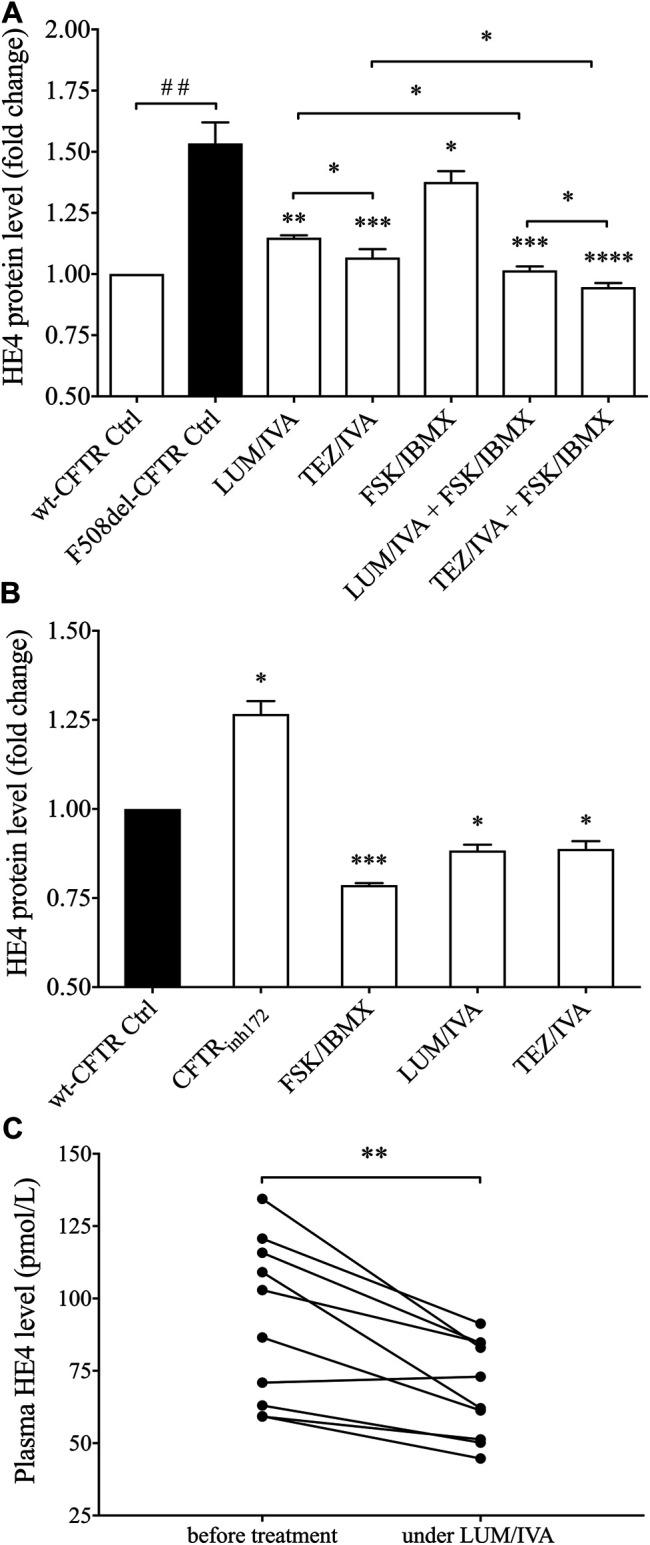
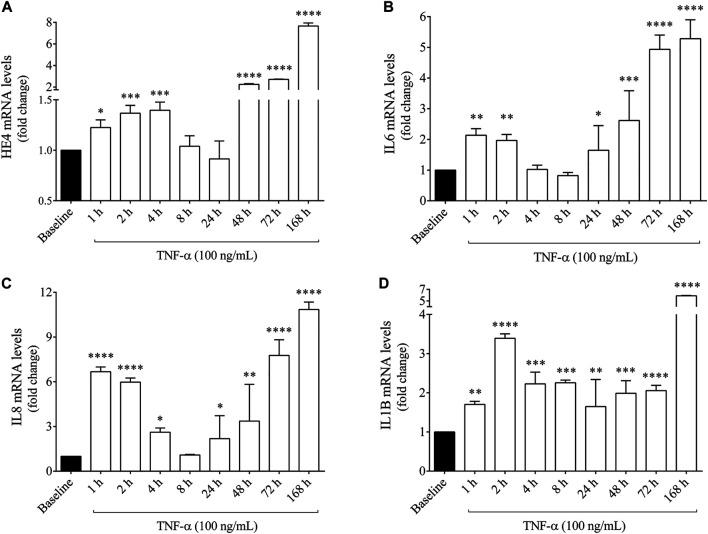
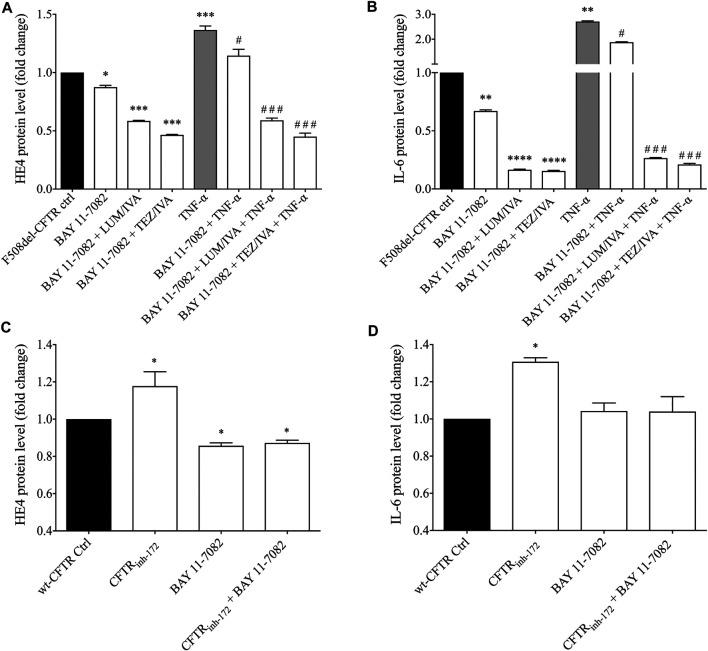
Decreased human epididymis protein 4 (HE4) plasma levels were reported in cystic fibrosis (CF) patients under CFTR potentiator therapy, which inversely correlated with lung function improvement. In this study, we investigated whether HE4 expression was affected via modulation of CFTR function in CF bronchial epithelial (CFBE) cells . HE4 protein levels were measured in the supernatants of CFBE 41o cells expressing F508del-CFTR or wild-type CFTR (wt-CFTR) after administration of or , while HE4 expression in CFBE 41o cells were also analyzed following application of adenylate cyclase activators Forskolin/IBMX or CFTR. The effect of all of these compounds on CFTR function was monitored by the whole-cell patch-clamp technique. Induced HE4 expression was studied with interleukin-6 (IL-6) in F508del-CFTR CFBE 41o cells under TNF-α stimulation for 1 h up to 1 week in duration. In parallel, plasma HE4 was determined in CF subjects homozygous for mutation receiving (Orkambi) therapy. NF-κB-mediated signaling was observed via the nuclear translocation of p65 subunit by fluorescence microscopy together with the analysis of IL-6 expression by an immunoassay. In addition, HE4 expression was examined after NF-κB pathway inhibitor BAY 11-7082 treatment with or without CFTR modulators. CFTR modulators partially restored the activity of F508del-CFTR and reduced HE4 concentration was found in F508del-CFTR CFBE 41o cells that was close to what we observed in CFBE 41o cells with wt-CFTR. These data were in agreement with decreased plasma HE4 concentrations in CF patients treated with Orkambi. Furthermore, CFTR inhibitor induced elevated HE4 levels, while CFTR activator Forskolin/IBMX downregulated HE4 in the cell cultures and these effects were more pronounced in the presence of CFTR modulators. Higher activation level of baseline and TNF-α stimulated NF-κB pathway was detected in F508del-CFTR vs. wt-CFTR CFBE 41o cells that was substantially reduced by CFTR modulators based on lower p65 nuclear positivity and IL-6 levels. Finally, HE4 expression was upregulated by TNF-α with elevated IL-6, and both protein levels were suppressed by combined administration of NF-κB pathway inhibitor and CFTR modulators in CFBE 41o cells. In conclusion, CFTR dysfunction contributes to abnormal HE4 expression via NF-κB in CF.
据报道,接受CFTR增强剂治疗的囊性纤维化(CF)患者血浆中人附睾蛋白4(HE4)水平降低,这与肺功能改善呈负相关。在本研究中,我们调查了CF支气管上皮(CFBE)细胞中CFTR功能的调节是否会影响HE4的表达。在用[具体药物1]或[具体药物2]处理后,测量表达F508del-CFTR或野生型CFTR(wt-CFTR)的CFBE 41o细胞上清液中的HE4蛋白水平,同时在应用腺苷酸环化酶激活剂福斯高林/异丁基甲基黄嘌呤(Forskolin/IBMX)或CFTR后,也分析CFBE 41o细胞中HE4的表达。通过全细胞膜片钳技术监测所有这些化合物对CFTR功能的影响。在TNF-α刺激下,用白细胞介素-6(IL-6)在F508del-CFTR CFBE 41o细胞中诱导HE4表达,刺激持续1小时至1周。同时,在接受[药物名称](Orkambi)治疗的[具体突变]纯合CF患者中测定血浆HE4。通过荧光显微镜观察p65亚基的核转位以及通过免疫测定分析IL-6表达,观察NF-κB介导的信号传导。此外,在用或不用CFTR调节剂的情况下,用NF-κB途径抑制剂BAY 11-7082处理后检测HE4的表达。CFTR调节剂部分恢复了F508del-CFTR的活性,并且在F508del-CFTR CFBE 41o细胞中发现HE4浓度降低,接近我们在表达wt-CFTR的CFBE 41o细胞中观察到的水平。这些数据与接受Orkambi治疗的CF患者血浆HE4浓度降低一致。此外,CFTR抑制剂诱导HE4水平升高,而CFTR激活剂Forskolin/IBMX在细胞培养物中下调HE4,并且在存在CFTR调节剂的情况下这些作用更明显。在F508del-CFTR与wt-CFTR CFBE 41o细胞中检测到基线和TNF-α刺激的NF-κB途径的激活水平更高,基于较低的p65核阳性和IL-6水平,CFTR调节剂使其大幅降低。最后,TNF-α通过升高IL-6上调HE4表达,并且在CFBE 41o细胞中,NF-κB途径抑制剂和CFTR调节剂联合给药可抑制这两种蛋白水平。总之,CFTR功能障碍通过NF-κB导致CF中HE4表达异常。




 Zotero 插件