
北欧一个大湖泊中城市和污泥源微塑料大量输入的旁路现象
Bypass of Booming Inputs of Urban and Sludge-Derived Microplastics in a Large Nordic Lake.
作者信息
Clayer François, Jartun Morten, Buenaventura Nina T, Guerrero Jose-Luis, Lusher Amy
机构信息
Norwegian Institute for Water Research (NIVA), Gaustadalléen 21, 0349 Oslo, Norway.
出版信息
Environ Sci Technol. 2021 Jun 15;55(12):7949-7958. doi: 10.1021/acs.est.0c08443. Epub 2021 Jun 1.
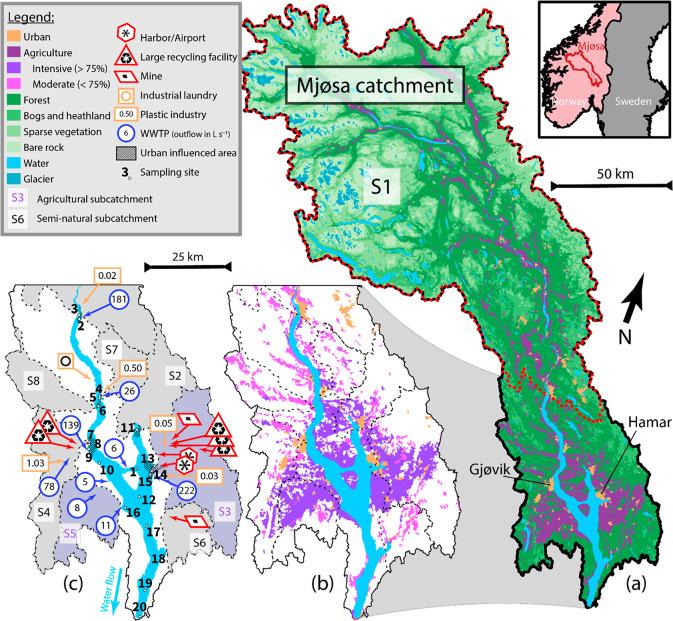
Microplastic research, initially focusing on marine environments, left freshwater ecosystems largely unexplored. Freshwaters are also vulnerable to microplastics and are likely the largest microplastic supplier to the ocean. However, microplastic sources, transport pathways, and fluxes at the catchment level remain to be quantified, compromising efficient actions toward mitigation and remediation. Here we show that 70-90% of microplastics reaching Norway's largest lake, originating primarily from urban waste mismanagement and sludge application on crops, continue their journey toward the ocean without being buried. Indeed, our microplastic budget for the catchment shows that out of the 35.9 tons (7.4-119.4 t) of microplastics annually released into the lake, only 3.5 tons (1.3-8.8 t) are settling to the lake bottom. The spatial and vertical microplastic distribution and diversity in lake sediments, the socio-economic modeling of plastic fluxes and spatial information on land use and potential plastic sources all point toward urban and agricultural areas as emission hotspots of increasing importance. We conclude that the degree to which lake sediments represent a net microplastic sink is likely influenced by the nature of microplastics the lake receives, and ultimately on their origin.
微塑料研究最初聚焦于海洋环境,很大程度上未对淡水生态系统进行探索。淡水也易受微塑料影响,并且很可能是海洋最大的微塑料来源地。然而,流域层面的微塑料来源、传输路径和通量仍有待量化,这不利于采取有效的缓解和修复行动。在此我们表明,进入挪威最大湖泊的微塑料有70% - 90%主要源自城市垃圾管理不善和污泥用于农作物,这些微塑料未经掩埋便继续流向海洋。事实上,我们对该流域的微塑料预算显示,每年排入该湖泊的35.9吨(7.4 - 119.4吨)微塑料中,只有3.5吨(1.3 - 8.8吨)沉降至湖底。湖泊沉积物中微塑料的空间和垂直分布及多样性、塑料通量的社会经济模型以及土地利用和潜在塑料来源的空间信息均表明,城市和农业地区正成为日益重要的排放热点。我们得出结论,湖泊沉积物成为微塑料净汇的程度可能受湖泊所接收微塑料的性质影响,最终受其来源影响。



 Zotero 插件