
眼部表面组织中药物的分区与空间分布
Partitioning and Spatial Distribution of Drugs in Ocular Surface Tissues.
作者信息
Balla Anusha, Auriola Seppo, Grey Angus C, Demarais Nicholas J, Valtari Annika, Heikkinen Emma M, Toropainen Elisa, Urtti Arto, Vellonen Kati-Sisko, Ruponen Marika
机构信息
School of Pharmacy, University of Eastern Finland, Yliopistonranta 1, 70211 Kuopio, Finland.
School of Medical Sciences, University of Auckland, Auckland 1142, New Zealand.
出版信息
Pharmaceutics. 2021 May 4;13(5):658. doi: 10.3390/pharmaceutics13050658.
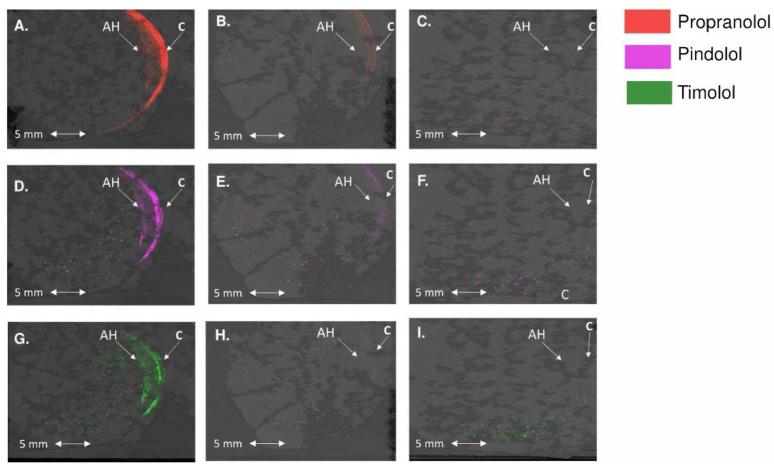
Ocular drug absorption after eye drop instillation has been widely studied, but partitioning phenomena and spatial drug distribution are poorly understood. We investigated partitioning of seven beta-blocking drugs in corneal epithelium, corneal stroma, including endothelium and conjunctiva, using isolated porcine tissues and cultured human corneal epithelial cells. The chosen beta-blocking drugs had a wide range (-1.76-0.79) of -octanol/buffer solution distribution coefficients at pH 7.4 (Log D). In addition, the ocular surface distribution of three beta-blocking drugs was determined by matrix-assisted laser desorption/ionization imaging mass spectrometry (MALDI-IMS) after their simultaneous application in an eye drop to the rabbits in vivo. Studies with isolated porcine corneas revealed that the distribution coefficient () between the corneal epithelium and donor solution showed a positive relationship and good correlation with Log D and about a 50-fold range of values (0.1-5). On the contrary, between corneal stroma and epithelium showed an inverse (negative) relationship and correlation with Log D based on a seven-fold range of values. In vitro corneal cell uptake showed a high correlation with the ex vivo corneal epithelium/donor values. Partitioning of the drugs into the porcine conjunctiva also showed a positive relationship with lipophilicity, but the range of values was less than with the corneal epithelium. MALDI-IMS allowed simultaneous detection of three compounds in the cornea, showed data in line with other experiments, and revealed uneven spatial drug distribution in the cornea. Our data indicate the importance of lipophilicity in defining the corneal pharmacokinetics and the values are a useful building block in the kinetic simulation models for topical ocular drug administration.
滴眼液滴入后眼内药物吸收已得到广泛研究,但分配现象和药物空间分布却知之甚少。我们使用分离的猪组织和培养的人角膜上皮细胞,研究了七种β受体阻滞剂在角膜上皮、角膜基质(包括内皮)和结膜中的分配情况。所选用的β受体阻滞剂在pH 7.4时具有较宽范围(-1.76至0.79)的辛醇/缓冲溶液分配系数(Log D)。此外,三种β受体阻滞剂在兔体内滴眼同时应用后,通过基质辅助激光解吸/电离成像质谱(MALDI-IMS)测定其眼表分布。对分离的猪角膜的研究表明,角膜上皮与供体溶液之间的分配系数()与Log D呈正相关且相关性良好,值范围约为50倍(0.1至5)。相反,基于值的七倍范围,角膜基质与上皮之间的呈反比(负)关系且与Log D相关。体外角膜细胞摄取与离体角膜上皮/供体的值高度相关。药物在猪结膜中的分配也与亲脂性呈正相关,但值范围小于角膜上皮。MALDI-IMS能够同时检测角膜中的三种化合物,所得数据与其他实验一致,并揭示了角膜中药物空间分布不均匀。我们的数据表明亲脂性在定义角膜药代动力学中的重要性,并且值是局部眼用药物给药动力学模拟模型中的一个有用组成部分。


 Zotero 插件