
可视化 pH 传感器:从化学角度到新型生物工程材料。
Visual pH Sensors: From a Chemical Perspective to New Bioengineered Materials.
机构信息
Department of Agricultural Sciences, University of Naples Federico II, 100, 80055 Portici, Italy.
出版信息
Molecules. 2021 May 16;26(10):2952. doi: 10.3390/molecules26102952.
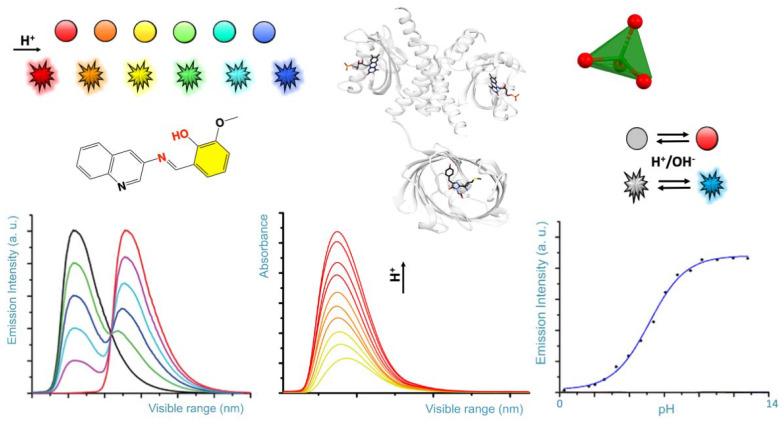
Many human activities and cellular functions depend upon precise pH values, and pH monitoring is considered a fundamental task. Colorimetric and fluorescence sensors for pH measurements are chemical and biochemical tools able to sense protons and produce a visible signal. These pH sensors are gaining widespread attention as non-destructive tools, visible to the human eye, that are capable of a real-time and in-situ response. Optical "visual" sensors are expanding researchers' interests in many chemical contexts and are routinely used for biological, environmental, and medical applications. In this review we provide an overview of trending colorimetric, fluorescent, or dual-mode responsive visual pH sensors. These sensors include molecular synthetic organic sensors, metal organic frameworks (MOF), engineered sensing nanomaterials, and bioengineered sensors. We review different typological chemical entities of visual pH sensors, three-dimensional structures, and signaling mechanisms for pH sensing and applications; developed in the past five years. The progression of this review from simple organic molecules to biological macromolecules seeks to benefit beginners and scientists embarking on a project of pH sensing development, who needs background information and a quick update on advances in the field. Lessons learned from these tools will aid pH determination projects and provide new ways of thinking for cell bioimaging or other cutting-edge in vivo applications.
许多人类活动和细胞功能都依赖于精确的 pH 值,因此 pH 值监测被认为是一项基本任务。用于 pH 值测量的比色法和荧光传感器是能够感应质子并产生可见信号的化学和生化工具。这些 pH 传感器作为非破坏性工具,肉眼可见,能够实时和原位响应,因此受到了广泛关注。光学“视觉”传感器扩展了研究人员在许多化学环境中的兴趣,并经常用于生物、环境和医疗应用。在这篇综述中,我们概述了趋势性的比色法、荧光法或双模式响应的视觉 pH 传感器。这些传感器包括分子合成有机传感器、金属有机框架(MOF)、工程化传感纳米材料和生物工程化传感器。我们综述了过去五年中开发的不同类型的视觉 pH 传感器的化学实体、三维结构和 pH 感应及应用的信号机制。本综述从简单的有机分子到生物大分子的进展,旨在为初学者和从事 pH 传感开发项目的科学家提供帮助,他们需要了解背景信息并快速了解该领域的最新进展。从这些工具中吸取的经验教训将有助于 pH 测定项目,并为细胞生物成像或其他前沿的体内应用提供新的思路。



 Zotero 插件