
从体液的宏基因组全基因组测序中检测隐匿性恶性肿瘤。
Detection of cryptogenic malignancies from metagenomic whole genome sequencing of body fluids.
机构信息
Department of Laboratory Medicine, University of California San Francisco, San Francisco, CA, 94107, USA.
UCSF-Abbott Viral Diagnostics and Discovery Center, San Francisco, CA, 91407, USA.
出版信息
Genome Med. 2021 Jun 1;13(1):98. doi: 10.1186/s13073-021-00912-z.
BACKGROUND
Metagenomic next-generation sequencing (mNGS) of body fluids is an emerging approach to identify occult pathogens in undiagnosed patients. We hypothesized that metagenomic testing can be simultaneously used to detect malignant neoplasms in addition to infectious pathogens.
METHODS
From two independent studies (n = 205), we used human data generated from a metagenomic sequencing pipeline to simultaneously screen for malignancies by copy number variation (CNV) detection. In the first case-control study, we analyzed body fluid samples (n = 124) from patients with a clinical diagnosis of either malignancy (positive cases, n = 65) or infection (negative controls, n = 59). In a second verification cohort, we analyzed a series of consecutive cases (n = 81) sent to cytology for malignancy workup that included malignant positives (n = 32), negatives (n = 18), or cases with an unclear gold standard (n = 31).
RESULTS
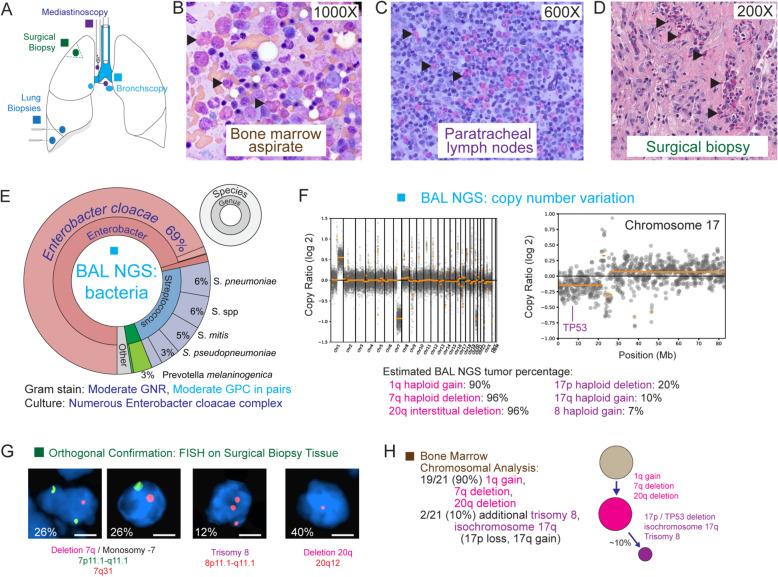
The overall CNV test sensitivity across all studies was 87% (55 of 63) in patients with malignancies confirmed by conventional cytology and/or flow cytometry testing and 68% (23 of 34) in patients who were ultimately diagnosed with cancer but negative by conventional testing. Specificity was 100% (95% CI 95-100%) with no false positives detected in 77 negative controls. In one example, a patient hospitalized with an unknown pulmonary illness had non-diagnostic lung biopsies, while CNVs implicating a malignancy were detectable from bronchoalveolar fluid.
CONCLUSIONS
Metagenomic sequencing of body fluids can be used to identify undetected malignant neoplasms through copy number variation detection. This study illustrates the potential clinical utility of a single metagenomic test to uncover the cause of undiagnosed acute illnesses due to cancer or infection using the same specimen.
背景
体液的宏基因组下一代测序(mNGS)是一种新兴的方法,可用于鉴定未确诊患者的隐匿性病原体。我们假设宏基因组检测除了可以检测感染性病原体外,还可以同时用于检测恶性肿瘤。
方法
我们从两项独立的研究(n = 205)中使用宏基因组测序分析产生的人类数据,通过拷贝数变异(CNV)检测来同时筛查恶性肿瘤。在第一项病例对照研究中,我们分析了来自临床诊断为恶性肿瘤(阳性病例,n = 65)或感染(阴性对照,n = 59)患者的体液样本。在第二项验证队列中,我们分析了一系列连续病例(n = 81),这些病例被送到细胞学进行恶性肿瘤检查,包括恶性阳性(n = 32)、阴性(n = 18)或金标准不明确的病例(n = 31)。
结果
在所有研究中,通过常规细胞学和/或流式细胞术检测确认的恶性肿瘤患者中,总体 CNV 检测的敏感性为 87%(55/63),最终被诊断为癌症但常规检测为阴性的患者中为 68%(23/34)。特异性为 100%(95%CI 95-100%),在 77 例阴性对照中未检测到假阳性。在一个例子中,一名因不明肺部疾病住院的患者的肺部活检没有得出诊断结果,而从支气管肺泡液中可以检测到提示恶性肿瘤的 CNV。
结论
体液的宏基因组测序可以通过拷贝数变异检测来识别未被发现的恶性肿瘤。这项研究说明了使用相同的标本,通过单一宏基因组检测来发现癌症或感染导致的未确诊急性疾病的潜在临床应用。

 Zotero 插件