
间充质干细胞通过外泌体介导的 microRNA Let-7i-5p 拮抗剂传递减轻肾纤维化。
Mesenchymal Stem Cells Attenuate Renal Fibrosis via Exosomes-Mediated Delivery of microRNA Let-7i-5p Antagomir.
机构信息
Department of Nephrology, Zhejiang Provincial People's Hospital and Affiliated People's Hospital, Hangzhou Medical College, Hangzhou, Zhejiang, 310014, People's Republic of China.
出版信息
Int J Nanomedicine. 2021 May 25;16:3565-3578. doi: 10.2147/IJN.S299969. eCollection 2021.
BACKGROUND
Renal fibrosis is a chronic and progressive process affecting kidneys in chronic kidney disease (CKD). Mesenchymal stem cells-derived exosomes (MSCs-Exo) have been shown to alleviate renal fibrosis and injury, but the mechanism of MSCs-Exo-induced renal protection remains unknown.
METHODS
In this study, MSCs were transfected with let-7i-5p antagomir (anti-let-7i-5p), and then exosomes were isolated from the transfected MSCs to deliver anti-let-7i-5p oligonucleotides to inhibit the level of let-7i-5p in kidney tubular epithelial cells (NRK-52E).
RESULTS
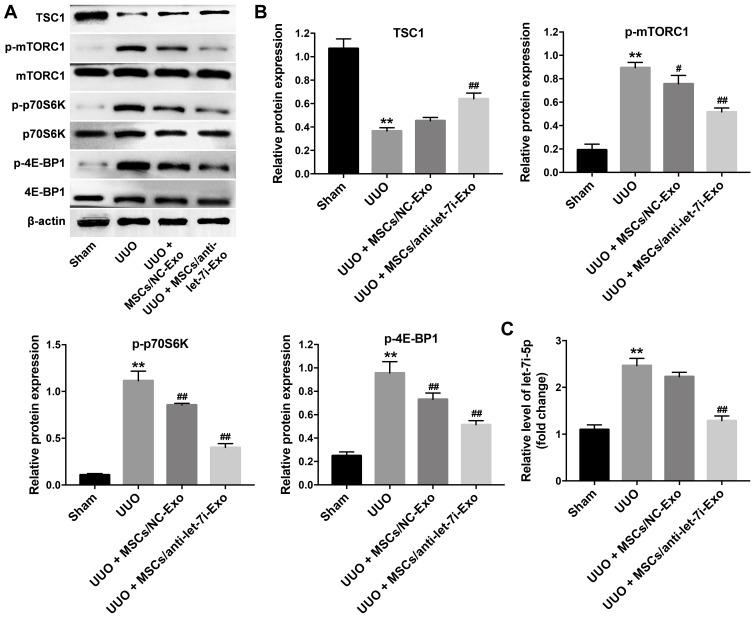
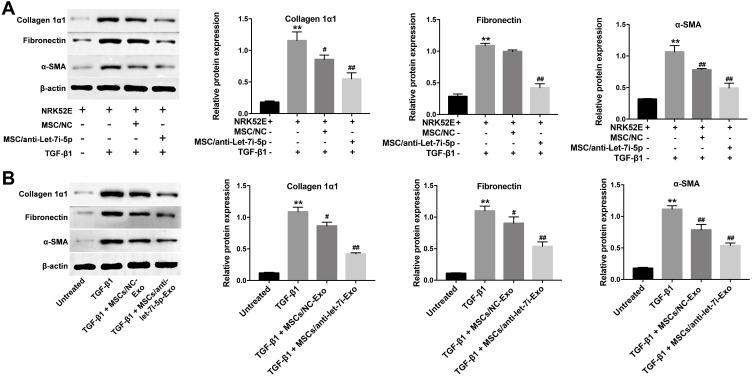
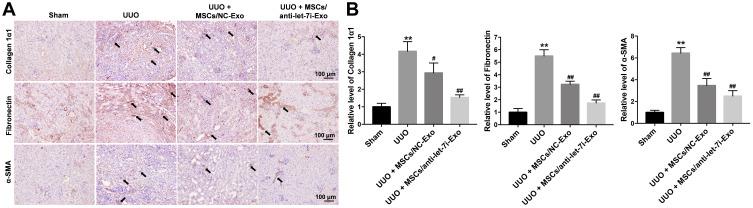
In both NRK-52E cells stimulated by TGF-β1 and the mouse kidneys after unilateral ureteral obstruction (UUO), we demonstrated increased level of let-7i-5p. In addition, MSCs-Exo can deliver anti-let-7i-5p to reduce the level of let-7i-5p in NRK-52E cells and increase the expression of its target gene TSC1. Moreover, exosomal anti-let-7i-5p reduced extracellular matrix (ECM) deposition and attenuated epithelial-mesenchymal transition (EMT) process in transforming growth factor beta 1 (TGF-β1)-stimulated NRK-52E cells and in the kidneys of UUO-treated mice. Meanwhile, mice received exosomal anti-let-7i-5p displayed reduced renal fibrosis and improved kidney function when challenged with UUO. Furthermore, exosomal anti-let-7i-5p promoted the activation the tuberous sclerosis complex subunit 1/mammalian target of rapamycin (TSC1/mTOR) signaling pathway in vivo and in vitro.
CONCLUSION
In conclusion, exosomal anti-let-7i-5p from MSCs exerts anti-fibrotic effects in TGF-β1-induced fibrogenic responses in NRK52E cells in vitro as well as in UUO-induced renal fibrosis model in vivo. These results provided a novel perspective on improving renal fibrosis by MSCs-Exo.
背景
肾纤维化是一种影响慢性肾脏病(CKD)患者肾脏的慢性进行性过程。间充质干细胞衍生的外泌体(MSCs-Exo)已被证明可减轻肾纤维化和损伤,但 MSCs-Exo 诱导肾保护的机制尚不清楚。
方法
在这项研究中,将 let-7i-5p 反义寡核苷酸(anti-let-7i-5p)转染到 MSCs 中,然后从转染的 MSCs 中分离出外泌体,以递呈 anti-let-7i-5p 寡核苷酸来抑制肾小管上皮细胞(NRK-52E)中 let-7i-5p 的水平。
结果
在 TGF-β1 刺激的 NRK-52E 细胞和单侧输尿管梗阻(UUO)后的小鼠肾脏中,我们都发现 let-7i-5p 的水平升高。此外,MSCs-Exo 可以递呈 anti-let-7i-5p,以降低 NRK-52E 细胞中 let-7i-5p 的水平,并增加其靶基因 TSC1 的表达。此外,外泌体 anti-let-7i-5p 减少了转化生长因子β 1(TGF-β1)刺激的 NRK-52E 细胞和 UUO 处理的小鼠肾脏中的细胞外基质(ECM)沉积,并减弱了上皮-间充质转化(EMT)过程。同时,当接受 UUO 挑战时,接受外泌体 anti-let-7i-5p 的小鼠表现出更少的肾纤维化和改善的肾功能。此外,外泌体 anti-let-7i-5p 在体内和体外促进了结节性硬化复合物亚单位 1/哺乳动物雷帕霉素靶蛋白(TSC1/mTOR)信号通路的激活。
结论
总之,MSCs 来源的外泌体 anti-let-7i-5p 在体外 TGF-β1 诱导的 NRK52E 细胞纤维化反应以及体内 UUO 诱导的肾纤维化模型中发挥抗纤维化作用。这些结果为通过 MSCs-Exo 改善肾纤维化提供了新的视角。




 Zotero 插件