
衰老研究的替代动物模型。
Alternative Animal Models of Aging Research.
作者信息
Holtze Susanne, Gorshkova Ekaterina, Braude Stan, Cellerino Alessandro, Dammann Philip, Hildebrandt Thomas B, Hoeflich Andreas, Hoffmann Steve, Koch Philipp, Terzibasi Tozzini Eva, Skulachev Maxim, Skulachev Vladimir P, Sahm Arne
机构信息
Department of Reproduction Management, Leibniz Institute for Zoo and Wildlife Research, Berlin, Germany.
Center for Precision Genome Editing and Genetic Technologies for Biomedicine, Engelhardt Institute of Molecular Biology, Russian Academy of Sciences, Moscow, Russia.
出版信息
Front Mol Biosci. 2021 May 17;8:660959. doi: 10.3389/fmolb.2021.660959. eCollection 2021.
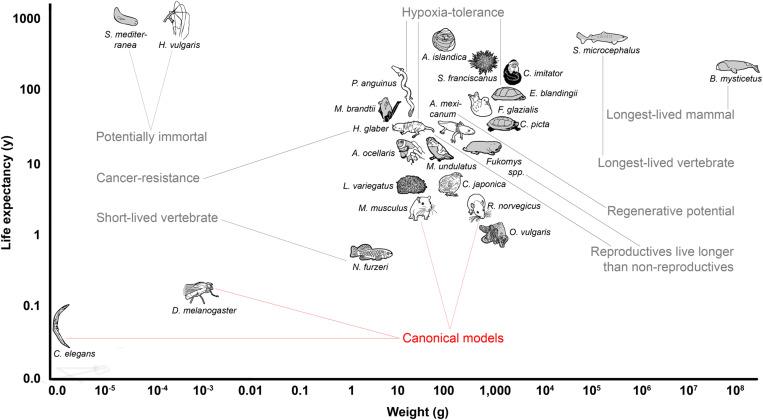
Most research on mechanisms of aging is being conducted in a very limited number of classical model species, i.e., laboratory mouse (), rat (), the common fruit fly () and roundworm (). The obvious advantages of using these models are access to resources such as strains with known genetic properties, high-quality genomic and transcriptomic sequencing data, versatile experimental manipulation capabilities including well-established genome editing tools, as well as extensive experience in husbandry. However, this approach may introduce interpretation biases due to the specific characteristics of the investigated species, which may lead to inappropriate, or even false, generalization. For example, it is still unclear to what extent knowledge of aging mechanisms gained in short-lived model organisms is transferable to long-lived species such as humans. In addition, other specific adaptations favoring a long and healthy life from the immense evolutionary toolbox may be entirely missed. In this review, we summarize the specific characteristics of emerging animal models that have attracted the attention of gerontologists, we provide an overview of the available data and resources related to these models, and we summarize important insights gained from them in recent years. The models presented include short-lived ones such as killifish (), long-lived ones such as primates (), bathyergid mole-rats (), bats (), birds, olms (), turtles, greenland sharks, bivalves ), and potentially non-aging ones such as and .
大多数关于衰老机制的研究是在极少数经典模式物种中进行的,即实验室小鼠()、大鼠()、普通果蝇()和蛔虫()。使用这些模型的明显优势包括能够获取诸如具有已知遗传特性的品系等资源、高质量的基因组和转录组测序数据、包括成熟的基因组编辑工具在内的多种实验操作能力,以及丰富的饲养经验。然而,由于所研究物种的特定特征,这种方法可能会引入解释偏差,这可能导致不恰当甚至错误的概括。例如,在短命模式生物中获得的衰老机制知识在多大程度上可转移到诸如人类等长寿物种,目前仍不清楚。此外,可能会完全忽略从庞大的进化工具箱中有利于长寿健康生活的其他特定适应性。在本综述中,我们总结了已引起老年医学家关注的新兴动物模型的具体特征,概述了与这些模型相关的现有数据和资源,并总结了近年来从它们身上获得的重要见解。所介绍的模型包括短命的物种,如鳉鱼(),长寿的物种,如灵长类动物()、裸鼹鼠()、蝙蝠()、鸟类、洞螈()、海龟、格陵兰鲨、双壳类动物(),以及可能不会衰老的物种,如 和 。


 Zotero 插件