
SARS-CoV-2 刺突 RBD 中的 V367F 突变增强了与人类 ACE2 受体的结合亲和力,从而提高了病毒的感染性。
V367F Mutation in SARS-CoV-2 Spike RBD Emerging during the Early Transmission Phase Enhances Viral Infectivity through Increased Human ACE2 Receptor Binding Affinity.
机构信息
Guangdong Provincial Key Laboratory of Tropical Disease Research, School of Public Health, Southern Medical University, Guangzhou, Guangdong, China.
Key Laboratory of Functional Protein Research of Guangdong Higher Education Institutes, Institute of Life and Health Engineering, College of Life Science and Technology, Jinan University, Guangzhou, Guangdong, China.
出版信息
J Virol. 2021 Jul 26;95(16):e0061721. doi: 10.1128/JVI.00617-21.
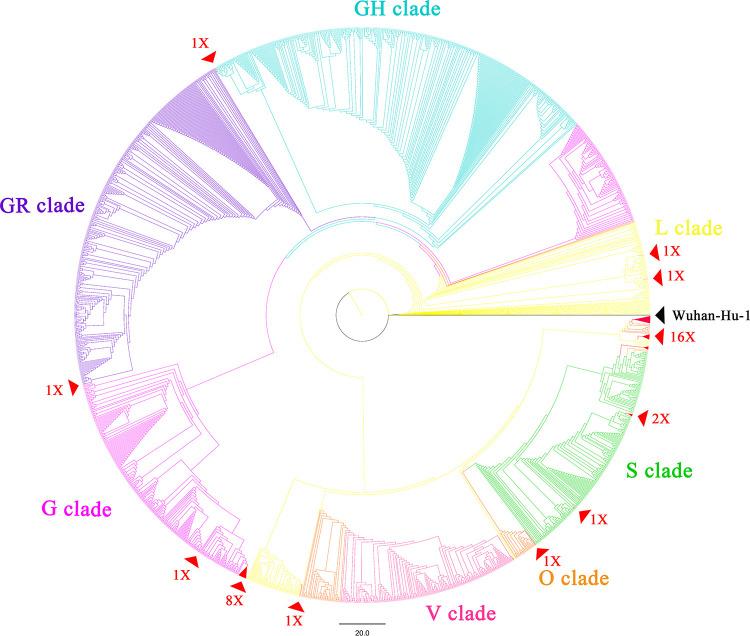
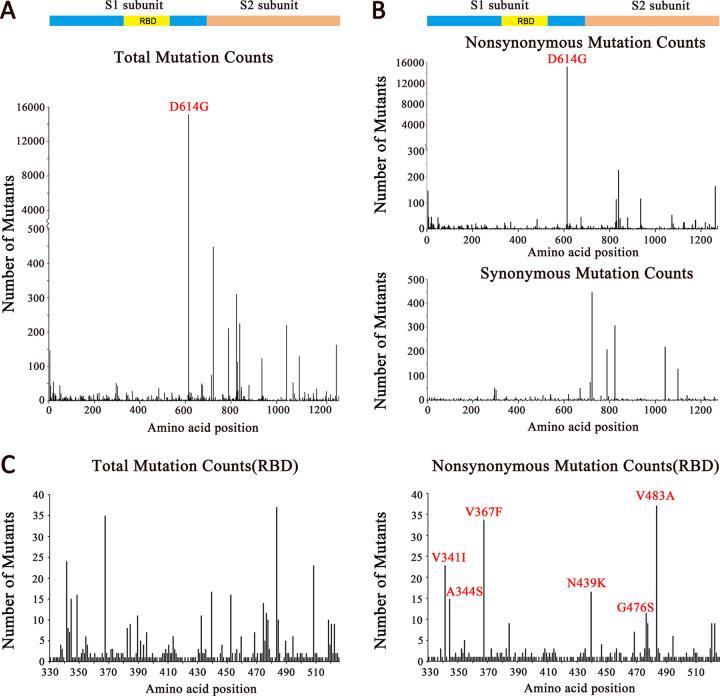
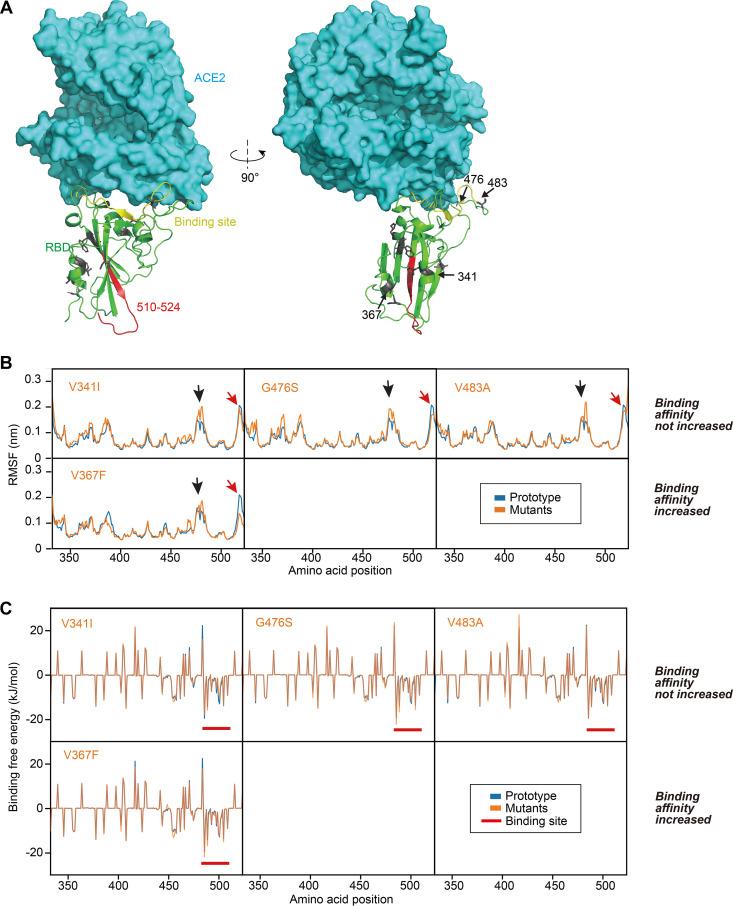
The current pandemic of COVID-19 is caused by a novel coronavirus, severe acute respiratory syndrome coronavirus 2 (SARS-CoV-2). The SARS-CoV-2 spike protein receptor-binding domain (RBD) is the critical determinant of viral tropism and infectivity. To investigate whether naturally occurring RBD mutations during the early transmission phase have altered the receptor binding affinity and infectivity, we first analyzed the binding dynamics between SARS-CoV-2 RBD mutants and the human angiotensin-converting enzyme 2 (ACE2) receptor. Among 32,123 genomes of SARS-CoV-2 isolates (December 2019 through March 2020), 302 nonsynonymous RBD mutants were identified and clustered into 96 mutant types. The six dominant mutations were analyzed applying molecular dynamics simulations (MDS). The mutant type V367F continuously circulating worldwide displayed higher binding affinity to human ACE2 due to the enhanced structural stabilization of the RBD beta-sheet scaffold. The MDS also indicated that it would be difficult for bat SARS-like CoV to infect humans. However, the pangolin CoV is potentially infectious to humans. The increased infectivity of V367 mutants was further validated by performing receptor-ligand binding enzyme-linked immunosorbent assay (ELISA), surface plasmon resonance, and pseudotyped virus assays. Phylogenetic analysis of the genomes of V367F mutants showed that during the early transmission phase, most V367F mutants clustered more closely with the SARS-CoV-2 prototype strain than the dual-mutation variants (V367F+D614G), which may derivate from recombination. The analysis of critical RBD mutations provides further insights into the evolutionary trajectory of early SARS-CoV-2 variants of zoonotic origin under negative selection pressure and supports the continuing surveillance of spike mutations to aid in the development of new COVID-19 drugs and vaccines. A novel coronavirus, severe acute respiratory syndrome coronavirus 2 (SARS-CoV-2), has caused the pandemic of COVID-19. The origin of SARS-CoV-2 was associated with zoonotic infections. The spike protein receptor-binding domain (RBD) is identified as the critical determinant of viral tropism and infectivity. Thus, whether mutations in the RBD of the circulating SARS-CoV-2 isolates have altered the receptor binding affinity and made them more infectious has been the research hot spot. Given that SARS-CoV-2 is a novel coronavirus, the significance of our research is in identifying and validating the RBD mutant types emerging during the early transmission phase and increasing human angiotensin-converting enzyme 2 (ACE2) receptor binding affinity and infectivity. Our study provides insights into the evolutionary trajectory of early SARS-CoV-2 variants of zoonotic origin. The continuing surveillance of RBD mutations with increased human ACE2 affinity in human or other animals is critical to the development of new COVID-19 drugs and vaccines against these variants during the sustained COVID-19 pandemic.
当前的 COVID-19 大流行是由一种新型冠状病毒引起的,即严重急性呼吸系统综合症冠状病毒 2(SARS-CoV-2)。SARS-CoV-2 的刺突蛋白受体结合域(RBD)是病毒趋向性和感染力的关键决定因素。为了研究早期传播阶段中自然发生的 RBD 突变是否改变了受体结合亲和力和感染力,我们首先分析了 SARS-CoV-2 RBD 突变体与人类血管紧张素转化酶 2(ACE2)受体之间的结合动力学。在 2019 年 12 月至 2020 年 3 月期间,对 32123 个 SARS-CoV-2 分离株的基因组进行分析,鉴定出 302 个非同义 RBD 突变体,并聚类为 96 种突变体类型。对六种主要突变体进行了分子动力学模拟(MDS)分析。在全球范围内持续传播的突变体类型 V367F 由于 RBD β-折叠支架结构稳定性增强,与人类 ACE2 的结合亲和力更高。MDS 还表明,蝙蝠 SARS 样冠状病毒很难感染人类。然而,穿山甲冠状病毒可能对人类具有传染性。通过进行受体配体结合酶联免疫吸附测定(ELISA)、表面等离子体共振和假型病毒测定,进一步验证了 V367 突变体的高感染力。对 V367F 突变体基因组的系统发育分析表明,在早期传播阶段,大多数 V367F 突变体与 SARS-CoV-2 原型株聚类更紧密,而不是与双重突变变体(V367F+D614G)聚类更紧密,后者可能来自重组。对关键 RBD 突变的分析进一步深入了解了在负选择压力下,源自动物的早期 SARS-CoV-2 变体的进化轨迹,并支持对刺突突变的持续监测,以帮助开发新的 COVID-19 药物和疫苗。
一种新型冠状病毒,严重急性呼吸系统综合症冠状病毒 2(SARS-CoV-2),引发了 COVID-19 大流行。SARS-CoV-2 的起源与动物源性感染有关。刺突蛋白受体结合域(RBD)被确定为病毒趋向性和感染力的关键决定因素。因此,循环 SARS-CoV-2 分离株中的 RBD 突变是否改变了受体结合亲和力,使其更具感染力,一直是研究热点。鉴于 SARS-CoV-2 是一种新型冠状病毒,我们研究的意义在于识别和验证早期传播阶段出现的 RBD 突变体类型,并增加人类血管紧张素转化酶 2(ACE2)受体的结合亲和力和感染力。我们的研究提供了对源自动物的早期 SARS-CoV-2 变体的进化轨迹的深入了解。在持续的 COVID-19 大流行期间,对人类或其他动物中具有更高人类 ACE2 亲和力的 RBD 突变的持续监测,对于开发针对这些变体的新的 COVID-19 药物和疫苗至关重要。



 Zotero 插件