
联合肿瘤靶向招募和免疫抑制保护可增强 CAR T 细胞在实体瘤中的疗效。
Combined tumor-directed recruitment and protection from immune suppression enable CAR T cell efficacy in solid tumors.
机构信息
Center of Integrated Protein Science Munich and Division of Clinical Pharmacology, Department of Medicine IV, Klinikum der Universität München, Munich, Germany.
Department of Internal Medicine III, University of Munich, Munich, Germany.
出版信息
Sci Adv. 2021 Jun 9;7(24). doi: 10.1126/sciadv.abi5781. Print 2021 Jun.
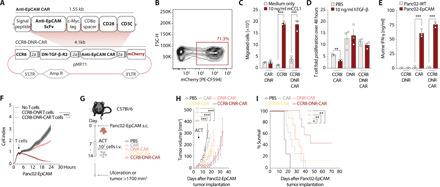
CAR T cell therapy remains ineffective in solid tumors, due largely to poor infiltration and T cell suppression at the tumor site. T regulatory (T) cells suppress the immune response via inhibitory factors such as transforming growth factor-β (TGF-β). T cells expressing the C-C chemokine receptor 8 (CCR8) have been associated with poor prognosis in solid tumors. We postulated that CCR8 could be exploited to redirect effector T cells to the tumor site while a dominant-negative TGF-β receptor 2 (DNR) can simultaneously shield them from TGF-β. We identified that CCL1 from activated T cells potentiates a feedback loop for CCR8 T cell recruitment to the tumor site. This sustained and improved infiltration of engineered T cells synergized with TGF-β shielding for improved therapeutic efficacy. Our results demonstrate that addition of CCR8 and DNR into CAR T cells can render them effective in solid tumors.
嵌合抗原受体 T 细胞疗法在实体瘤中仍然无效,主要是由于在肿瘤部位的浸润不良和 T 细胞抑制。调节性 T 细胞(Treg)通过转化生长因子-β(TGF-β)等抑制因子抑制免疫反应。表达 C-C 趋化因子受体 8(CCR8)的 T 细胞与实体瘤的不良预后相关。我们假设 CCR8 可用于将效应 T 细胞重新导向肿瘤部位,而显性负 TGF-β 受体 2(DNR)可以同时保护它们免受 TGF-β 的影响。我们发现,激活的 T 细胞中的 CCL1 增强了 CCR8 T 细胞募集到肿瘤部位的反馈回路。这种持续和改善的工程 T 细胞浸润与 TGF-β 屏蔽协同作用,可提高治疗效果。我们的结果表明,将 CCR8 和 DNR 添加到 CAR T 细胞中可以使它们在实体瘤中有效。


 Zotero 插件