
新型冠状病毒与宿主细胞相互作用的分子机制及干预治疗
Molecular mechanism of interaction between SARS-CoV-2 and host cells and interventional therapy.
作者信息
Zhang Qianqian, Xiang Rong, Huo Shanshan, Zhou Yunjiao, Jiang Shibo, Wang Qiao, Yu Fei
机构信息
Key Laboratory of Medical Molecular Virology (MOE/NHC/CAMS), School of Basic Medical Sciences, Shanghai Institute of Infectious Disease and Biosecurity, Fudan University, Shanghai, China.
College of Life Sciences, Hebei Agricultural University, Baoding, China.
出版信息
Signal Transduct Target Ther. 2021 Jun 11;6(1):233. doi: 10.1038/s41392-021-00653-w.
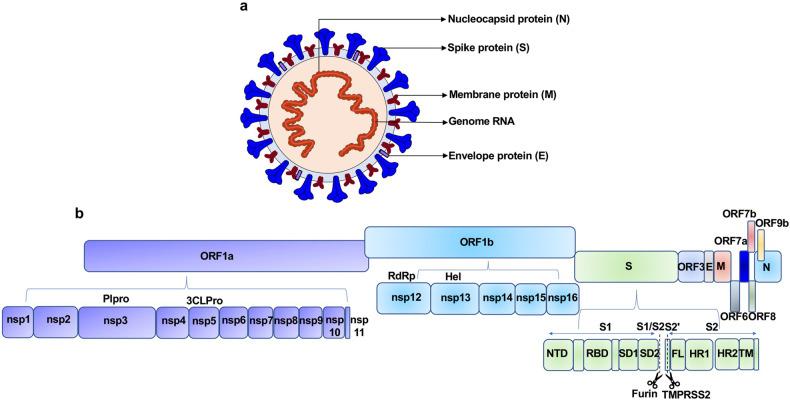
The pandemic of coronavirus disease 2019 (COVID-19) caused by severe acute respiratory syndrome coronavirus 2 (SARS-CoV-2) infection has resulted in an unprecedented setback for global economy and health. SARS-CoV-2 has an exceptionally high level of transmissibility and extremely broad tissue tropism. However, the underlying molecular mechanism responsible for sustaining this degree of virulence remains largely unexplored. In this article, we review the current knowledge and crucial information about how SARS-CoV-2 attaches on the surface of host cells through a variety of receptors, such as ACE2, neuropilin-1, AXL, and antibody-FcγR complexes. We further explain how its spike (S) protein undergoes conformational transition from prefusion to postfusion with the help of proteases like furin, TMPRSS2, and cathepsins. We then review the ongoing experimental studies and clinical trials of antibodies, peptides, or small-molecule compounds with anti-SARS-CoV-2 activity, and discuss how these antiviral therapies targeting host-pathogen interaction could potentially suppress viral attachment, reduce the exposure of fusion peptide to curtail membrane fusion and block the formation of six-helix bundle (6-HB) fusion core. Finally, the specter of rapidly emerging SARS-CoV-2 variants deserves a serious review of broad-spectrum drugs or vaccines for long-term prevention and control of COVID-19 in the future.
由严重急性呼吸综合征冠状病毒2(SARS-CoV-2)感染引起的2019冠状病毒病(COVID-19)大流行给全球经济和健康带来了前所未有的挫折。SARS-CoV-2具有极高的传播性和极其广泛的组织嗜性。然而,维持这种毒力程度的潜在分子机制在很大程度上仍未得到探索。在本文中,我们综述了有关SARS-CoV-2如何通过多种受体(如血管紧张素转换酶2、神经纤毛蛋白-1、AXL和抗体-FcγR复合物)附着在宿主细胞表面的现有知识和关键信息。我们进一步解释了其刺突(S)蛋白如何在弗林蛋白酶、跨膜丝氨酸蛋白酶2和组织蛋白酶等蛋白酶的帮助下从预融合构象转变为融合后构象。然后,我们综述了正在进行的具有抗SARS-CoV-2活性的抗体、肽或小分子化合物的实验研究和临床试验,并讨论了这些针对宿主-病原体相互作用的抗病毒疗法如何可能抑制病毒附着、减少融合肽的暴露以抑制膜融合并阻止六螺旋束(6-HB)融合核心的形成。最后,迅速出现的SARS-CoV-2变体的幽灵值得认真审视用于未来长期预防和控制COVID-19的广谱药物或疫苗。



 Zotero 插件