
探索宏基因组下一代测序在肺部感染诊断中的临床应用价值。
Exploring the Clinical Utility of Metagenomic Next-Generation Sequencing in the Diagnosis of Pulmonary Infection.
作者信息
Xie Guijuan, Zhao Bo, Wang Xun, Bao Liang, Xu Yiming, Ren Xian, Ji Jiali, He Ting, Zhao Hongqing
机构信息
Department of Respiratory, The Affiliated Wuxi Second People's Hospital of Nanjing Medical University, Wuxi, China.
Affiliated Wuxi Clinical College of Nantong University, Wuxi, China.
出版信息
Infect Dis Ther. 2021 Sep;10(3):1419-1435. doi: 10.1007/s40121-021-00476-w. Epub 2021 Jun 12.
INTRODUCTION
We aimed to explore the real-world clinical application value and challenges of metagenomic next-generation sequencing (mNGS) for pulmonary infection diagnosis.
METHODS
We retrospectively reviewed the results of mNGS and conventional tests from 140 hospitalized patients with suspected pulmonary infections from January 2019 to December 2020. The sample types included bronchoalveolar lavage fluid, lung tissue by transbronchial lung biopsy, pleural effusion, blood, and bronchial sputum. Apart from the mNGS reports that our patients received, an extra comprehensive and thorough literature search was conducted.
RESULTS
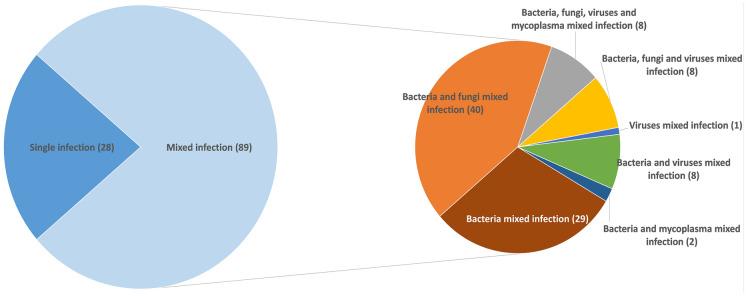
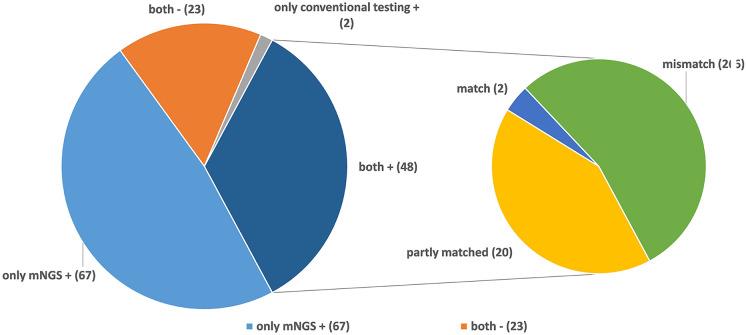
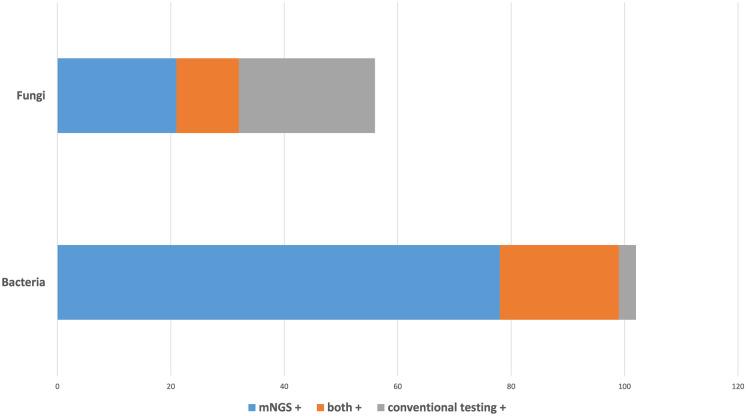
Significant differences were noticed in the positive detection rates of pathogens between mNGS and conventional diagnostic testing (115/140, 82.14% vs 50/140, 35.71%, P < 0.05). The percentage of mNGS-positive patients was significantly higher than that of conventional testing-positive patients with regard to bacterial detection (P < 0.01), but no significant differences were found with regard to fungal detection (P = 0.67). Significant statistical differences were found between mixed infection cases (15, 22.70%) and single infection cases (4, 7.84%) in terms of diabetes (P = 0.03). The most frequent pattern of mixed infection was bacteria and fungi mixed infection (40, 40/89 = 44.94%), followed by bacteria mixed infection (29, 29/89 = 32.58%). The sensitivity of mNGS in pulmonary infection diagnosis was much higher than that of conventional test (89.17% vs 50.00%; P < 0.01), but the specificity was the opposite (75.00% vs 81.82%; P > 0.05).
CONCLUSION
mNGS is a valuable tool for the detection of pulmonary infections, especially mixed pulmonary infections. The most common combinations we found were bacterial-fungal coinfection and bacterial-bacterial coinfection. Still, there are many challenges in the clinical application of mNGS in the diagnosis of pulmonary infections. There is still a lot of work to be done in interpreting the mNGS reports, because both clinical judgment and literature analysis strategy need to be refined.
引言
我们旨在探讨宏基因组下一代测序(mNGS)在肺部感染诊断中的真实世界临床应用价值及挑战。
方法
我们回顾性分析了2019年1月至2020年12月期间140例疑似肺部感染住院患者的mNGS及传统检测结果。样本类型包括支气管肺泡灌洗液、经支气管肺活检获取的肺组织、胸腔积液、血液及支气管痰液。除了我们患者所接受的mNGS报告外,还进行了额外全面且深入的文献检索。
结果
mNGS与传统诊断检测在病原体阳性检出率上存在显著差异(115/140,82.14% 对50/140,35.71%,P < 0.05)。在细菌检测方面,mNGS阳性患者的比例显著高于传统检测阳性患者(P < 0.01),但在真菌检测方面未发现显著差异(P = 0.67)。在糖尿病方面,混合感染病例(15例,22.70%)与单一感染病例(4例,7.84%)之间存在显著统计学差异(P = 0.03)。最常见的混合感染模式是细菌与真菌混合感染(40例,40/89 = 44.94%),其次是细菌混合感染(29例,29/89 = 32.58%)。mNGS在肺部感染诊断中的敏感性远高于传统检测(89.17% 对50.00%;P < 0.01),但特异性则相反(75.00% 对81.82%;P > 0.05)。
结论
mNGS是检测肺部感染尤其是混合性肺部感染的有价值工具。我们发现最常见的组合是细菌 - 真菌共感染和细菌 - 细菌共感染。尽管如此,mNGS在肺部感染诊断的临床应用中仍存在许多挑战。在解读mNGS报告方面仍有大量工作要做,因为临床判断和文献分析策略都需要完善。

 Zotero 插件