
表观遗传时钟 GrimAge 是否独立于遗传影响预测死亡率:一项对老年女性双胞胎 18 年的随访研究。
Does the epigenetic clock GrimAge predict mortality independent of genetic influences: an 18 year follow-up study in older female twin pairs.
机构信息
Faculty of Sport and Health Sciences, Gerontology Research Center (GEREC), University of Jyväskylä, P.O. Box 35 (VIV), 40014, Jyväskylä, Finland.
Faculty of Sport and Health Sciences, University of Jyväskylä, Jyväskylä, Finland.
出版信息
Clin Epigenetics. 2021 Jun 13;13(1):128. doi: 10.1186/s13148-021-01112-7.
BACKGROUND
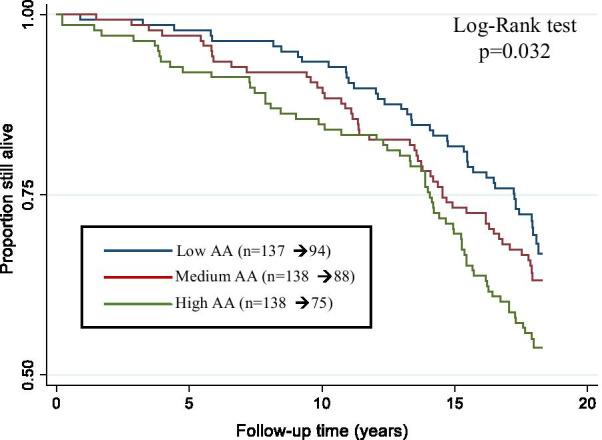
Epigenetic clocks are based on DNA methylation (DNAm). It has been suggested that these clocks are useable markers of biological aging and premature mortality. Because genetic factors explain variations in both epigenetic aging and mortality, this association could also be explained by shared genetic factors. We investigated the influence of genetic and lifestyle factors (smoking, alcohol consumption, physical activity, chronic diseases, body mass index) and education on the association of accelerated epigenetic aging with mortality using a longitudinal twin design. Utilizing a publicly available online tool, we calculated the epigenetic age using two epigenetic clocks, Horvath DNAmAge and DNAm GrimAge, in 413 Finnish twin sisters, aged 63-76 years, at the beginning of the 18-year mortality follow-up. Epigenetic age acceleration was calculated as the residuals from a linear regression model of epigenetic age estimated on chronological age (AA, AA, respectively). Cox proportional hazard models were conducted for individuals and twin pairs.
RESULTS
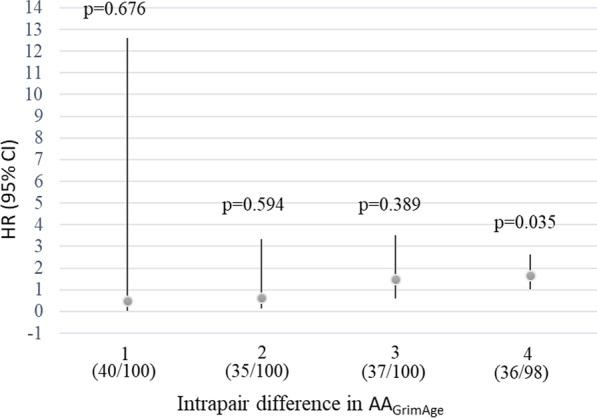
The results of the individual-based analyses showed an increased mortality hazard ratio (HR) of 1.31 (CI: 1.13-1.53) per one standard deviation (SD) increase in AA. The results indicated no significant associations of AA with mortality. Pairwise mortality analyses showed an HR of 1.50 (CI: 1.02-2.20) per 1 SD increase in AA. However, after adjusting for smoking, the HR attenuated substantially and was statistically non-significant (1.29; CI: 0.84-1.99). Similarly, in multivariable adjusted models the HR (1.42-1.49) was non-significant. In AA, the non-significant HRs were lower among monozygotic pairs in comparison to dizygotic pairs, while in AA there were no systematic differences by zygosity. Further, the pairwise analysis in quartiles showed that the increased within pair difference in AA was associated with a higher all-cause mortality risk.
CONCLUSIONS
In conclusion, the findings suggest that DNAm GrimAge is a strong predictor of mortality independent of genetic influences. Smoking, which is known to alter DNAm levels and is built into the DNAm GrimAge algorithm, attenuated the association between epigenetic aging and mortality risk.
背景
表观遗传时钟基于 DNA 甲基化(DNAm)。有人提出,这些时钟是生物衰老和过早死亡的有用标志物。由于遗传因素可以解释表观遗传衰老和死亡率的变化,因此这种关联也可以用共同的遗传因素来解释。我们利用纵向双胞胎设计,研究了遗传和生活方式因素(吸烟、饮酒、体力活动、慢性疾病、体重指数)以及教育对加速表观遗传衰老与死亡率之间关联的影响。我们利用一个公开的在线工具,在开始为期 18 年的死亡率随访时,对 413 名年龄在 63-76 岁的芬兰双胞胎姐妹,使用两种表观遗传时钟——Horvath DNAmAge 和 DNAm GrimAge,计算了表观遗传年龄。表观遗传年龄加速是通过对估计的与实际年龄(AA)的线性回归模型计算的表观遗传年龄的残差来计算的。为个体和双胞胎对进行了 Cox 比例风险模型分析。
结果
个体分析的结果显示,AA 每增加一个标准差,死亡率的危险比(HR)增加 1.31(CI:1.13-1.53)。结果表明,AA 与死亡率无显著关联。成对死亡率分析显示,AA 每增加一个标准差,死亡率的 HR 增加 1.50(CI:1.02-2.20)。然而,调整吸烟因素后,HR 显著减弱,无统计学意义(1.29;CI:0.84-1.99)。同样,在多变量调整模型中,HR(1.42-1.49)也无统计学意义。在 AA 中,与异卵双胞胎相比,同卵双胞胎的 HR 较低,而在 AA 中,HR 没有因同卵而异的系统差异。此外,四分位的成对分析表明,AA 中双胞胎内差异的增加与全因死亡率风险的增加相关。
结论
总之,研究结果表明,DNAm GrimAge 是独立于遗传影响的死亡率的有力预测指标。已知会改变 DNAm 水平并被纳入 DNAm GrimAge 算法的吸烟,减弱了表观遗传衰老与死亡率风险之间的关联。
 Zotero 插件