
血小板内皮聚集受体-1基因分型对轻度卒中或短暂性脑缺血发作患者长期脑血管结局的影响。
Impact of Platelet Endothelial Aggregation Receptor-1 Genotypes on Long-Term Cerebrovascular Outcomes in Patients With Minor Stroke or Transient Ischemic Attack.
作者信息
Zhang Xiao-Guang, Gu Jing-Yu, Fu Qiang-Qiang, Chen Shi-Wu, Xue Jie, Jiang Shan-Shan, Kong Yu-Ming, Li You-Mei, Yue Yun-Hua
机构信息
Department of Neurology, Yangpu Hospital, Tongji University School of Medicine, Shanghai, China.
出版信息
Front Neurol. 2021 May 28;12:649056. doi: 10.3389/fneur.2021.649056. eCollection 2021.
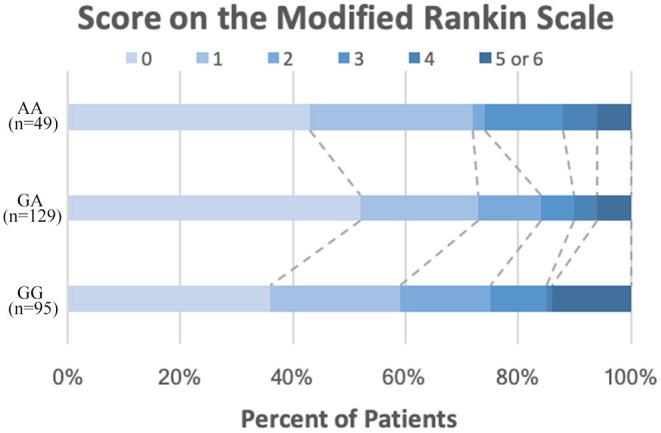
Platelet endothelial aggregation receptor-1 (PEAR1) rs12041331 has been reported to affect agonist-stimulated platelet aggregation, but it remains unclear whether this variant plays a role in recurrent stroke. Here we assess the clinical relevance of PEAR1 rs12041331 in acute minor ischemic stroke (AMIS) and transient ischemic attack (TIA) Chinese patients treated with dual antiplatelet therapy (DAPT). We recruited 273 consecutive minor stroke and TIA patients, and Cox proportional hazard regression was used to model the relationship between PEAR1 rs12041331 and thrombotic and bleeding events. Genotyping for PEAR1 rs12041331 showed 49 (18.0%) AA homozygotes, 129 (47.3%) GA heterozygotes, and 95 (34.7%) GG homozygotes. No association was observed between PEAR1 rs12041331 genotype and stroke or composite clinical vascular event rates (ischemic stroke, hemorrhagic stroke, TIA, myocardial infarction, or vascular death) or bleeding events regardless if individuals carried one or two copies of the A allele. Our results suggested that rs12041331 genetic polymorphism was not an important contributor to clinical events in AMIS and TIA patients in the setting of secondary prevention. Our data do provide robust evidence that genetic variation in PEAR1 rs12041331 do not contribute to atherothrombotic or bleeding risk in minor stroke and TIA patients treated with DAPT.
据报道,血小板内皮聚集受体1(PEAR1)基因rs12041331会影响激动剂刺激的血小板聚集,但该变体是否在复发性中风中起作用尚不清楚。在此,我们评估了PEAR1基因rs12041331在中国接受双重抗血小板治疗(DAPT)的急性轻度缺血性中风(AMIS)和短暂性脑缺血发作(TIA)患者中的临床相关性。我们招募了273例连续性轻度中风和TIA患者,并使用Cox比例风险回归模型来分析PEAR1基因rs12041331与血栓形成和出血事件之间的关系。对PEAR1基因rs12041331进行基因分型显示,有49例(18.0%)AA纯合子、129例(47.3%)GA杂合子和95例(34.7%)GG纯合子。无论个体携带一个还是两个A等位基因拷贝,均未观察到PEAR1基因rs12041331基因型与中风或复合临床血管事件发生率(缺血性中风、出血性中风、TIA、心肌梗死或血管性死亡)或出血事件之间存在关联。我们的结果表明,在二级预防背景下,rs12041331基因多态性并非AMIS和TIA患者临床事件的重要影响因素。我们的数据确实提供了有力证据,表明PEAR1基因rs12041331的基因变异不会增加接受DAPT治疗的轻度中风和TIA患者的动脉粥样硬化血栓形成或出血风险。


 Zotero 插件