
欧洲血源感染中耐万古霉素和耐甲氧西林感染里利奈唑胺和达托霉素耐药比例较低
Low Proportion of Linezolid and Daptomycin Resistance Among Bloodborne Vancomycin-Resistant and Methicillin-Resistant Infections in Europe.
作者信息
Markwart Robby, Willrich Niklas, Eckmanns Tim, Werner Guido, Ayobami Olaniyi
机构信息
Jena University Hospital, Institute of General Practice and Family Medicine, Jena, Germany.
Unit 37: Nosocomial Infections, Surveillance of Antimicrobial Resistance and Consumption, Robert Koch Institute, Berlin, Germany.
出版信息
Front Microbiol. 2021 May 31;12:664199. doi: 10.3389/fmicb.2021.664199. eCollection 2021.
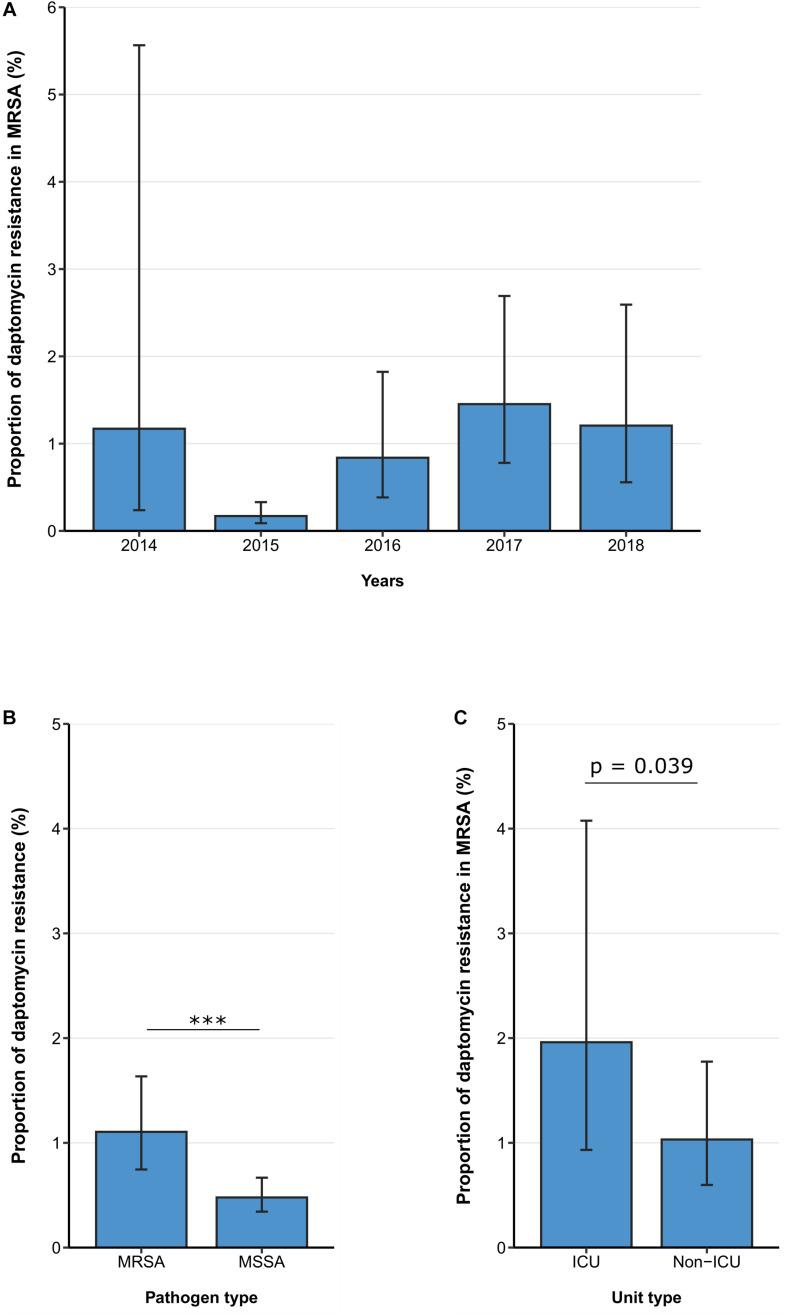
Vancomycin-resistant (VREF) and methicillin-resistant (MRSA) are associated with significant health burden. We investigated linezolid and daptomycin resistance among VREF and MRSA in the EU/EEA between 2014 and 2018. Descriptive statistics and multivariable logistic regression were used to analyze 6,949 VREF and 35,131 MRSA blood isolates from patients with bloodstream infection. The population-weighted mean proportion of linezolid resistance in VREF and MRSA between 2014 and 2018 was 1.6% (95% CI 1.33-2.03%) and 0.28% (95% CI 0.32-0.38%), respectively. Daptomycin resistance in MRSA isolates was similarly low [1.1% (95% CI 0.75-1.6%)]. On the European level, there was no temporal change of daptomycin and linezolid resistance in MRSA and VREF. Multivariable regression analyses showed that there was a higher likelihood of linezolid and daptomycin resistance in MRSA (aOR: 2.74, < 0.001; aOR: 2.25, < 0.001) and linezolid in VREF (aOR: 1.99, < 0.001) compared to their sensitive isolates. The low proportion of linezolid and daptomycin resistance in VREF and MRSA suggests that these last-resort antibiotics remain effective and will continue to play an important role in the clinical management of these infections in Europe. However, regional and national efforts to contain antimicrobial resistance should continue to monitor the trend through strengthened surveillance that includes genomic surveillance for early warning and action.
耐万古霉素(VREF)和耐甲氧西林(MRSA)与严重的健康负担相关。我们调查了2014年至2018年期间欧盟/欧洲经济区VREF和MRSA对利奈唑胺和达托霉素的耐药情况。采用描述性统计和多变量逻辑回归分析了6949株来自血流感染患者的VREF和35131株MRSA血培养分离株。2014年至2018年期间,VREF和MRSA中利奈唑胺耐药的人群加权平均比例分别为1.6%(95%CI 1.33 - 2.03%)和0.28%(95%CI 0.32 - 0.38%)。MRSA分离株对达托霉素的耐药率同样较低[1.1%(95%CI 0.75 - 1.6%)]。在欧洲层面,MRSA和VREF对达托霉素和利奈唑胺的耐药情况没有随时间变化。多变量回归分析显示,与敏感分离株相比,MRSA对利奈唑胺和达托霉素耐药的可能性更高(调整后比值比:2.74,<0.001;调整后比值比:2.25,<0.001),VREF对利奈唑胺耐药的可能性更高(调整后比值比:1.99,<0.001)。VREF和MRSA中利奈唑胺和达托霉素耐药比例较低表明,这些最后手段的抗生素仍然有效,并将继续在欧洲这些感染的临床管理中发挥重要作用。然而,区域和国家层面控制抗菌药物耐药性的努力应通过加强监测(包括基因组监测以进行早期预警和采取行动)继续监测这一趋势。


 Zotero 插件