
CD8+ PD-L1+ T细胞和M2巨噬细胞低浸润预示非小细胞肺癌免疫检查点抑制剂治疗后临床结局改善
Low Infiltration of CD8+ PD-L1+ T Cells and M2 Macrophages Predicts Improved Clinical Outcomes After Immune Checkpoint Inhibitor Therapy in Non-Small Cell Lung Carcinoma.
作者信息
Li Liuning, Lu Guojie, Liu Yang, Gong Longlong, Zheng Xue, Zheng Hongbo, Gu Weiguang, Yang Lin
机构信息
Department of Medical Oncology, Guangdong Provincial Hospital of Chinese Medicine, The Second Clinical Collage of Guangzhou University of Chinese Medicine, Guangzhou, China.
Department of Thoracic Surgery (Respiratory Center Area 1), Guangzhou Panyu Central Hospital, Guangzhou, China.
出版信息
Front Oncol. 2021 Jun 4;11:658690. doi: 10.3389/fonc.2021.658690. eCollection 2021.
BACKGROUND
Many clinical studies have shown that patients with non-small cell lung carcinoma (NSCLC) can benefit from immune checkpoint inhibitor (ICI) therapy; however, PD-L1 and tumor mutation burden (TMB), which are recommended by the NCCN guidelines, are still insufficient in predicting the response to and prognosis of immunotherapy. Given the widespread use of ICIs, it is important to find biomarkers that can predict immunotherapy outcomes in NSCLC patients, and the exploration of additional effective biomarkers for ICI therapy is urgently needed.
METHODS
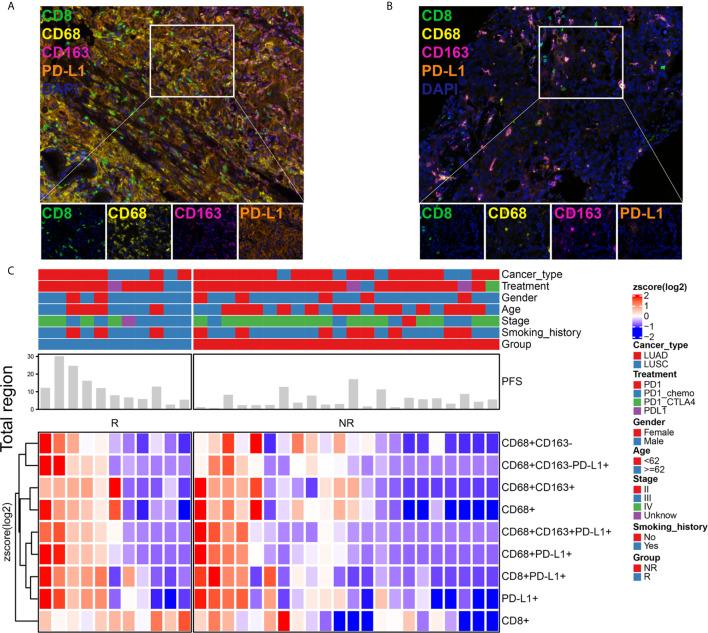
A total of 33 stage II-IV NSCLC patients were included in this study. We analyzed immune markers in biopsy and surgical tissue resected from these patients before treatment with ICIs. We examined the infiltration of immune cells and expression of PD-L1 in immune cells using fluorescent multiplex immunohistochemistry (mIHC) stained with CD8/CD68/CD163/PD-L1 antibodies.
RESULTS
In this cohort, we observed that the levels of CD8+ T cells, CD8+PD-L1+ T cells, and CD68+CD163+ M2 macrophages in the total region were independent prognostic factors for progression-free survival (PFS) in NSCLC patients treated with ICIs (HR=0.04, P=0.013; HR=17.70, P=0.026; and HR=17.88, P=0.011, respectively). High infiltration of CD8+ T cells and low infiltration of CD8+PD-L1+ T cells throughout the region were correlated with prolonged PFS (P=0.016 and P=0.02, respectively). No statistically significant difference was observed for CD68+CD163+ M2 macrophages. The joint parameters CD8+ high/CD8+PD-L1+ low, CD8+ high/CD68+CD163+ low and CD8+PD-L1+ low/CD68+CD163+ low predicted better PFS than other joint parameters (P<0.01, P<0.01, and P<0.001, respectively), and they also demonstrated stronger stratification than single biomarkers. The response rate of patients with high infiltration of CD8+ T cells was significantly higher than that of those with low infiltration (P<0.01), and the joint parameters CD8+/CD8+PD-L1+ and CD8+/CD68+CD163+ also demonstrated stronger stratification than single biomarkers.
CONCLUSIONS
This retrospective study identified the predictive value of CD8+PD-L1+ T cells, CD8+ T cells, and CD68+CD163+ M2 macrophages in NSCLC patients who received ICIs. Interestingly, our results indicate that the evaluation of joint parameters has certain significance in guiding ICI treatment in NSCLC patients.
背景
许多临床研究表明,非小细胞肺癌(NSCLC)患者可从免疫检查点抑制剂(ICI)治疗中获益;然而,美国国立综合癌症网络(NCCN)指南推荐的程序性死亡受体配体1(PD-L1)和肿瘤突变负荷(TMB)在预测免疫治疗反应和预后方面仍存在不足。鉴于ICI的广泛应用,寻找能够预测NSCLC患者免疫治疗结果的生物标志物非常重要,并且迫切需要探索用于ICI治疗的其他有效生物标志物。
方法
本研究共纳入33例II-IV期NSCLC患者。我们分析了这些患者在接受ICI治疗前活检和手术切除组织中的免疫标志物。我们使用CD8/CD68/CD163/PD-L1抗体进行荧光多重免疫组织化学(mIHC)染色,检测免疫细胞浸润情况以及免疫细胞中PD-L1的表达。
结果
在该队列中,我们观察到在接受ICI治疗的NSCLC患者中,全区域CD8+T细胞、CD8+PD-L1+T细胞和CD68+CD163+M2巨噬细胞水平是无进展生存期(PFS)的独立预后因素(风险比[HR]=0.04,P=0.013;HR=17.70,P=0.026;HR=17.88,P=0.011)。全区域CD8+T细胞高浸润和CD8+PD-L1+T细胞低浸润与PFS延长相关(分别为P=0.016和P=0.02)。CD68+CD163+M2巨噬细胞未观察到统计学显著差异。联合参数CD8+高/CD8+PD-L1+低、CD8+高/CD68+CD163+低和CD8+PD-L1+低/CD68+CD163+低比其他联合参数预测的PFS更好(分别为P<0.01、P<0.01和P<0.001),并且它们的分层能力也比单一生物标志物更强。CD8+T细胞高浸润患者的缓解率显著高于低浸润患者(P<0.01),联合参数CD8+/CD8+PD-L1+和CD8+/CD68+CD163+的分层能力也比单一生物标志物更强。
结论
这项回顾性研究确定了CD8+PD-L1+T细胞、CD8+T细胞和CD68+CD163+M2巨噬细胞在接受ICI治疗的NSCLC患者中的预测价值。有趣的是,我们的结果表明联合参数评估在指导NSCLC患者ICI治疗方面具有一定意义。



 Zotero 插件