
构建并比较114个金黄色葡萄球菌菌株特异性的全基因组规模代谢模型。
Curating and comparing 114 strain-specific genome-scale metabolic models of Staphylococcus aureus.
作者信息
Renz Alina, Dräger Andreas
机构信息
Computational Systems Biology of Infections and Antimicrobial-Resistant Pathogens, Institute for Bioinformatics and Medical Informatics (IBMI), University of Tübingen, Tübingen, Germany.
Department of Computer Science, University of Tübingen, Tübingen, Germany.
出版信息
NPJ Syst Biol Appl. 2021 Jun 29;7(1):30. doi: 10.1038/s41540-021-00188-4.
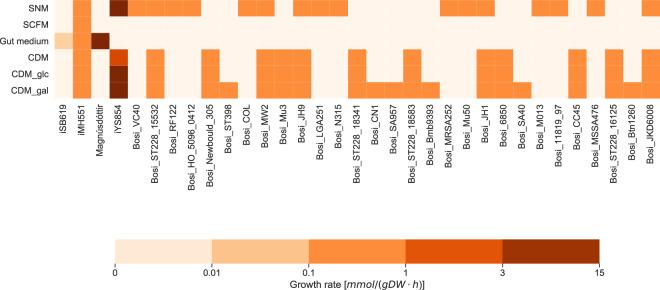
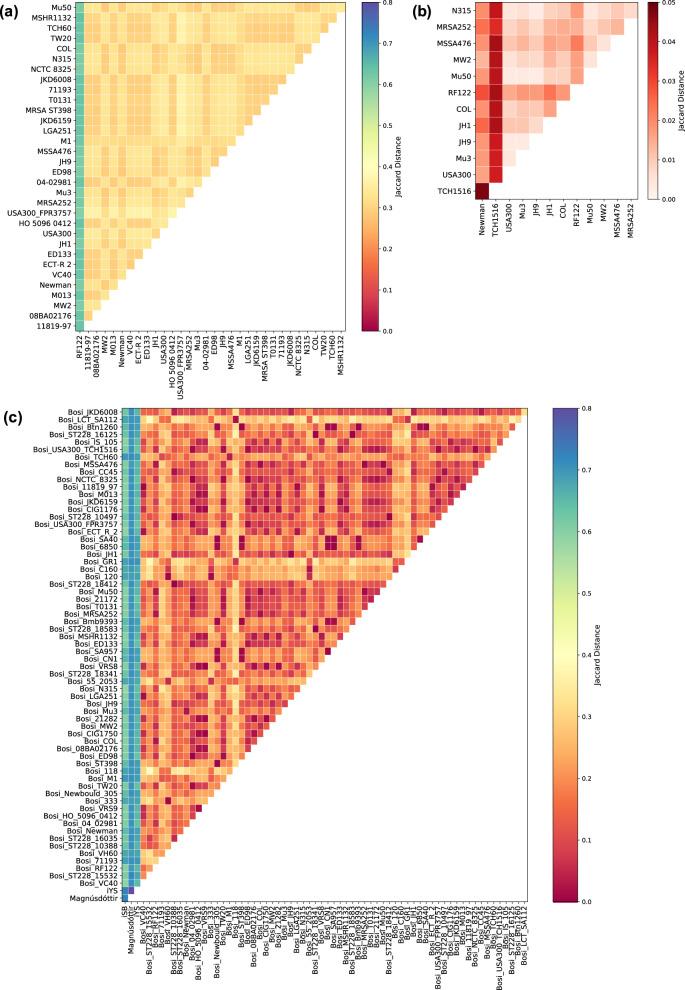
Staphylococcus aureus is a high-priority pathogen causing severe infections with high morbidity and mortality worldwide. Many S. aureus strains are methicillin-resistant (MRSA) or even multi-drug resistant. It is one of the most successful and prominent modern pathogens. An effective fight against S. aureus infections requires novel targets for antimicrobial and antistaphylococcal therapies. Recent advances in whole-genome sequencing and high-throughput techniques facilitate the generation of genome-scale metabolic models (GEMs). Among the multiple applications of GEMs is drug-targeting in pathogens. Hence, comprehensive and predictive metabolic reconstructions of S. aureus could facilitate the identification of novel targets for antimicrobial therapies. This review aims at giving an overview of all available GEMs of multiple S. aureus strains. We downloaded all 114 available GEMs of S. aureus for further analysis. The scope of each model was evaluated, including the number of reactions, metabolites, and genes. Furthermore, all models were quality-controlled using MEMOTE, an open-source application with standardized metabolic tests. Growth capabilities and model similarities were examined. This review should lead as a guide for choosing the appropriate GEM for a given research question. With the information about the availability, the format, and the strengths and potentials of each model, one can either choose an existing model or combine several models to create models with even higher predictive values. This facilitates model-driven discoveries of novel antimicrobial targets to fight multi-drug resistant S. aureus strains.
金黄色葡萄球菌是一种高优先级病原体,在全球范围内引发严重感染,发病率和死亡率都很高。许多金黄色葡萄球菌菌株对甲氧西林耐药(MRSA),甚至具有多重耐药性。它是最成功且最突出的现代病原体之一。有效对抗金黄色葡萄球菌感染需要新型的抗微生物和抗葡萄球菌治疗靶点。全基因组测序和高通量技术的最新进展促进了基因组规模代谢模型(GEMs)的生成。GEMs的多种应用之一是病原体中的药物靶向。因此,金黄色葡萄球菌的全面且具有预测性的代谢重建有助于确定抗微生物治疗的新靶点。本综述旨在概述多种金黄色葡萄球菌菌株的所有可用GEMs。我们下载了所有114个可用的金黄色葡萄球菌GEMs用于进一步分析。评估了每个模型的范围,包括反应、代谢物和基因的数量。此外,使用MEMOTE(一种具有标准化代谢测试的开源应用程序)对所有模型进行了质量控制。检查了生长能力和模型相似性。本综述应作为为特定研究问题选择合适GEM的指南。借助有关每个模型的可用性、格式以及优势和潜力的信息,人们可以选择现有模型或组合多个模型以创建具有更高预测价值的模型。这有助于通过模型驱动发现对抗多重耐药金黄色葡萄球菌菌株的新型抗微生物靶点。
 Zotero 插件