
CRISPR-Cas:ESKAPE感染治疗与研究的一场革命——临床前研究
CRISPR-Cas, a Revolution in the Treatment and Study of ESKAPE Infections: Pre-Clinical Studies.
作者信息
González de Aledo Manuel, González-Bardanca Mónica, Blasco Lucía, Pacios Olga, Bleriot Inés, Fernández-García Laura, Fernández-Quejo Melisa, López María, Bou Germán, Tomás María
机构信息
Microbiology Department-A Coruña University Hospital (CHUAC), 15006 A Coruña, Spain.
A Coruña Biomedical Research Institute (INIBIC), University of A Coruña (UDC), 15006 A Coruña, Spain.
出版信息
Antibiotics (Basel). 2021 Jun 22;10(7):756. doi: 10.3390/antibiotics10070756.
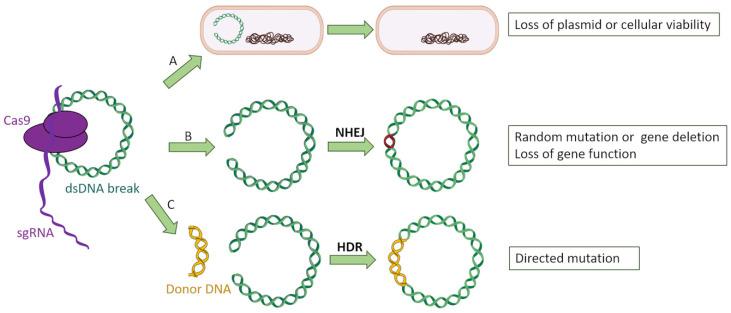
One of the biggest threats we face globally is the emergence of antimicrobial-resistant (AMR) bacteria, which runs in parallel with the lack in the development of new antimicrobials. Among these AMR bacteria pathogens belonging to the ESKAPE group can be highlighted ( spp., , , , and spp.) due to their profile of drug resistance and virulence. Therefore, innovative lines of treatment must be developed for these bacteria. In this review, we summarize the different strategies for the treatment and study of molecular mechanisms of AMR in the ESKAPE pathogens based on the clustered regularly interspaced short palindromic repeats (CRISPR) and CRISPR-associated (Cas) proteins' technologies: loss of plasmid or cellular viability, random mutation or gene deletion as well directed mutations that lead to a gene's loss of function.
我们在全球面临的最大威胁之一是耐抗菌药(AMR)细菌的出现,这与新型抗菌药物研发的匮乏同时存在。在这些AMR细菌中,属于ESKAPE组的病原体(粪肠球菌、金黄色葡萄球菌、肺炎克雷伯菌、鲍曼不动杆菌、铜绿假单胞菌和阴沟肠杆菌)因其耐药性和毒力特征而备受关注。因此,必须针对这些细菌开发创新的治疗方法。在本综述中,我们总结了基于成簇规律间隔短回文重复序列(CRISPR)和CRISPR相关(Cas)蛋白技术,针对ESKAPE病原体中AMR的治疗和分子机制研究的不同策略:质粒丢失或细胞活力丧失、随机突变或基因缺失以及导致基因功能丧失的定向突变。


 Zotero 插件