
胰岛素样生长因子结合蛋白2是驱动多形性胶质母细胞瘤中导致生存期短的失调基因网络的潜在主要调节因子。
IGFBP2 Is a Potential Master Regulator Driving the Dysregulated Gene Network Responsible for Short Survival in Glioblastoma Multiforme.
作者信息
Kalya Manasa, Kel Alexander, Wlochowitz Darius, Wingender Edgar, Beißbarth Tim
机构信息
Department of Medical Bioinformatics, University Medical Center Göttingen, Göttingen, Germany.
geneXplain GmbH, Wolfenbüttel, Germany.
出版信息
Front Genet. 2021 Jun 15;12:670240. doi: 10.3389/fgene.2021.670240. eCollection 2021.
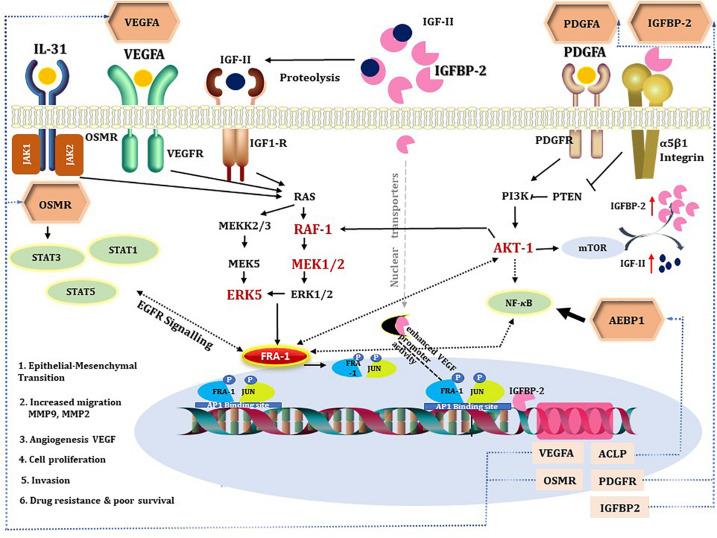
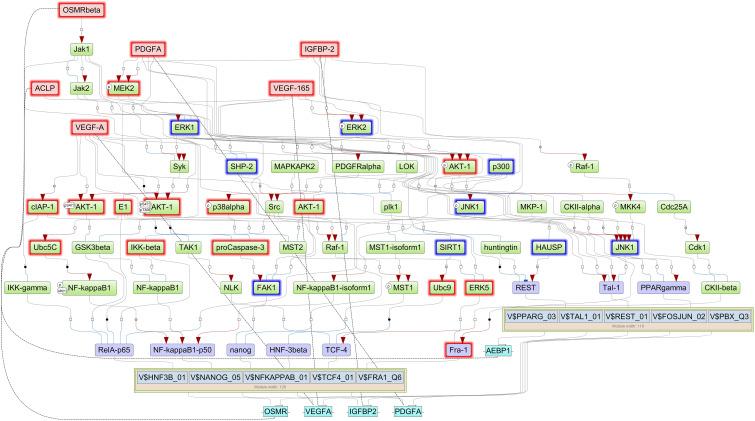
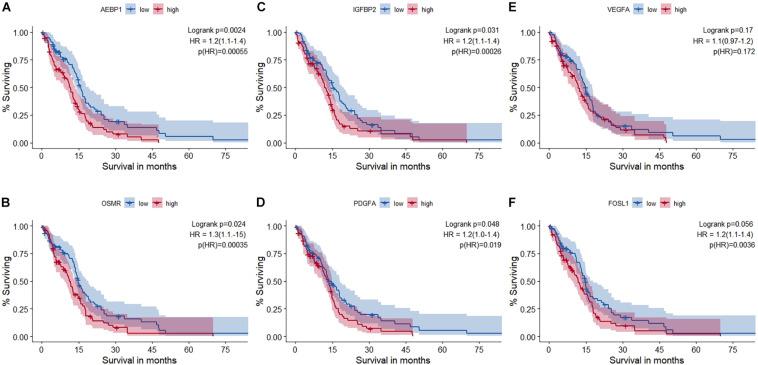
Only 2% of glioblastoma multiforme (GBM) patients respond to standard therapy and survive beyond 36 months (long-term survivors, LTS), while the majority survive less than 12 months (short-term survivors, STS). To understand the mechanism leading to poor survival, we analyzed publicly available datasets of 113 STS and 58 LTS. This analysis revealed 198 differentially expressed genes (DEGs) that characterize aggressive tumor growth and may be responsible for the poor prognosis. These genes belong largely to the Gene Ontology (GO) categories "epithelial-to-mesenchymal transition" and "response to hypoxia." In this article, we applied an upstream analysis approach that involves state-of-the-art promoter analysis and network analysis of the dysregulated genes potentially responsible for short survival in GBM. Binding sites for transcription factors (TFs) associated with GBM pathology like NANOG, NF-κB, REST, FRA-1, PPARG, and seven others were found enriched in the promoters of the dysregulated genes. We reconstructed the gene regulatory network with several positive feedback loops controlled by five master regulators [insulin-like growth factor binding protein 2 (IGFBP2), vascular endothelial growth factor A (VEGFA), VEGF165, platelet-derived growth factor A (PDGFA), adipocyte enhancer-binding protein (AEBP1), and oncostatin M (OSMR)], which can be proposed as biomarkers and as therapeutic targets for enhancing GBM prognosis. A critical analysis of this gene regulatory network gives insights into the mechanism of gene regulation by IGFBP2 several TFs including the key molecule of GBM tumor invasiveness and progression, FRA-1. All the observations were validated in independent cohorts, and their impact on overall survival has been investigated.
只有2%的多形性胶质母细胞瘤(GBM)患者对标准治疗有反应并存活超过36个月(长期存活者,LTS),而大多数患者存活时间少于12个月(短期存活者,STS)。为了解导致存活率低的机制,我们分析了公开可用的包含113例STS和58例LTS的数据集。该分析揭示了198个差异表达基因(DEG),这些基因表征侵袭性肿瘤生长,可能是预后不良的原因。这些基因主要属于基因本体(GO)类别“上皮-间质转化”和“缺氧反应”。在本文中,我们应用了一种上游分析方法,该方法涉及对可能导致GBM短期存活的失调基因进行最先进的启动子分析和网络分析。在失调基因的启动子中发现与GBM病理学相关的转录因子(TF)如NANOG、NF-κB、REST、FRA-1、PPARG等七个转录因子的结合位点富集。我们重建了由五个主调控因子[胰岛素样生长因子结合蛋白2(IGFBP2)、血管内皮生长因子A(VEGFA)、VEGF165、血小板衍生生长因子A(PDGFA)、脂肪细胞增强子结合蛋白(AEBP1)和制瘤素M(OSMR)]控制的具有多个正反馈环的基因调控网络,这些主调控因子可被提议作为生物标志物和改善GBM预后的治疗靶点。对该基因调控网络的批判性分析深入了解了IGFBP2对基因调控的机制,IGFBP2调控包括GBM肿瘤侵袭和进展的关键分子FRA-1在内的几个TF。所有观察结果均在独立队列中得到验证,并研究了它们对总生存期的影响。


 Zotero 插件