
肝半胱氨酸亚磺酸脱羧酶耗竭和牛磺酸代谢缺陷在大鼠部分肾切除慢性肾脏病模型中的作用。
Hepatic cysteine sulphinic acid decarboxylase depletion and defective taurine metabolism in a rat partial nephrectomy model of chronic kidney disease.
机构信息
Department of Respiratory Sciences, University of Leicester, Leicester, LE1 7RH, UK.
School of Life and Medical Sciences, University of Hertfordshire, Hertfordshire, UK.
出版信息
BMC Nephrol. 2021 Jul 5;22(1):250. doi: 10.1186/s12882-021-02442-7.
BACKGROUND
Taurine depletion occurs in patients with end-stage chronic kidney disease (CKD). In contrast, in the absence of CKD, plasma taurine is reported to increase following dietary L-glutamine supplementation. This study tested the hypothesis that taurine biosynthesis decreases in a rat CKD model, but is rectified by L-glutamine supplementation.
METHODS
CKD was induced by partial nephrectomy in male Sprague-Dawley rats, followed 2 weeks later by 2 weeks of 12% w/w L-glutamine supplemented diet (designated NxT) or control diet (NxC). Sham-operated control rats (S) received control diet.
RESULTS
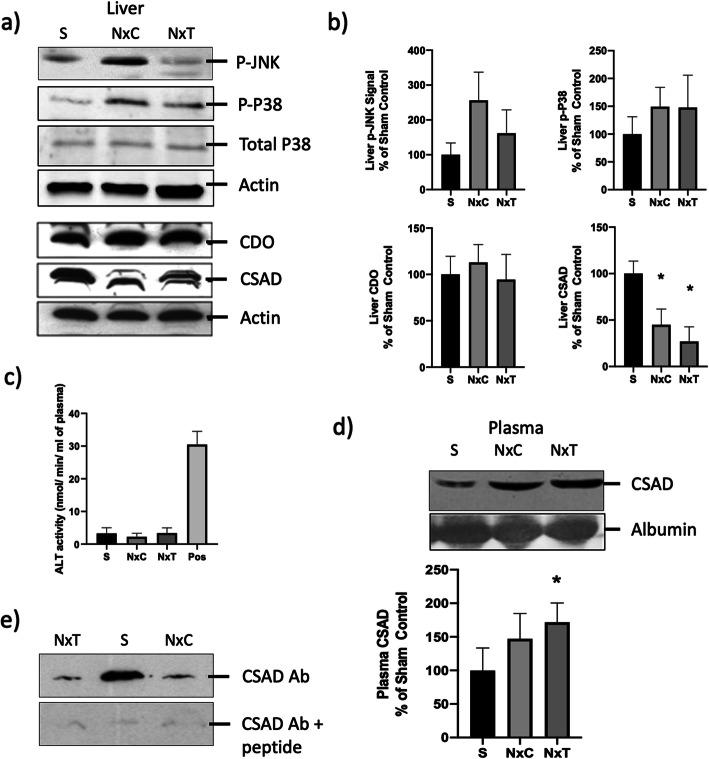
Taurine concentration in plasma, liver and skeletal muscle was not depleted, but steady-state urinary taurine excretion (a measure of whole-body taurine biosynthesis) was strongly suppressed (28.3 ± 8.7 in NxC rats versus 78.5 ± 7.6 μmol/24 h in S, P < 0.05), accompanied by reduced taurine clearance (NxC 0.14 ± 0.05 versus 0.70 ± 0.11 ml/min/Kg body weight in S, P < 0.05). Hepatic expression of mRNAs encoding key enzymes of taurine biosynthesis (cysteine sulphinic acid decarboxylase (CSAD) and cysteine dioxygenase (CDO)) showed no statistically significant response to CKD (mean relative expression of CSAD and CDO in NxC versus S was 0.91 ± 0.18 and 0.87 ± 0.14 respectively). Expression of CDO protein was also unaffected. However, CSAD protein decreased strongly in NxC livers (45.0 ± 16.8% of that in S livers, P < 0.005). L-glutamine supplementation failed to rectify taurine biosynthesis or CSAD protein expression, but worsened CKD (proteinuria in NxT 12.5 ± 1.2 versus 6.7 ± 1.5 mg/24 h in NxC, P < 0.05).
CONCLUSION
In CKD, hepatic CSAD is depleted and taurine biosynthesis impaired. This is important in view of taurine's reported protective effect against cardio-vascular disease - the leading cause of death in human CKD.
背景
在终末期慢性肾脏病(CKD)患者中,牛磺酸会被消耗殆尽。相反,在没有 CKD 的情况下,据报道,在饮食中补充 L-谷氨酰胺后,血浆牛磺酸会增加。本研究检验了以下假设:在 CKD 大鼠模型中,牛磺酸生物合成会减少,但 L-谷氨酰胺的补充可以纠正这种情况。
方法
通过部分肾切除术诱导雄性 Sprague-Dawley 大鼠 CKD,2 周后给予 12%w/w L-谷氨酰胺补充饮食(命名为 NxT)或对照饮食(NxC)2 周。假手术对照大鼠(S)给予对照饮食。
结果
血浆、肝脏和骨骼肌中的牛磺酸浓度没有被消耗,但稳态尿牛磺酸排泄(衡量全身牛磺酸生物合成的指标)受到强烈抑制(NxC 大鼠 28.3±8.7μmol/24h,S 大鼠 78.5±7.6μmol/24h,P<0.05),同时牛磺酸清除率降低(NxC 大鼠 0.14±0.05ml/min/Kg 体重,S 大鼠 0.70±0.11ml/min/Kg 体重,P<0.05)。肝脏中编码牛磺酸生物合成关键酶的 mRNA 表达(半胱氨酸亚磺酸脱羧酶(CSAD)和半胱氨酸双加氧酶(CDO))对 CKD 没有表现出统计学上的显著反应(NxC 大鼠相对于 S 大鼠 CSAD 和 CDO 的相对表达分别为 0.91±0.18 和 0.87±0.14)。CDO 蛋白的表达也没有受到影响。然而,NxC 大鼠肝脏中的 CSAD 蛋白强烈减少(S 大鼠肝脏中的 CSAD 蛋白减少 45.0±16.8%,P<0.005)。L-谷氨酰胺的补充未能纠正牛磺酸的生物合成或 CSAD 蛋白的表达,但使 CKD 恶化(NxT 大鼠蛋白尿为 12.5±1.2mg/24h,NxC 大鼠蛋白尿为 6.7±1.5mg/24h,P<0.05)。
结论
在 CKD 中,肝 CSAD 被消耗,牛磺酸生物合成受损。鉴于牛磺酸对心血管疾病(人类 CKD 死亡的主要原因)的保护作用已有报道,这一点很重要。
 Zotero 插件