
利用无偏基因组筛选技术鉴定参与 HIV 感染巨噬细胞凋亡的新基因。
Identification of novel genes involved in apoptosis of HIV-infected macrophages using unbiased genome-wide screening.
机构信息
Apoptosis Research Center, Children's Hospital of Eastern Ontario, Faculty of Medicine, University of Ottawa, Ottawa, ON, Canada.
Department of Microbiology and Immunology, Faculty of Medicine, University of Ottawa, Ottawa, ON, Canada.
出版信息
BMC Infect Dis. 2021 Jul 7;21(1):655. doi: 10.1186/s12879-021-06346-7.
BACKGROUND
Macrophages, besides resting latently infected CD4+ T cells, constitute the predominant stable, major non-T cell HIV reservoirs. Therefore, it is essential to eliminate both latently infected CD4+ T cells and tissue macrophages to completely eradicate HIV in patients. Until now, most of the research focus is directed towards eliminating latently infected CD4+ T cells. However, few approaches have been directed at killing of HIV-infected macrophages either in vitro or in vivo. HIV infection dysregulates the expression of many host genes essential for the survival of infected cells. We postulated that exploiting this alteration may yield novel targets for the selective killing of infected macrophages.
METHODS
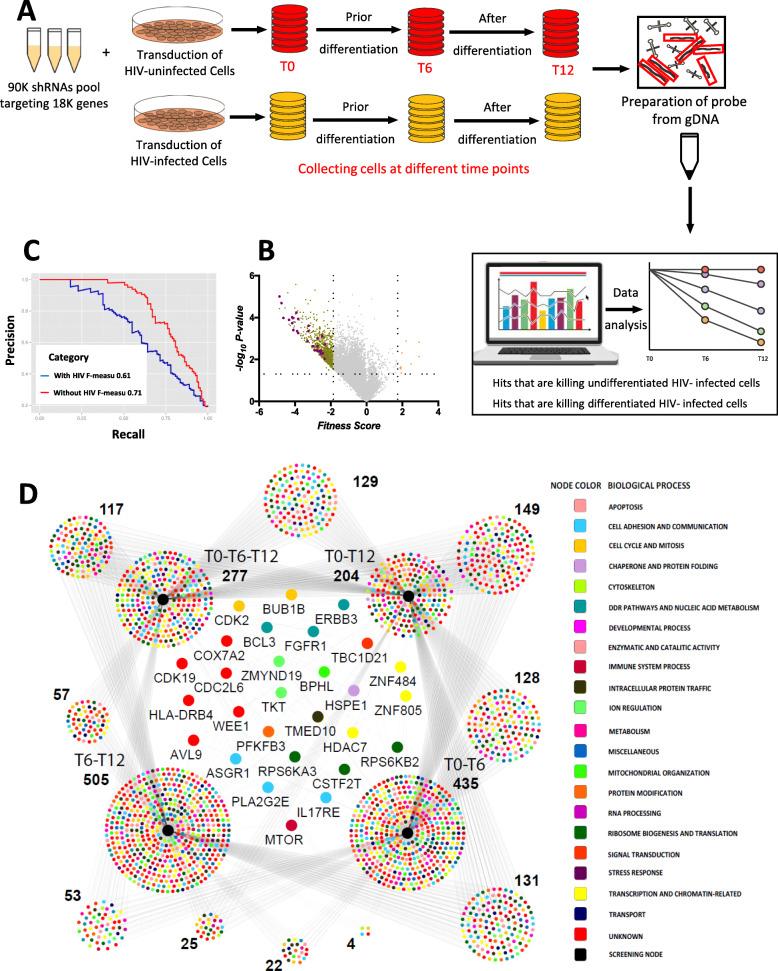
We applied a pooled shRNA-based genome-wide approach by employing a lentivirus-based library of shRNAs to screen novel gene targets whose inhibition should selectively induce apoptosis in HIV-infected macrophages. Primary human MDMs were infected with HIV-eGFP and HIV-HSA viruses. Infected MDMs were transfected with siRNAs specific for the promising genes followed by analysis of apoptosis by flow cytometry using labelled Annexin-V in HIV-infected, HIV-exposed but uninfected bystander MDMs and uninfected MDMs. The results were analyzed using student's t-test from at least four independent experiments.
RESULTS
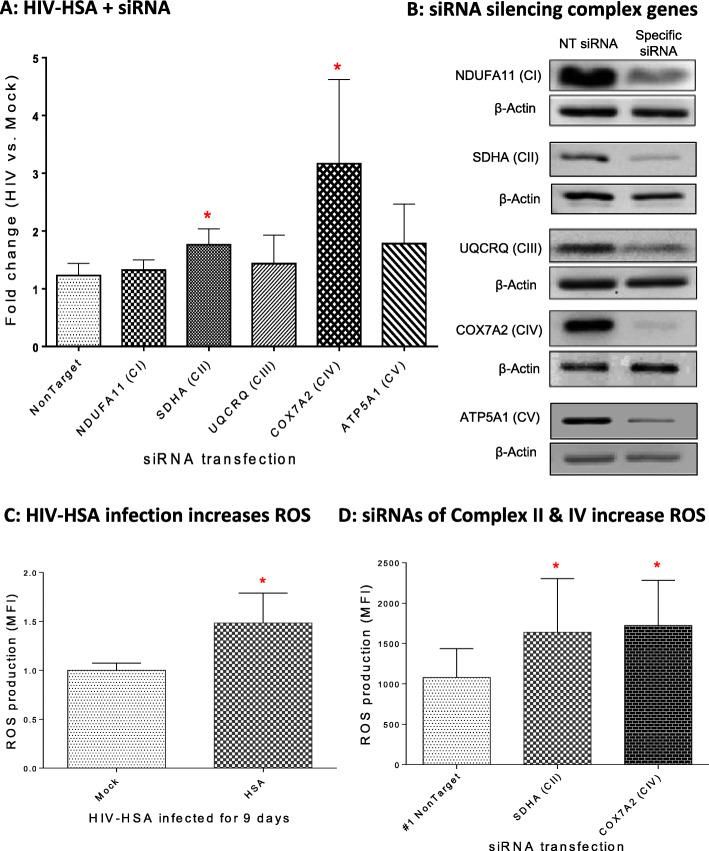
We validated 28 top hits in two independent HIV infection models. This culminated in the identification of four target genes, Cox7a2, Znf484, Cstf2t, and Cdk2, whose loss-of-function induced apoptosis preferentially in HIV-infected macrophages. Silencing these single genes killed significantly higher number of HIV-HSA-infected MDMs compared to the HIV-HSA-exposed, uninfected bystander macrophages, indicating the specificity in the killing of HIV-infected macrophages. The mechanism governing Cox7a2-mediated apoptosis of HIV-infected macrophages revealed that targeting respiratory chain complex II and IV genes also selectively induced apoptosis of HIV-infected macrophages possibly through enhanced ROS production.
CONCLUSIONS
We have identified above-mentioned novel genes and specifically the respiratory chain complex II and IV genes whose silencing may cause selective elimination of HIV-infected macrophages and eventually the HIV-macrophage reservoirs. The results highlight the potential of the identified genes as targets for eliminating HIV-infected macrophages in physiological environment as part of an HIV cure strategy.
背景
除了潜伏感染的 CD4+T 细胞外,巨噬细胞构成了主要的稳定的、非 T 细胞 HIV 储存库。因此,为了在患者体内完全清除 HIV,必须消除潜伏感染的 CD4+T 细胞和组织巨噬细胞。到目前为止,大多数研究都集中在消除潜伏感染的 CD4+T 细胞上。然而,很少有方法用于体外或体内杀死感染 HIV 的巨噬细胞。HIV 感染会失调感染细胞存活所必需的许多宿主基因的表达。我们推测,利用这种改变可能会为选择性杀伤感染巨噬细胞提供新的靶点。
方法
我们通过使用基于慢病毒的 shRNA 文库,应用基于 pooled shRNA 的全基因组方法,筛选出抑制这些基因表达应能选择性诱导 HIV 感染的巨噬细胞凋亡的新基因靶点。原代人巨噬细胞(MDM)被 HIV-eGFP 和 HIV-HSA 病毒感染。用针对有前途基因的 siRNA 转染感染的 MDM,然后通过流式细胞术分析 HIV 感染、HIV 暴露但未被感染的旁观者 MDM 和未感染的 MDM 中用标记的 Annexin-V 进行的凋亡。使用来自至少四个独立实验的学生 t 检验分析结果。
结果
我们在两个独立的 HIV 感染模型中验证了 28 个 top hits。这最终确定了 Cox7a2、Znf484、Cstf2t 和 Cdk2 四个靶基因,其功能丧失可优先诱导 HIV 感染的巨噬细胞凋亡。沉默这些单个基因可显著杀死更多的 HIV-HSA 感染的 MDM,与 HIV-HSA 暴露但未感染的旁观者 MDM 相比,表明在杀伤 HIV 感染的巨噬细胞方面具有特异性。调控 Cox7a2 介导的 HIV 感染的巨噬细胞凋亡的机制表明,靶向呼吸链复合物 II 和 IV 基因也可选择性诱导 HIV 感染的巨噬细胞凋亡,可能是通过增强 ROS 产生。
结论
我们已经确定了上述新基因,特别是呼吸链复合物 II 和 IV 基因,其沉默可能导致 HIV 感染的巨噬细胞选择性消除,最终消除 HIV-巨噬细胞储库。这些结果突出了这些已识别基因作为在生理环境中消除 HIV 感染的巨噬细胞的靶点的潜力,作为 HIV 治愈策略的一部分。




 Zotero 插件