
利用 HLA Ⅱ类限制性 TCR 靶向 KRAS 突变治疗实体瘤。
Targeting KRAS mutations with HLA class II-restricted TCRs for the treatment of solid tumors.
机构信息
Translational Research Unit, Department of Cellular Therapy, Oslo University Hospital, Oslo, Norway.
Department of Cancer Immunology, Institute for Cancer Research, Oslo University Hospital, Oslo, Norway.
出版信息
Oncoimmunology. 2021 Jun 17;10(1):1936757. doi: 10.1080/2162402X.2021.1936757. eCollection 2021.
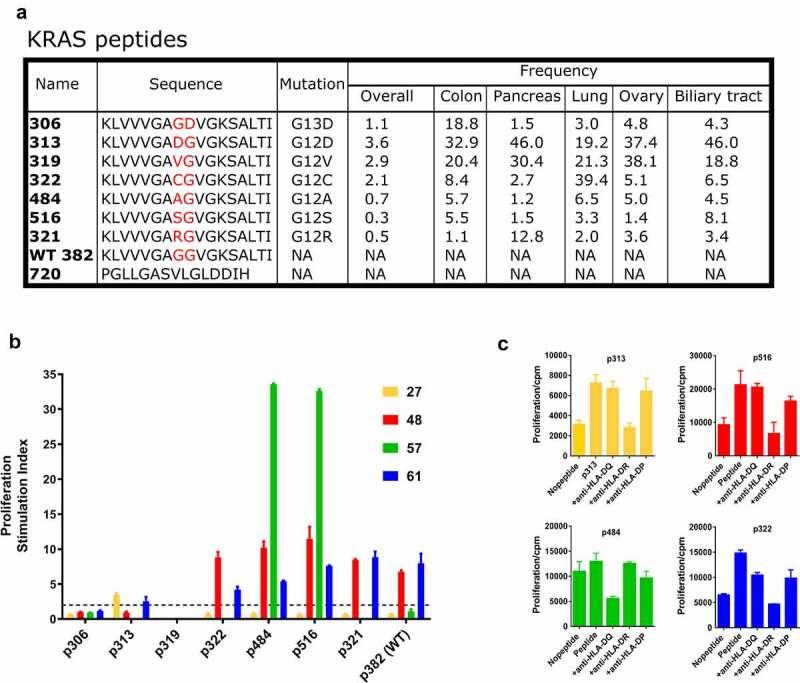
T-cell receptor (TCR) redirected T cells are considered as the next generation of care for the treatment of numerous solid tumors. KRAS mutations are driver neoantigens that are expressed in over 25% of all cancers and are thus regarded as ideal targets for Adoptive Cell Therapy (ACT). We have isolated four KRAS-specific TCRs from a long-term surviving pancreatic cancer patient vaccinated with a mix of mutated KRAS peptides. The sequence of these TCRs could be identified and expressed in primary cells. We demonstrated stable expression of all TCRs as well as target-specific functionality when expressing T cells were co-incubated with target cells presenting KRAS peptides. In addition, these TCRs were all partially co-receptor independent since they were functional in both CD4 and CD8 T cells, thus indicating high affinity. Interestingly, we observed that certain TCRs were able to recognize several KRAS mutations in complex with their cognate Human leukocyte antigen (HLA), suggesting that, here, the point mutations were less important for the HLA binding and TCR recognition, whereas others were single-mutation restricted. Finally, we demonstrated that these peptides were indeed processed and presented, since HLA-matched antigen presenting cells exogenously loaded with KRAS proteins were recognized by TCR-transduced T cells. Taken together, our data demonstrate that KRAS mutations are immunogenic for CD4 T cells and are interesting targets for TCR-based cancer immunotherapy.
T 细胞受体 (TCR) 重定向 T 细胞被认为是下一代治疗多种实体瘤的方法。KRAS 突变是驱动新抗原,在超过 25%的所有癌症中表达,因此被认为是过继细胞治疗 (ACT) 的理想靶点。我们从一位长期存活的胰腺癌患者中分离出四种 KRAS 特异性 TCR,该患者接种了混合突变 KRAS 肽的疫苗。这些 TCR 的序列可以在原代细胞中被识别和表达。我们证明了所有 TCR 的稳定表达以及当表达 T 细胞与呈现 KRAS 肽的靶细胞共孵育时的靶特异性功能。此外,这些 TCR 都部分独立于共受体,因为它们在 CD4 和 CD8 T 细胞中都具有功能,因此表明它们具有高亲和力。有趣的是,我们观察到某些 TCR 能够识别几种与同源人类白细胞抗原 (HLA) 结合的 KRAS 突变,这表明在这里,点突变对 HLA 结合和 TCR 识别不太重要,而其他突变则受到限制。最后,我们证明这些肽确实被加工和呈递,因为用 KRAS 蛋白外源加载的 HLA 匹配抗原呈递细胞被 TCR 转导的 T 细胞识别。总之,我们的数据表明 KRAS 突变对 CD4 T 细胞具有免疫原性,是 TCR 为基础的癌症免疫治疗的有趣靶点。



 Zotero 插件