
2018-2019 年中国药品集中采购政策对深圳相关抗生素药物使用的影响:一项中断时间序列分析。
The impacts of Chinese drug volume-based procurement policy on the use of policy-related antibiotic drugs in Shenzhen, 2018-2019: an interrupted time-series analysis.
机构信息
School of Health Sciences, Wuhan University, 115# Donghu Road, 430071, Wuhan, China.
Global Health Institute, Wuhan University, 115# Donghu Road, 430071, Wuhan, China.
出版信息
BMC Health Serv Res. 2021 Jul 8;21(1):668. doi: 10.1186/s12913-021-06698-5.
BACKGROUND
In 2019, Chinese government implemented volume-based procurement of 25 drugs in 4 municipalities and 7 sub-provincial cities, i.e. "4 + 7" policy. Competitive bidding was conducted by the government based on the annual agreed procurement volume submitted by each public medical institution in pilot cities. Pilot cities were required to implement bid winning results in March 2019 and the use volume of bid winning products was examined to ensure the completion of agreed procurement volume. In the policy, an oral antibiotic (cefuroxime) was included. Given the current condition of the irrational use of antibiotics in China, this study aims to evaluate the impact of "4 + 7" policy on the use of policy-related antibiotics.
METHODS
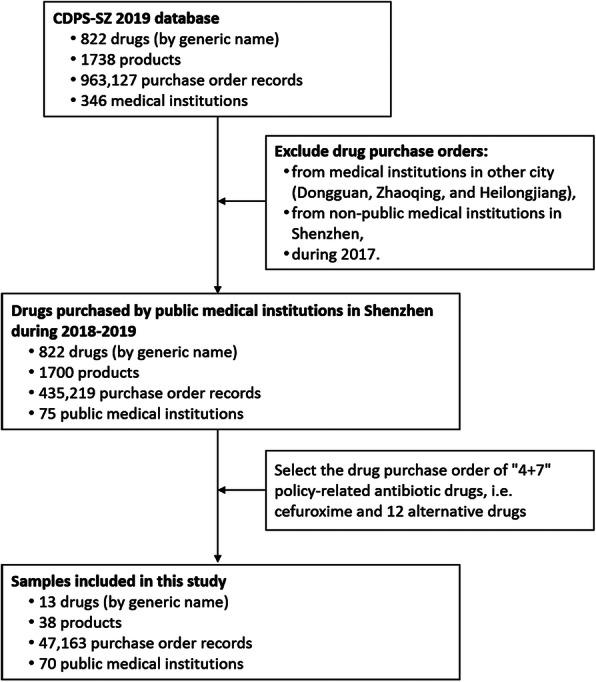
This study used drug purchase data from the Centralized Drug Procurement Survey in Shenzhen 2019, covering 24 months from January 2018 to December 2019. Oral antibiotic drugs related to "4 + 7" policy were selected as study samples, including cefuroxime and 12 antibiotic drugs that have an alternative relationship with cefuroxime in clinical use. Purchase volume and expenditures were selected as outcome variables, and were measured using Defined Daily Doses (DDDs) and Chinese yuan, respectively. Segmented linear regression analysis with interrupted time series was adopted to examine the effect of "4 + 7" policy.
RESULTS
After the implementation of "4 + 7" policy, the overall volume of cefuroxime and its alternative drugs increased from 9.47 million DDDs to 13.42 million DDDs, with an increase of 41.8 %. The results of segmented linear regression showed that the volume of cefuroxime significantly increased 161.16 thousand DDDs after "4 + 7" policy (95 % CI: 59.43 to 262.90, p-value = 0.004). The volume of alternative drugs significantly increased 273.65 thousand DDDs (95 % CI: 90.17 to 457.12, p-value = 0.006). The overall "4 + 7" policy-related antibiotics significantly increased 436.31 thousand DDDs (95 % CI: 190.81 to 681.81, p-value = 0.001) after "4 + 7" policy.
CONCLUSIONS
This study provides evidence that the implementation of "4 + 7" volume-based procurement policy was associated with significant increases in the volume of policy-related antibiotic drugs. The increase in antibiotic use after the policy needs special attention and vigilance.
背景
2019 年,中国政府在 4 个直辖市和 7 个副省级城市实施了 25 种药品的基于量的采购,即“4+7”政策。政府根据试点城市各公立医疗机构提交的年度约定采购量进行竞争性招标。试点城市要求在 2019 年 3 月实施中标结果,并检查中标产品的使用量,以确保完成约定的采购量。该政策中包含一种口服抗生素(头孢呋辛)。鉴于中国目前抗生素不合理使用的情况,本研究旨在评估“4+7”政策对相关抗生素使用的影响。
方法
本研究使用了 2019 年深圳集中药品采购调查的药品采购数据,涵盖了 2018 年 1 月至 2019 年 12 月的 24 个月。选择与“4+7”政策相关的口服抗生素药物作为研究样本,包括头孢呋辛和临床使用中与头孢呋辛有替代关系的 12 种抗生素药物。采购量和支出分别作为结果变量,分别用限定日剂量(DDD)和人民币衡量。采用分段线性回归分析中断时间序列来检验“4+7”政策的效果。
结果
“4+7”政策实施后,头孢呋辛及其替代药物的总用量从 947 万 DDD 增加到 1342 万 DDD,增加了 41.8%。分段线性回归结果显示,“4+7”政策后,头孢呋辛的用量显著增加了 161.16 千 DDD(95%CI:59.43 至 262.90,p 值=0.004)。替代药物的用量显著增加了 273.65 千 DDD(95%CI:90.17 至 457.12,p 值=0.006)。“4+7”政策后,“4+7”相关抗生素的总用量显著增加了 436.31 千 DDD(95%CI:190.81 至 681.81,p 值=0.001)。
结论
本研究提供的证据表明,实施“4+7”基于量的采购政策与相关抗生素药物用量的显著增加有关。政策实施后抗生素使用量的增加需要特别关注和警惕。


 Zotero 插件