
台湾中老年人群十大主要死因死亡前的失能轨迹。
Disability trajectories prior to death for ten leading causes of death among middle-aged and older adults in Taiwan.
作者信息
Chiu Ching-Ju, Li Meng-Ling, Chang Chia-Ming, Wu Chih-Hsing, Tan Maw Pin
机构信息
Institute of Gerontology, College of Medicine, National Cheng Kung University, No. 1 University Road, 701, Tainan, Taiwan.
Department of Medicine, College of Medicine, National Cheng Kung University, Tainan, Taiwan.
出版信息
BMC Geriatr. 2021 Jul 10;21(1):420. doi: 10.1186/s12877-021-02300-z.
BACKGROUND
Prolonged life expectancy is associated with increased prevalence of chronic diseases. The aim of this study was to determine the different disability trajectories for the top ten leading causes of death in Taiwan .
METHODS
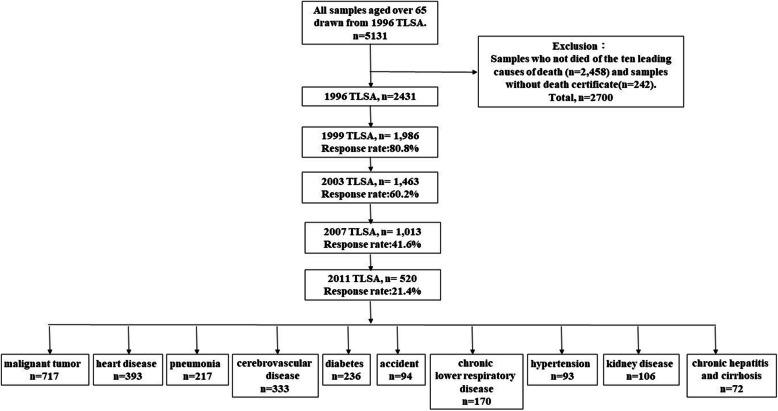
A total of 2,431 participants aged 50-96 in 1996 from the Taiwan longitudinal study on aging (TLSA) who died from 1996 to 2016 were analyzed. Integration of Cause of Death Data and TLSA helped sort out participants who had died from the ten leading causes of death. The level of physical disability was evaluated with the Activities of Daily Living Scale (ADLs), ranging from 0 to 6 points, in 1996, 1999, 2003, 2007, and 2011. A multilevel model was used to investigate the levels and rates of change in disability development before death.
RESULTS
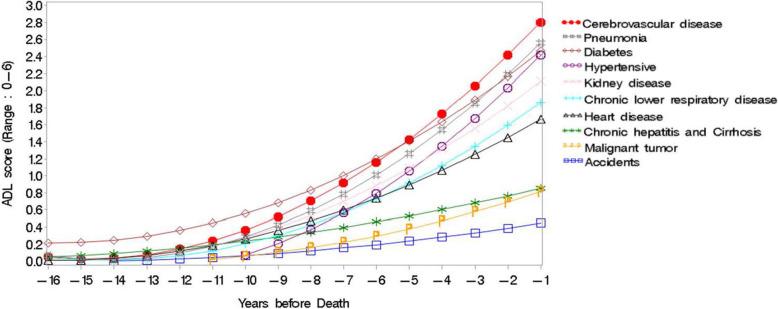
The outcome of the research showed that the earliest group to experience physical limitation was individuals living with diabetes. The groups with the highest ADL scores were participants with diabetes, cerebrovascular disease, and hypertension-related diseases. Most groups reach ADL scores ≥ 1 (mild-level) during 4-6 years before death except chronic hepatitis and cirrhosis and injury.
CONCLUSIONS
People who had died from the ten leading causes of death experienced different disability trajectories before death. The trajectory of the participants who had died from diabetes showed a unique pattern with the earliest occurrence and more severe deterioration in terms of development of disabilities. Disability trajectories provide a prediction of survival status for middle-aged and older adults associated with the ten leading causes of death.
背景
预期寿命延长与慢性病患病率增加相关。本研究的目的是确定台湾十大主要死因的不同残疾轨迹。
方法
对1996年台湾纵向衰老研究(TLSA)中年龄在50 - 96岁、于1996年至2016年期间死亡的2431名参与者进行分析。整合死亡原因数据和TLSA有助于梳理出死于十大主要死因的参与者。在1996年、1999年、2003年、2007年和2011年,使用日常生活活动量表(ADLs)评估身体残疾水平,范围为0至6分。采用多水平模型研究死亡前残疾发展的水平和变化率。
结果
研究结果表明,最早出现身体限制的群体是糖尿病患者。ADL得分最高的群体是患有糖尿病、脑血管疾病和高血压相关疾病的参与者。除慢性肝炎、肝硬化和损伤外,大多数群体在死亡前4 - 6年达到ADL得分≥1(轻度)。
结论
死于十大主要死因的人在死亡前经历了不同的残疾轨迹。死于糖尿病的参与者的轨迹呈现出独特的模式,在残疾发展方面出现最早且恶化更严重。残疾轨迹为与十大主要死因相关的中老年人的生存状况提供了预测。
 Zotero 插件