
术前全身免疫炎症指数与预后营养指数与泡型包虫病患者预后的关系。
The Relationship Between Preoperative Systemic Immune Inflammation Index and Prognostic Nutritional Index and the Prognosis of Patients With Alveolar Hydatid Disease.
机构信息
Department of Hepatopancreatobiliary Surgery, Affiliated Hospital of Qinghai University, Xining, China.
Key Laboratory of Hydatid Disease Research in Qinghai Province, Xining, China.
出版信息
Front Immunol. 2021 Jun 24;12:691364. doi: 10.3389/fimmu.2021.691364. eCollection 2021.
BACKGROUND
To explore the relationship between the preoperative immune inflammation index (SII) and the prognostic nutritional index (PNI) and the overall survival rate (OS) of patients with alveolar hydatid disease.
METHODS
The clinical data of patients with hepatic alveolar echinococcosis treated by surgery in the Department of Hepatobiliary and Pancreatic Surgery, Affiliated Hospital of Qinghai University from January 2015 to January 2019 were analyzed retrospectively, and the SII, PNI, PLR and NLR were calculated. Spearman correlation analysis was utilized to analyze the correlation among SII, PNI, PLR and NLR. Receiver operating characteristic curve (ROC) was utilized to determine the best intercept values of SII, PNI, PLR and NLR, and Chi-square test was used to evaluate the relationship between SII, PNI and various clinicopathological features in patients with hepatic alveolar echinococcosis. The kaplan-Meier method was used to draw survival curves and analyze the relationship between them and the total survival time of patients. A cox regression model was used to analyze the relationship between SII, PNI and the prognosis of patients with hepatic alveolar echinococcosis. Finally, ROC curve was used to estimate the predictive efficacy of SII, PNI and COSII-PNI for the prognosis of patients with hepatic alveolar echinococcosis.
RESULTS
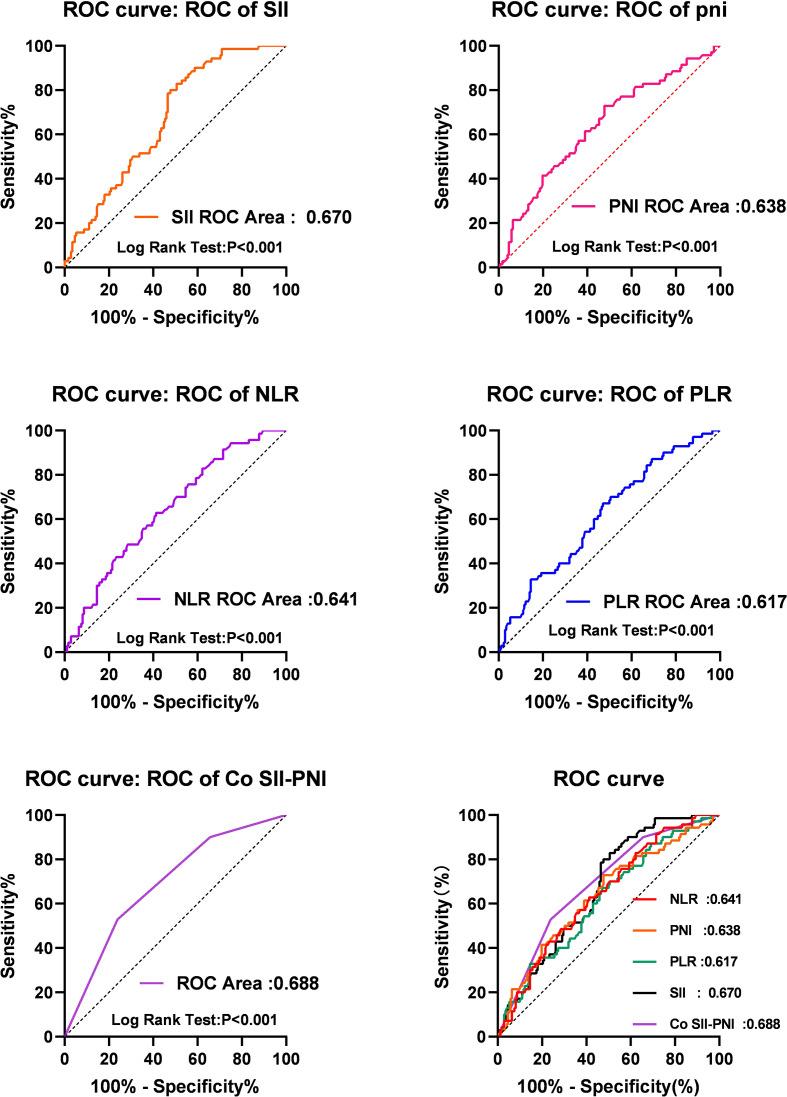
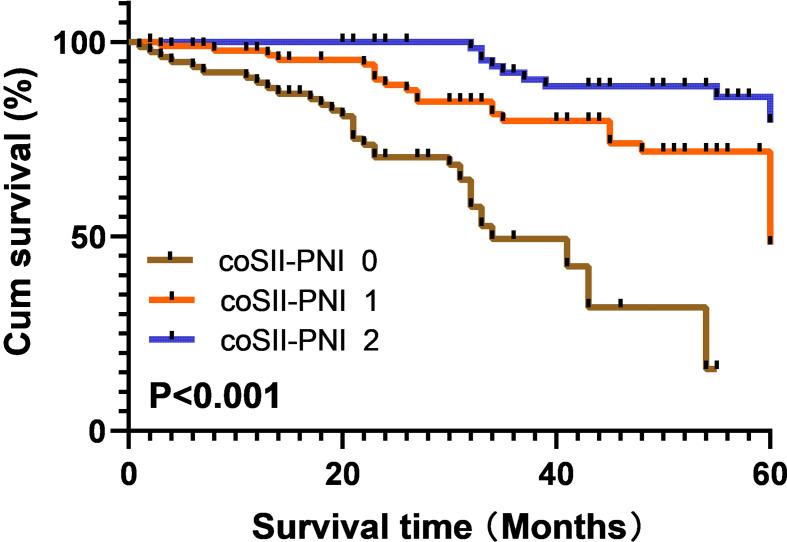
A total of 242 patients were included, including 96 males and 146 females, aged 11.0-67.0 (36.6 ± 11.7) years. The values of SII, PNI, PLR and NLR are calculated, and the best truncation values of SII, PNI, PLR and NLR are given in ROC curve. The kaplan-Meier survival curve was used to analyze the relationship between SII, PNI, PLR, NLR and the overall survival time of patients with hepatic alveolar echinococcosis. The results showed that the median follow-up time was 45 months (95%CI: 39.484-50.516), and the average survival time was 49 months (95%CI: 47.300-51.931), which was low p<0.001); The 5-year OS rate of low PNI was significantly lower than that of high PNI group (37.7% 71.6%; p<0.001); The 5-year OS rate in low PLR group was significantly higher than that in high PLR group (70.4% 24.3%; p<0.001); The 5-year OS rate in low NLR group was significantly higher than that in high NLR group (67.2% 28.8%; p<0.001). Cox unifoliate analysis showed that SII, PNI, PLR and NLR were important prognostic factors related to OS. Cox multivariate analysis showed that SII(HR=4.678, 95% CI: 2.581-8.480, P<0.001) and PNI(HR=0.530, 95%CI: 0.305-0.920, P<0.05) were identified as independent risk indicators of OS, while NL was identified as independent risk indicators of OS ROC curve analysis showed that AUC of SII, PNI, PLR, NLR and COSII-PNI were 0.670(95%CI: 0.601-0.738), 0.638(95%CI: 0.561-0.716) and 0.618(95% CI: 0.541-0.694), respectively COSII-PNI is superior to SII and PNI in evaluating prognosis (P < 0.05).
CONCLUSIONS
SII and PNI can be regarded as independent risk factors reflecting the prognosis of patients with hepatic alveolar echinococcosis. The lower SII and the higher PNI before operation, the better the prognosis of patients, and the combined application of SII and PNI before operation can improve the accuracy of prediction.
背景
探讨术前免疫炎症指数(SII)和预后营养指数(PNI)与泡型包虫病患者总生存率(OS)的关系。
方法
回顾性分析 2015 年 1 月至 2019 年 1 月青海大学附属医院肝胆胰外科手术治疗的肝泡型包虫病患者的临床资料,计算 SII、PNI、PLR 和 NLR。采用 Spearman 相关分析 SII、PNI、PLR 和 NLR 之间的相关性。利用受试者工作特征曲线(ROC)确定 SII、PNI、PLR 和 NLR 的最佳截断值,采用卡方检验评估肝泡型包虫病患者 SII、PNI 与各临床病理特征的关系。Kaplan-Meier 法绘制生存曲线,分析其与患者总生存时间的关系。Cox 回归模型分析 SII、PNI 与肝泡型包虫病患者预后的关系。最后,ROC 曲线评估 SII、PNI 和 COSII-PNI 对肝泡型包虫病患者预后的预测效能。
结果
共纳入 242 例患者,其中男 96 例,女 146 例,年龄 11.0-67.0(36.6±11.7)岁。计算 SII、PNI、PLR 和 NLR 值,ROC 曲线给出 SII、PNI、PLR 和 NLR 的最佳截断值。Kaplan-Meier 生存曲线分析 SII、PNI、PLR、NLR 与肝泡型包虫病患者总生存时间的关系。结果显示,中位随访时间为 45 个月(95%CI:39.484-50.516),平均生存时间为 49 个月(95%CI:47.300-51.931),差异有统计学意义(P<0.001);低 PNI 组的 5 年 OS 率明显低于高 PNI 组(37.7% vs. 71.6%;P<0.001);低 PLR 组的 5 年 OS 率明显高于高 PLR 组(70.4% vs. 24.3%;P<0.001);低 NLR 组的 5 年 OS 率明显高于高 NLR 组(67.2% vs. 28.8%;P<0.001)。Cox 单因素分析显示,SII、PNI、PLR 和 NLR 是影响 OS 的重要预后因素。Cox 多因素分析显示,SII(HR=4.678,95%CI:2.581-8.480,P<0.001)和 PNI(HR=0.530,95%CI:0.305-0.920,P<0.05)是 OS 的独立危险因素,而 NLR 是 OS 的独立危险因素 ROC 曲线分析显示,SII、PNI、PLR、NLR 和 COSII-PNI 的 AUC 分别为 0.670(95%CI:0.601-0.738)、0.638(95%CI:0.561-0.716)和 0.618(95%CI:0.541-0.694),COSI-PNI 评估预后优于 SII 和 PNI(P<0.05)。
结论
SII 和 PNI 可作为反映肝泡型包虫病患者预后的独立危险因素。术前 SII 越低,PNI 越高,患者预后越好,术前联合应用 SII 和 PNI 可提高预测准确性。

 Zotero 插件