
复发性卵巢癌二次细胞减灭术加化疗的生存结局和并发症:系统评价和荟萃分析。
The survival outcome and complication of secondary cytoreductive surgery plus chemotherapy in recurrent ovarian cancer: a systematic review and meta-analysis.
机构信息
Department of Obstetrics and Gynecology, West China Second Hospital, Key Laboratory of Birth Defects and Related Diseases of Women and Children, Sichuan University, Ministry of Education, Number 20, 3rd Section, South Renmin Road, Chengdu, 610041, Sichuan Province, China.
Department of Obstetrics and Gynecology, West China Second University Hospital, Key Laboratory of Birth Defects and Related Diseases of Women and Children, Sichuan University, Ministry of Education, Number 20, 3rd Section, South Renmin Road, Chengdu, 610041, Sichuan Province, China.
出版信息
J Ovarian Res. 2021 Jul 13;14(1):93. doi: 10.1186/s13048-021-00842-9.
OBJECTIVE
The aim of this meta-analysis was to assess the effectiveness and safety of secondary cytoreductive surgery plus chemotherapy (SCS + CT) in recurrent ovarian cancer (ROC). Our secondary purpose was to analyze whether patients could benefit from complete resection.
METHODS
We searched EMBASE, MEDLINE, the Cochrane Database of Systematic Reviews and Cochrane Central Register of Controlled Trials, from inception to April 2021. We used appropriate scales to assess the risk of bias. Data from included studies that reported median PFS or OS were weighted by individual study sample size, and aggregated for meta-analysis. We calculated the pooled proportion of complications within 30 days after surgery.
RESULTS
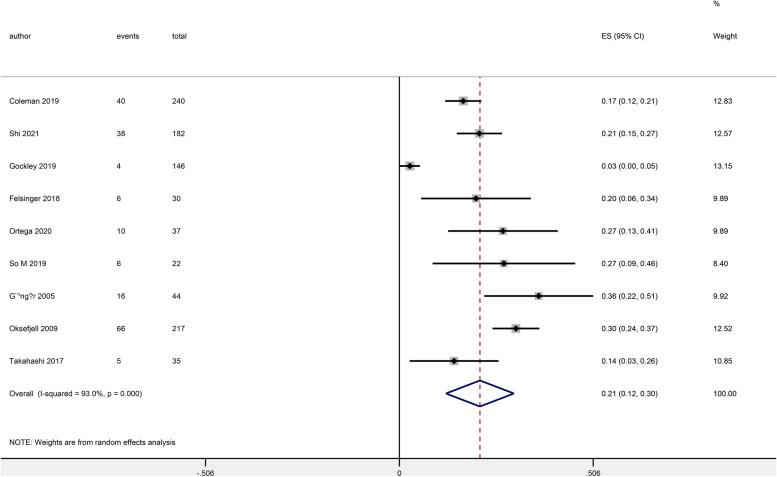
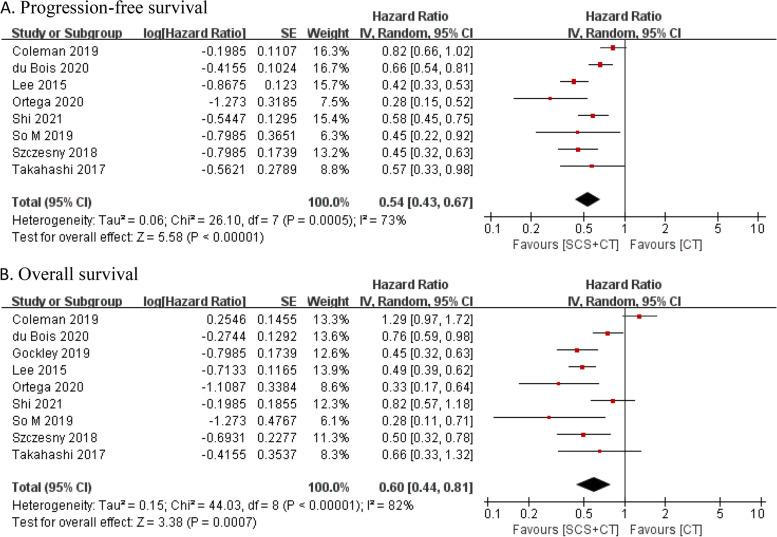
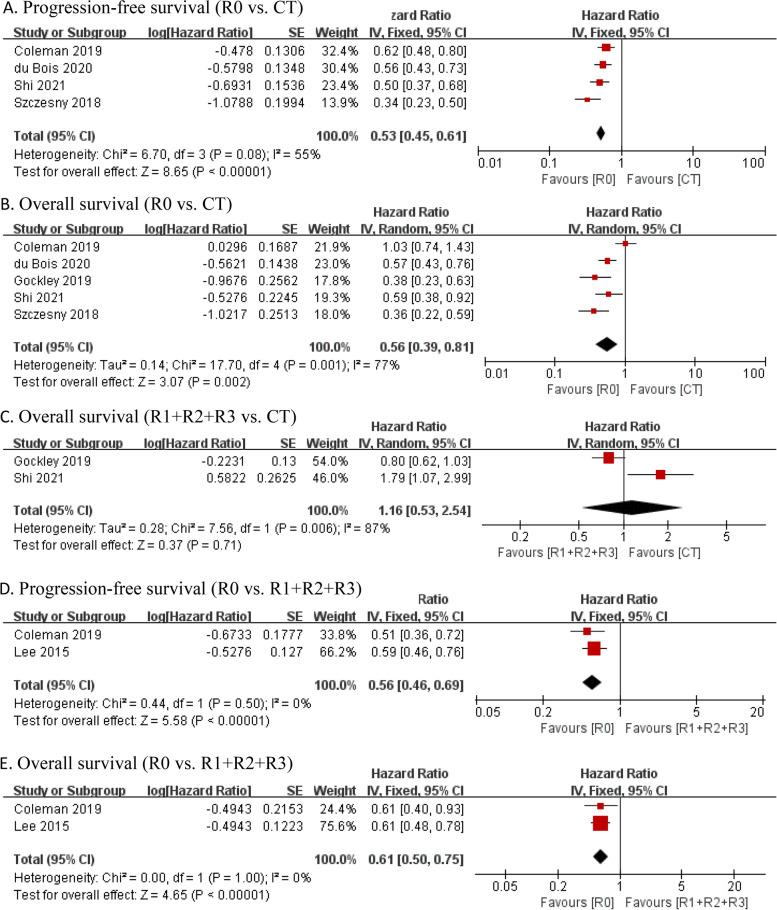
We identified 13 articles, including three RCTs and ten retrospective cohort studies. A total of 4572 patients were included, of which 916 patients achieved complete resection, and all patients were comparable at baseline. Compared with chemotherapy alone, SCS + CT significantly improved the PFS (HR = 0.54, 95% CI: 0.43-0.67) and OS (HR = 0.60, 95% CI: 0.44-0.81). Contrary to the results of cohort studies, the meta-analysis of RCTs showed that SCS + CT could not bring OS benefits (HR = 0.93, 95% CI: 0.66-1.3). The subgroup analysis showed the prognostic importance of complete resection. Compared with chemotherapy alone, complete resection was associated with longer PFS (HR = 0.53, 95% CI: 0.45-0.61) and OS (HR = 0.56, 95% CI: 0.39-0.81), while incomplete resection had no survival benefit. Additionally, complete resection could maximize survival benefit compared with incomplete resection (HR = 0.56, 95% CI: 0.46-0.69; HR = 0.61, 95% CI: 0.50-0.75). The pooled proportion for complications at 30 days was 21% (95% CI: 0.12-0.30), and there was no statistical difference in chemotherapy toxicity between the two groups.
CONCLUSION
The review indicated that SCS + CT based regimens was correlated with better clinical prognosis for patients with recurrent ovarian cancer, but the interpretation of OS should be cautious. The meta-analysis emphasizes the importance of complete resection, suggesting that the potential benefits of prolonging survival may outweigh the disadvantages of any short-term complications associated with surgery.
目的
本荟萃分析旨在评估复发性卵巢癌(ROC)患者接受二次细胞减灭术加化疗(SCS+CT)的疗效和安全性。我们的次要目的是分析患者是否可以从完全切除中获益。
方法
我们检索了 EMBASE、MEDLINE、Cochrane 系统评价数据库和 Cochrane 对照试验中心注册库,检索时间从建库至 2021 年 4 月。我们使用适当的量表评估偏倚风险。对纳入的报告中位无进展生存期(PFS)或总生存期(OS)的研究数据,根据个体研究样本量进行加权,并进行荟萃分析。我们计算了术后 30 天内并发症的汇总比例。
结果
我们共纳入了 13 篇文章,其中包括 3 项 RCT 和 10 项回顾性队列研究。共纳入 4572 例患者,其中 916 例患者达到完全切除,所有患者在基线时均具有可比性。与单纯化疗相比,SCS+CT 显著改善了 PFS(HR=0.54,95%CI:0.43-0.67)和 OS(HR=0.60,95%CI:0.44-0.81)。与队列研究的结果相反,RCT 的荟萃分析显示 SCS+CT 并不能带来 OS 获益(HR=0.93,95%CI:0.66-1.3)。亚组分析表明了完全切除的预后重要性。与单纯化疗相比,完全切除与更长的 PFS(HR=0.53,95%CI:0.45-0.61)和 OS(HR=0.56,95%CI:0.39-0.81)相关,而不完全切除则没有生存获益。此外,与不完全切除相比,完全切除可以使生存获益最大化(HR=0.56,95%CI:0.46-0.69;HR=0.61,95%CI:0.50-0.75)。术后 30 天并发症的汇总比例为 21%(95%CI:0.12-0.30),两组间化疗毒性无统计学差异。
结论
本综述表明,SCS+CT 方案与复发性卵巢癌患者的临床预后改善相关,但 OS 的解释应谨慎。荟萃分析强调了完全切除的重要性,表明延长生存的潜在获益可能超过手术相关短期并发症的风险。

 Zotero 插件