
通过移动设备发送出生和死亡通知:一项混合方法系统评价。
Birth and death notification via mobile devices: a mixed methods systematic review.
机构信息
Center for Health Policy and Inequalities Research, Duke Global Health Institute, Durham, North Carolina, USA.
Department of Family Medicine and Community Health, Duke University, Durham, North Carolina, USA.
出版信息
Cochrane Database Syst Rev. 2021 Jul 16;7(7):CD012909. doi: 10.1002/14651858.CD012909.pub2.
BACKGROUND
Ministries of health, donors, and other decision-makers are exploring how they can use mobile technologies to acquire accurate and timely statistics on births and deaths. These stakeholders have called for evidence-based guidance on this topic. This review was carried out to support World Health Organization (WHO) recommendations on digital interventions for health system strengthening.
OBJECTIVES
Primary objective: To assess the effects of birth notification and death notification via a mobile device, compared to standard practice. Secondary objectives: To describe the range of strategies used to implement birth and death notification via mobile devices and identify factors influencing the implementation of birth and death notification via mobile devices.
SEARCH METHODS
We searched CENTRAL, MEDLINE, Embase, the Global Health Library, and POPLINE (August 2, 2019). We searched two trial registries (August 2, 2019). We also searched Epistemonikos for related systematic reviews and potentially eligible primary studies (August 27, 2019). We conducted a grey literature search using mHealthevidence.org (August 15, 2017) and issued a call for papers through popular digital health communities of practice. Finally, we conducted citation searches of included studies in Web of Science and Google Scholar (May 15, 2020). We searched for studies published after 2000 in any language. SELECTION CRITERIA: For the primary objective, we included individual and cluster-randomised trials; cross-over and stepped-wedge study designs; controlled before-after studies, provided they have at least two intervention sites and two control sites; and interrupted time series studies. For the secondary objectives, we included any study design, either quantitative, qualitative, or descriptive, that aimed to describe current strategies for birth and death notification via mobile devices; or to explore factors that influence the implementation of these strategies, including studies of acceptability or feasibility. For the primary objective, we included studies that compared birth and death notification via mobile devices with standard practice. For the secondary objectives, we included studies of birth and death notification via mobile device as long as we could extract data relevant to our secondary objectives. We included studies of all cadres of healthcare providers, including lay health workers; administrative, managerial, and supervisory staff; focal individuals at the village or community level; children whose births were being notified and their parents/caregivers; and individuals whose deaths were being notified and their relatives/caregivers.
DATA COLLECTION AND ANALYSIS
For the primary objective, two authors independently screened all records, extracted data from the included studies and assessed risk of bias. For the analyses of the primary objective, we reported means and proportions, where appropriate. We used the Grading of Recommendations Assessment, Development and Evaluation (GRADE) approach to assess the certainty of the evidence and we prepared a 'Summary of Findings' table. For the secondary objectives, two authors screened all records, one author extracted data from the included studies and assessed methodological limitations using the WEIRD tool and a second author checked the data and assessments. We carried out a framework analysis using the Supporting the Use of Research Evidence (SURE) framework to identify themes in the data. We used the GRADE-CERQual (Confidence in the Evidence from Reviews of Qualitative research) approach to assess our confidence in the evidence and we prepared a 'Summary of Qualitative Findings' table.
MAIN RESULTS
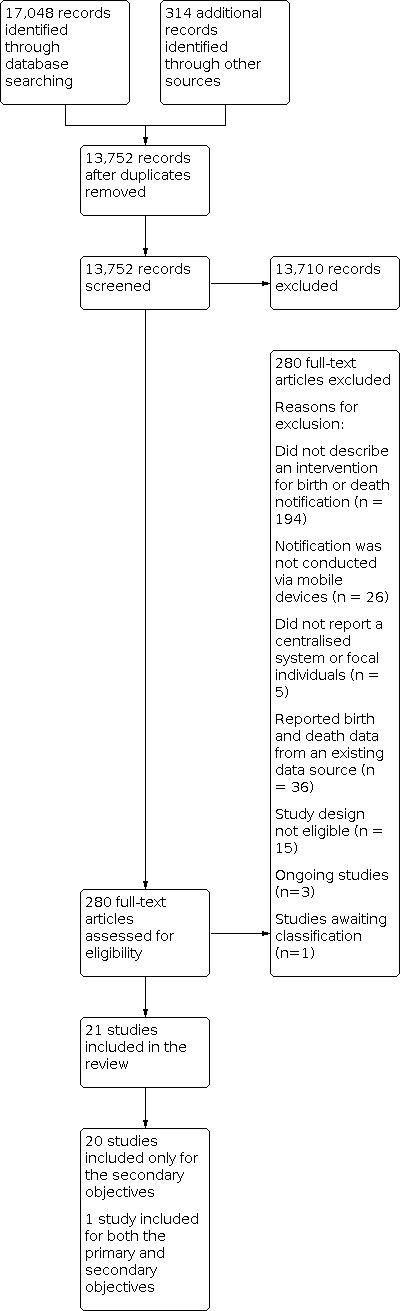
For the primary objective, we included one study, which used a controlled before-after study design. The study was conducted in Lao People's Democratic Republic and assessed the effect of using mobile devices for birth notification on outcomes related to coverage and timeliness of Hepatitis B vaccination. However, we are uncertain of the effect of this approach on these outcomes because the certainty of this evidence was assessed as very low. The included study did not assess resource use or unintended consequences. For the primary objective, we did not identify any studies using mobile devices for death notification. For the secondary objective, we included 21 studies. All studies were conducted in low- or middle-income settings. They focussed on identification of births and deaths in rural, remote, or marginalised populations who are typically under-represented in civil registration processes or traditionally seen as having poor access to health services. The review identified several factors that could influence the implementation of birth-death notification via mobile device. These factors were tied to the health system, the person responsible for notifying, the community and families; and include: - Geographic barriers that could prevent people's access to birth-death notification and post-notification services - Access to health workers and other notifiers with enough training, supervision, support, and incentives - Monitoring systems that ensure the quality and timeliness of the birth and death data - Legal frameworks that allow births and deaths to be notified by mobile device and by different types of notifiers - Community awareness of the need to register births and deaths - Socio-cultural norms around birth and death - Government commitment - Cost to the system, to health workers and to families - Access to electricity and network connectivity, and compatibility with existing systems - Systems that protect data confidentiality We have low to moderate confidence in these findings. This was mainly because of concerns about methodological limitations and data adequacy.
AUTHORS' CONCLUSIONS: We need more, well-designed studies of the effect of birth and death notification via mobile devices and on factors that may influence its implementation.
背景
各国卫生部、捐助者和其他决策者正在探索如何利用移动技术获取关于出生和死亡的准确、及时的统计数据。这些利益相关者呼吁提供有关这一主题的循证指导。本综述是为了支持世界卫生组织(世卫组织)关于数字干预措施以加强卫生系统的建议而进行的。
目的
主要目标:评估通过移动设备进行出生和死亡通知与标准做法相比的效果。次要目标:描述通过移动设备实施出生和死亡通知的各种策略,并确定影响通过移动设备实施出生和死亡通知的因素。
检索方法
我们检索了 CENTRAL、MEDLINE、Embase、全球卫生图书馆和 POPLINE(2019 年 8 月 2 日)。我们检索了两个试验注册库(2019 年 8 月 2 日)。我们还通过流行的数字健康社区实践,在 Epistemonikos 中检索了相关的系统评价和潜在的合格的原始研究(2019 年 8 月 27 日)。我们使用 mHealthevidence.org 进行了灰色文献检索(2017 年 8 月 15 日),并通过热门数字健康社区发布了征集论文的通知。最后,我们在 Web of Science 和 Google Scholar 中对纳入研究进行了引文搜索(2020 年 5 月 15 日)。我们搜索了 2000 年后以任何语言发表的研究。
选择标准
对于主要目标,我们纳入了个体和群组随机试验;交叉和逐步楔形研究设计;有至少两个干预地点和两个对照地点的对照前-后研究;以及中断时间序列研究。对于次要目标,我们纳入了任何研究设计,包括定量、定性或描述性研究,旨在描述通过移动设备进行出生和死亡通知的当前策略;或探索影响这些策略实施的因素,包括可接受性或可行性研究。对于主要目标,我们纳入了将通过移动设备进行出生和死亡通知与标准做法进行比较的研究。对于次要目标,只要我们能够提取与我们的次要目标相关的数据,我们就纳入了通过移动设备进行出生和死亡通知的研究。我们纳入了各级医疗保健提供者的研究,包括初级卫生保健工作者;行政、管理和监督人员;村级或社区一级的重点人员;正在通知出生的儿童及其父母/照顾者;以及正在通知死亡的个人及其亲属/照顾者。
数据收集和分析
对于主要目标,两位作者独立筛选所有记录,从纳入的研究中提取数据,并评估偏倚风险。对于主要目标的分析,我们报告了适当的均值和比例。我们使用推荐评估、制定和评估(GRADE)方法来评估证据的确定性,并编写了“证据概要”表。对于次要目标,两位作者筛选了所有记录,一位作者从纳入的研究中提取数据,并使用 WEIRD 工具评估方法学局限性,第二位作者检查数据和评估。我们使用支持研究证据使用(SURE)框架进行框架分析,以确定数据中的主题。我们使用 GRADE-CERQual(对定性研究证据的信心评估)方法评估我们对证据的信心,并编写了“定性研究结果概要”表。
主要结果
对于主要目标,我们纳入了一项研究,该研究采用了对照前-后研究设计。该研究在老挝人民民主共和国进行,评估了使用移动设备进行出生通知对乙型肝炎疫苗接种覆盖率和及时性相关结果的影响。然而,由于证据的确定性被评估为非常低,我们不确定这种方法对这些结果的影响。纳入的研究没有评估资源利用或意外后果。对于主要目标,我们没有发现任何使用移动设备进行死亡通知的研究。对于次要目标,我们纳入了 21 项研究。所有研究均在中低收入国家进行。它们侧重于识别农村、偏远或边缘化人群中的出生和死亡情况,这些人群通常在民事登记过程中代表性不足,或传统上被认为获得卫生服务的机会较少。该综述确定了可能影响通过移动设备进行出生-死亡通知实施的几个因素。这些因素与卫生系统、负责通知的人员、社区和家庭有关,包括:- 地理障碍可能阻止人们获得出生-死亡通知和通知后的服务- 获得足够培训、监督、支持和激励的卫生工作者和其他通知者- 监测系统确保出生和死亡数据的质量和及时性- 允许通过移动设备和不同类型的通知者通知出生和死亡的法律框架- 社区对登记出生和死亡的认识- 出生和死亡的社会文化规范- 政府承诺- 对系统、卫生工作者和家庭的成本- 对电力和网络连接的访问以及与现有系统的兼容性- 保护数据保密性的系统我们对这些发现的信心程度较低至中等。这主要是由于对方法学局限性和数据充分性的担忧。
作者结论
我们需要更多设计良好的关于通过移动设备进行出生和死亡通知及其对可能影响其实施的因素的效果的研究。

 Zotero 插件