
测量 1980 年至 2019 年期间 204 个国家和地区的常规儿童疫苗接种覆盖率:2020 年全球疾病负担研究系统分析,第 1 版
Measuring routine childhood vaccination coverage in 204 countries and territories, 1980-2019: a systematic analysis for the Global Burden of Disease Study 2020, Release 1.
出版信息
Lancet. 2021 Aug 7;398(10299):503-521. doi: 10.1016/S0140-6736(21)00984-3. Epub 2021 Jul 21.
BACKGROUND
Measuring routine childhood vaccination is crucial to inform global vaccine policies and programme implementation, and to track progress towards targets set by the Global Vaccine Action Plan (GVAP) and Immunization Agenda 2030. Robust estimates of routine vaccine coverage are needed to identify past successes and persistent vulnerabilities. Drawing from the Global Burden of Diseases, Injuries, and Risk Factors Study (GBD) 2020, Release 1, we did a systematic analysis of global, regional, and national vaccine coverage trends using a statistical framework, by vaccine and over time.
METHODS
For this analysis we collated 55 326 country-specific, cohort-specific, year-specific, vaccine-specific, and dose-specific observations of routine childhood vaccination coverage between 1980 and 2019. Using spatiotemporal Gaussian process regression, we produced location-specific and year-specific estimates of 11 routine childhood vaccine coverage indicators for 204 countries and territories from 1980 to 2019, adjusting for biases in country-reported data and reflecting reported stockouts and supply disruptions. We analysed global and regional trends in coverage and numbers of zero-dose children (defined as those who never received a diphtheria-tetanus-pertussis [DTP] vaccine dose), progress towards GVAP targets, and the relationship between vaccine coverage and sociodemographic development.
FINDINGS
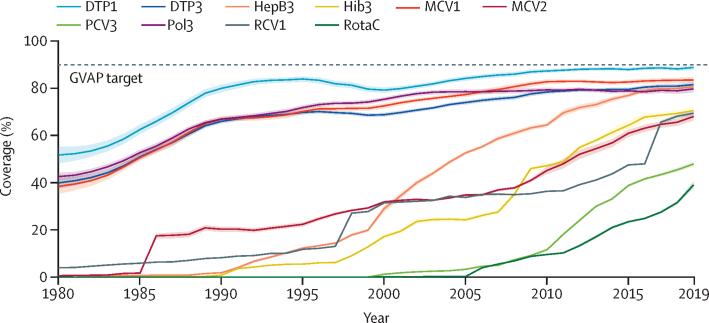
By 2019, global coverage of third-dose DTP (DTP3; 81·6% [95% uncertainty interval 80·4-82·7]) more than doubled from levels estimated in 1980 (39·9% [37·5-42·1]), as did global coverage of the first-dose measles-containing vaccine (MCV1; from 38·5% [35·4-41·3] in 1980 to 83·6% [82·3-84·8] in 2019). Third-dose polio vaccine (Pol3) coverage also increased, from 42·6% (41·4-44·1) in 1980 to 79·8% (78·4-81·1) in 2019, and global coverage of newer vaccines increased rapidly between 2000 and 2019. The global number of zero-dose children fell by nearly 75% between 1980 and 2019, from 56·8 million (52·6-60·9) to 14·5 million (13·4-15·9). However, over the past decade, global vaccine coverage broadly plateaued; 94 countries and territories recorded decreasing DTP3 coverage since 2010. Only 11 countries and territories were estimated to have reached the national GVAP target of at least 90% coverage for all assessed vaccines in 2019.
INTERPRETATION
After achieving large gains in childhood vaccine coverage worldwide, in much of the world this progress was stalled or reversed from 2010 to 2019. These findings underscore the importance of revisiting routine immunisation strategies and programmatic approaches, recentring service delivery around equity and underserved populations. Strengthening vaccine data and monitoring systems is crucial to these pursuits, now and through to 2030, to ensure that all children have access to, and can benefit from, lifesaving vaccines.
FUNDING
Bill & Melinda Gates Foundation.
背景
衡量常规儿童疫苗接种情况对于了解全球疫苗政策和计划实施至关重要,并且对于跟踪全球疫苗行动计划(GVAP)和 2030 年免疫议程设定的目标的进展情况也很重要。为了确定过去的成功和持续存在的脆弱性,需要有可靠的常规疫苗接种覆盖率估计数据。我们利用全球疾病、伤害和危险因素研究(GBD)2020 年第 1 版的数据,通过统计框架,按疫苗和时间对全球、区域和国家疫苗接种覆盖率趋势进行了系统分析。
方法
在这项分析中,我们收集了 1980 年至 2019 年期间 55326 个国家特定、队列特定、年份特定、疫苗特定和剂量特定的常规儿童疫苗接种覆盖率的观察数据。我们使用时空高斯过程回归方法,对 204 个国家和地区的 11 种常规儿童疫苗接种覆盖率指标进行了位置特定和年份特定的估计,对国家报告数据中的偏差进行了调整,并反映了报告的缺货和供应中断情况。我们分析了全球和区域范围内的覆盖率趋势和零剂量儿童人数(定义为从未接受过白喉-破伤风-百日咳[DTp]疫苗剂量的儿童)的变化,评估了在实现 GVAP 目标方面的进展情况,以及疫苗覆盖率与社会人口发展之间的关系。
结果
到 2019 年,第三剂白喉-破伤风-百日咳疫苗(DTP3)的全球覆盖率从 1980 年估计的 39.9%(37.5-42.1)增加了一倍以上,达到 81.6%(80.4-82.7);含麻疹疫苗(MCV1)的全球覆盖率也从 1980 年的 38.5%(35.4-41.3)增加到 83.6%(82.3-84.8)。第三剂脊髓灰质炎疫苗(Pol3)的覆盖率也有所增加,从 1980 年的 42.6%(41.4-44.1)增加到 2019 年的 79.8%(78.4-81.1),并且在 2000 年至 2019 年期间,新型疫苗的全球覆盖率迅速增加。1980 年至 2019 年期间,全球零剂量儿童的数量减少了近 75%,从 5680 万(5260-6090 万)减少到 1450 万(1340-1590 万)。然而,在过去十年中,全球疫苗覆盖率基本停滞不前;自 2010 年以来,有 94 个国家和地区记录到 DTP3 覆盖率下降。在 2019 年,只有 11 个国家和地区被估计达到了 GVAP 的国家目标,即所有评估疫苗的覆盖率至少达到 90%。
结论
在全球范围内儿童疫苗接种覆盖率取得了巨大进展之后,在世界大部分地区,这一进展从 2010 年开始停滞不前,甚至出现了逆转。这些发现强调了重新审视常规免疫战略和方案方法的重要性,将服务的重点重新放在公平和服务不足的人群上。加强疫苗数据和监测系统对于实现这些目标至关重要,无论是现在还是到 2030 年,都要确保所有儿童都能获得并受益于拯救生命的疫苗。
资金来源
比尔及梅琳达·盖茨基金会。



 Zotero 插件