
胰岛素在分子水平上的作用——100 年的进展。
Insulin action at a molecular level - 100 years of progress.
机构信息
Boston Children's Hospital and Harvard Medical School, Boston, MA, 02215, USA.
Joslin Diabetes Center, Harvard Medical School, Boston, MA, 02215, USA.
出版信息
Mol Metab. 2021 Oct;52:101304. doi: 10.1016/j.molmet.2021.101304. Epub 2021 Jul 15.
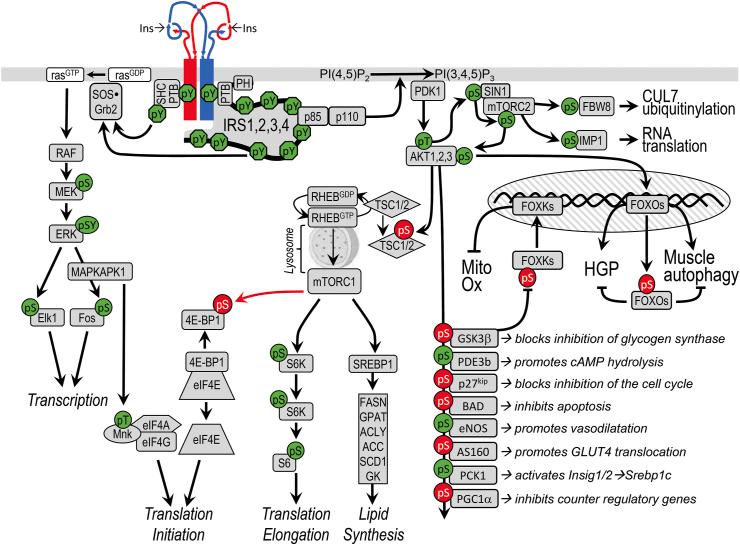
The discovery of insulin 100 years ago and its application to the treatment of human disease in the years since have marked a major turning point in the history of medicine. The availability of purified insulin allowed for the establishment of its physiological role in the regulation of blood glucose and ketones, the determination of its amino acid sequence, and the solving of its structure. Over the last 50 years, the function of insulin has been applied into the discovery of the insulin receptor and its signaling cascade to reveal the role of impaired insulin signaling-or resistance-in the progression of type 2 diabetes. It has also become clear that insulin signaling can impact not only classical insulin-sensitive tissues, but all tissues of the body, and that in many of these tissues the insulin signaling cascade regulates unexpected physiological functions. Despite these remarkable advances, much remains to be learned about both insulin signaling and how to use this molecular knowledge to advance the treatment of type 2 diabetes and other insulin-resistant states.
100 年前胰岛素的发现及其在随后几年中应用于人类疾病的治疗标志着医学史上的一个重大转折点。纯化胰岛素的出现使得确定其在调节血糖和酮体方面的生理作用、确定其氨基酸序列以及解决其结构成为可能。在过去的 50 年中,胰岛素的功能已被应用于胰岛素受体及其信号级联的发现,以揭示胰岛素信号受损或抵抗在 2 型糖尿病进展中的作用。人们也越来越清楚地认识到,胰岛素信号不仅可以影响经典的胰岛素敏感组织,而且可以影响身体的所有组织,而且在许多这些组织中,胰岛素信号级联调节着意想不到的生理功能。尽管取得了这些显著的进展,但关于胰岛素信号以及如何利用这些分子知识来推进 2 型糖尿病和其他胰岛素抵抗状态的治疗,仍有许多需要了解。


 Zotero 插件