
忘记锻炼了?阿尔茨海默病中运动产生的循环肌动蛋白:一种观点。
Forgot to Exercise? Exercise Derived Circulating Myokines in Alzheimer's Disease: A Perspective.
作者信息
Gupta Rajesh, Khan Rizwan, Cortes Constanza J
机构信息
Department of Cell, Developmental and Integrative Biology (CDIB), School of Medicine, University of Alabama at Birmingham, Birmingham, AL, United States.
Center for Neurodegeneration and Experimental Therapeutics (CNET), University of Alabama at Birmingham, Birmingham, AL, United States.
出版信息
Front Neurol. 2021 Jun 30;12:649452. doi: 10.3389/fneur.2021.649452. eCollection 2021.
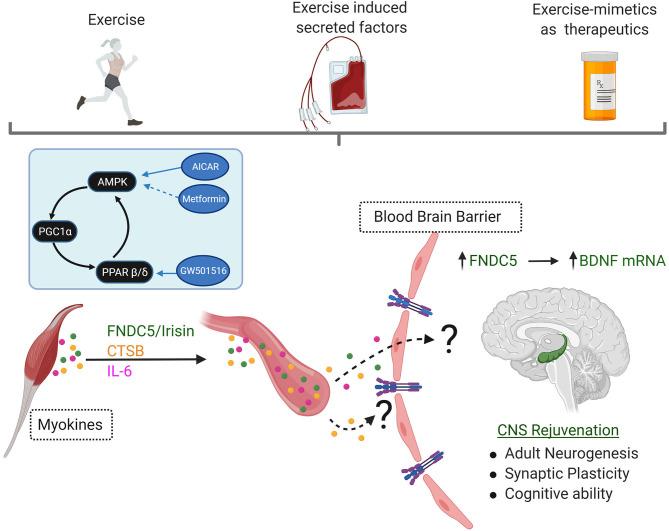
Regular exercise plays an essential role in maintaining healthy neurocognitive function and central nervous system (CNS) immuno-metabolism in the aging CNS. Physical activity decreases the risk of developing Alzheimer's Disease (AD), is associated with better AD prognosis, and positively affects cognitive function in AD patients. Skeletal muscle is an important secretory organ, communicating proteotoxic and metabolic stress to distant tissues, including the CNS, through the secretion of bioactive molecules collectively known as myokines. Skeletal muscle undergoes significant physical and metabolic remodeling during exercise, including alterations in myokine expression profiles. This suggests that changes in myokine and myometabolite secretion may underlie the well-documented benefits of exercise in AD. However, to date, very few studies have focused on specific alterations in skeletal muscle-originating secreted factors and their potential neuroprotective effects in AD. In this review, we discuss exercise therapy for AD prevention and intervention, and propose the use of circulating myokines as novel therapeutic tools for modifying AD progression.
规律运动在维持衰老中枢神经系统(CNS)健康的神经认知功能和中枢神经系统免疫代谢方面起着至关重要的作用。体育活动可降低患阿尔茨海默病(AD)的风险,与更好的AD预后相关,并对AD患者的认知功能产生积极影响。骨骼肌是一个重要的分泌器官,通过分泌统称为肌动蛋白的生物活性分子,将蛋白质毒性和代谢应激传递给包括中枢神经系统在内的远处组织。运动期间,骨骼肌会经历显著的物理和代谢重塑,包括肌动蛋白表达谱的改变。这表明,肌动蛋白和肌代谢产物分泌的变化可能是运动对AD具有诸多益处的基础。然而,迄今为止,很少有研究关注源自骨骼肌的分泌因子的具体变化及其在AD中的潜在神经保护作用。在这篇综述中,我们讨论了用于AD预防和干预的运动疗法,并建议将循环肌动蛋白用作改变AD病程的新型治疗工具。

 Zotero 插件