
人们通过网络搜索了解 COVID-19 与他们对公共卫生指南行为之间的关联:实证信息流行病学研究。
Association Between What People Learned About COVID-19 Using Web Searches and Their Behavior Toward Public Health Guidelines: Empirical Infodemiology Study.
机构信息
Department of Management & Information Systems, Kent State University, New Philadelphia, OH, United States.
Infectious Disease Internal Medicine Department, Yale School of Medicine, Yale University, New Haven, CT, United States.
出版信息
J Med Internet Res. 2021 Sep 2;23(9):e28975. doi: 10.2196/28975.
BACKGROUND
The use of the internet and web-based platforms to obtain public health information and manage health-related issues has become widespread in this digital age. The practice is so pervasive that the first reaction to obtaining health information is to "Google it." As SARS-CoV-2 broke out in Wuhan, China, in December 2019 and quickly spread worldwide, people flocked to the internet to learn about the novel coronavirus and the disease, COVID-19. Lagging responses by governments and public health agencies to prioritize the dissemination of information about the coronavirus outbreak through the internet and the World Wide Web and to build trust gave room for others to quickly populate social media, online blogs, news outlets, and websites with misinformation and conspiracy theories about the COVID-19 pandemic, resulting in people's deviant behaviors toward public health safety measures.
OBJECTIVE
The goals of this study were to determine what people learned about the COVID-19 pandemic through web searches, examine any association between what people learned about COVID-19 and behavior toward public health guidelines, and analyze the impact of misinformation and conspiracy theories about the COVID-19 pandemic on people's behavior toward public health measures.
METHODS
This infodemiology study used Google Trends' worldwide search index, covering the first 6 months after the SARS-CoV-2 outbreak (January 1 to June 30, 2020) when the public scrambled for information about the pandemic. Data analysis employed statistical trends, correlation and regression, principal component analysis (PCA), and predictive models.
RESULTS
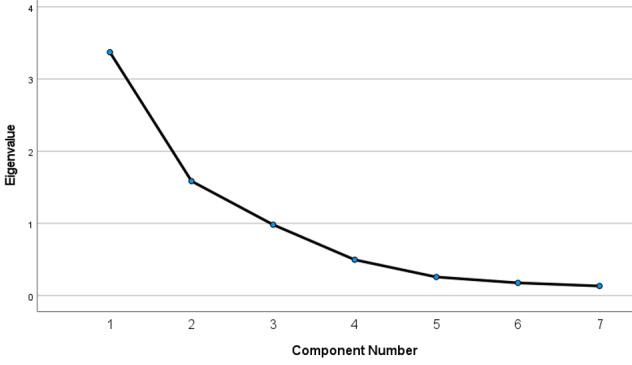
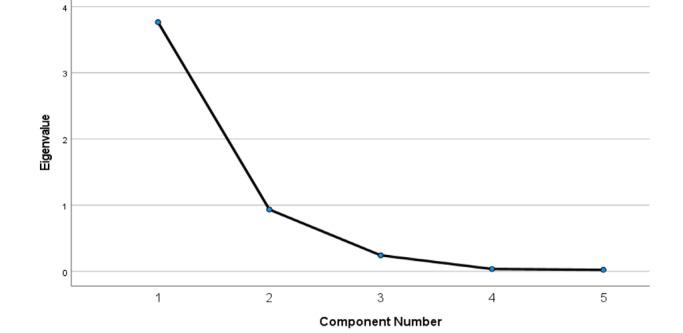
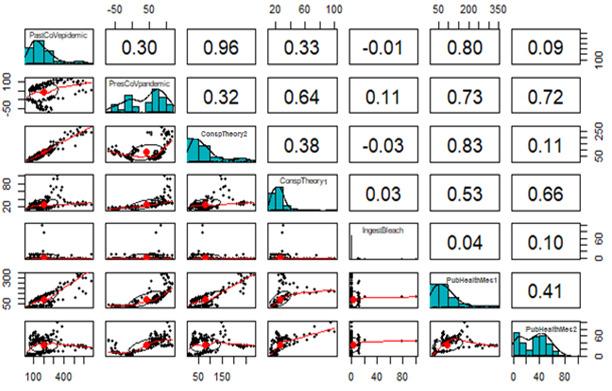
The PCA identified two latent variables comprising past coronavirus epidemics (pastCoVepidemics: keywords that address previous epidemics) and the ongoing COVID-19 pandemic (presCoVpandemic: keywords that explain the ongoing pandemic). Both principal components were used significantly to learn about SARS-CoV-2 and COVID-19 and explained 88.78% of the variability. Three principal components fuelled misinformation about COVID-19: misinformation (keywords "biological weapon," "virus hoax," "common cold," "COVID-19 hoax," and "China virus"), conspiracy theory 1 (ConspTheory1; keyword "5G" or "@5G"), and conspiracy theory 2 (ConspTheory2; keyword "ingest bleach"). These principal components explained 84.85% of the variability. The principal components represent two measurements of public health safety guidelines-public health measures 1 (PubHealthMes1; keywords "social distancing," "wash hands," "isolation," and "quarantine") and public health measures 2 (PubHealthMes2; keyword "wear mask")-which explained 84.7% of the variability. Based on the PCA results and the log-linear and predictive models, ConspTheory1 (keyword "@5G") was identified as a predictor of people's behavior toward public health measures (PubHealthMes2). Although correlations of misinformation (keywords "COVID-19," "hoax," "virus hoax," "common cold," and more) and ConspTheory2 (keyword "ingest bleach") with PubHealthMes1 (keywords "social distancing," "hand wash," "isolation," and more) were r=0.83 and r=-0.11, respectively, neither was statistically significant (P=.27 and P=.13, respectively).
CONCLUSIONS
Several studies focused on the impacts of social media and related platforms on the spreading of misinformation and conspiracy theories. This study provides the first empirical evidence to the mainly anecdotal discourse on the use of web searches to learn about SARS-CoV-2 and COVID-19.
背景
在数字时代,人们广泛使用互联网和基于网络的平台获取公共卫生信息并管理与健康相关的问题。这种做法已经非常普遍,以至于人们获取健康信息的第一反应就是“谷歌一下”。2019 年 12 月,SARS-CoV-2 在武汉爆发,并迅速在全球范围内传播,人们纷纷涌向互联网了解新型冠状病毒和 COVID-19 疾病。政府和公共卫生机构反应迟缓,未能优先通过互联网和万维网传播有关冠状病毒爆发的信息,并建立信任,这为其他人在社交媒体、在线博客、新闻媒体和网站上迅速传播有关 COVID-19 大流行的错误信息和阴谋论提供了空间,导致人们对公共卫生安全措施的行为出现偏差。
目的
本研究旨在确定人们通过网络搜索了解了有关 COVID-19 的哪些信息,考察人们了解的 COVID-19 与对公共卫生指南的行为之间的任何关联,并分析有关 COVID-19 大流行的错误信息和阴谋论对人们对公共卫生措施的行为的影响。
方法
本信息流行病学研究使用了 Google Trends 的全球搜索索引,涵盖了 SARS-CoV-2 爆发后的前 6 个月(2020 年 1 月 1 日至 6 月 30 日),当时公众正在争先恐后地获取有关大流行的信息。数据分析采用了统计趋势、相关性和回归、主成分分析(PCA)和预测模型。
结果
PCA 确定了由两个潜在变量组成的两个主成分,包括过去的冠状病毒流行(过去的冠状病毒流行:涉及以前流行的关键词)和正在进行的 COVID-19 大流行(当前的冠状病毒流行:解释正在进行的大流行的关键词)。这两个主成分都被显著地用于了解 SARS-CoV-2 和 COVID-19,并解释了 88.78%的可变性。三个主成分推动了有关 COVID-19 的错误信息:错误信息(关键词“生物武器”、“病毒骗局”、“普通感冒”、“COVID-19 骗局”和“中国病毒”)、阴谋论 1(ConspTheory1;关键词“5G”或“@5G”)和阴谋论 2(ConspTheory2;关键词“摄入漂白剂”)。这些主成分解释了 84.85%的可变性。主成分代表了公共卫生安全措施的两个测量值——公共卫生措施 1(PubHealthMes1;关键词“社交距离”、“洗手”、“隔离”和“检疫”)和公共卫生措施 2(PubHealthMes2;关键词“戴口罩”)——解释了 84.7%的可变性。基于 PCA 结果和对数线性和预测模型,发现阴谋论 1(关键词“@5G”)是人们对公共卫生措施(PubHealthMes2)行为的预测指标。尽管错误信息(关键词“COVID-19”、“骗局”、“病毒骗局”、“普通感冒”等)和阴谋论 2(关键词“摄入漂白剂”)与 PubHealthMes1(关键词“社交距离”、“洗手”、“隔离”等)的相关性分别为 r=0.83 和 r=-0.11,但均无统计学意义(分别为 P=.27 和 P=.13)。
结论
有几项研究集中于社交媒体和相关平台对错误信息和阴谋论传播的影响。本研究提供了第一个实证证据,证明了主要是轶事的关于使用网络搜索了解 SARS-CoV-2 和 COVID-19 的论述。




 Zotero 插件