
商业葡萄酒酵母中含氮化合物的利用和挥发性有机化合物的生产突出了菌株特异性代谢多样性。
Nitrogenous Compound Utilization and Production of Volatile Organic Compounds among Commercial Wine Yeasts Highlight Strain-Specific Metabolic Diversity.
机构信息
Department of Chemical Engineering, University of California, Davisgrid.27860.3b, California, USA.
Food Microbiology, Wageningen University & Research, Wageningen, The Netherlands.
出版信息
Microbiol Spectr. 2021 Sep 3;9(1):e0048521. doi: 10.1128/Spectrum.00485-21. Epub 2021 Jul 21.
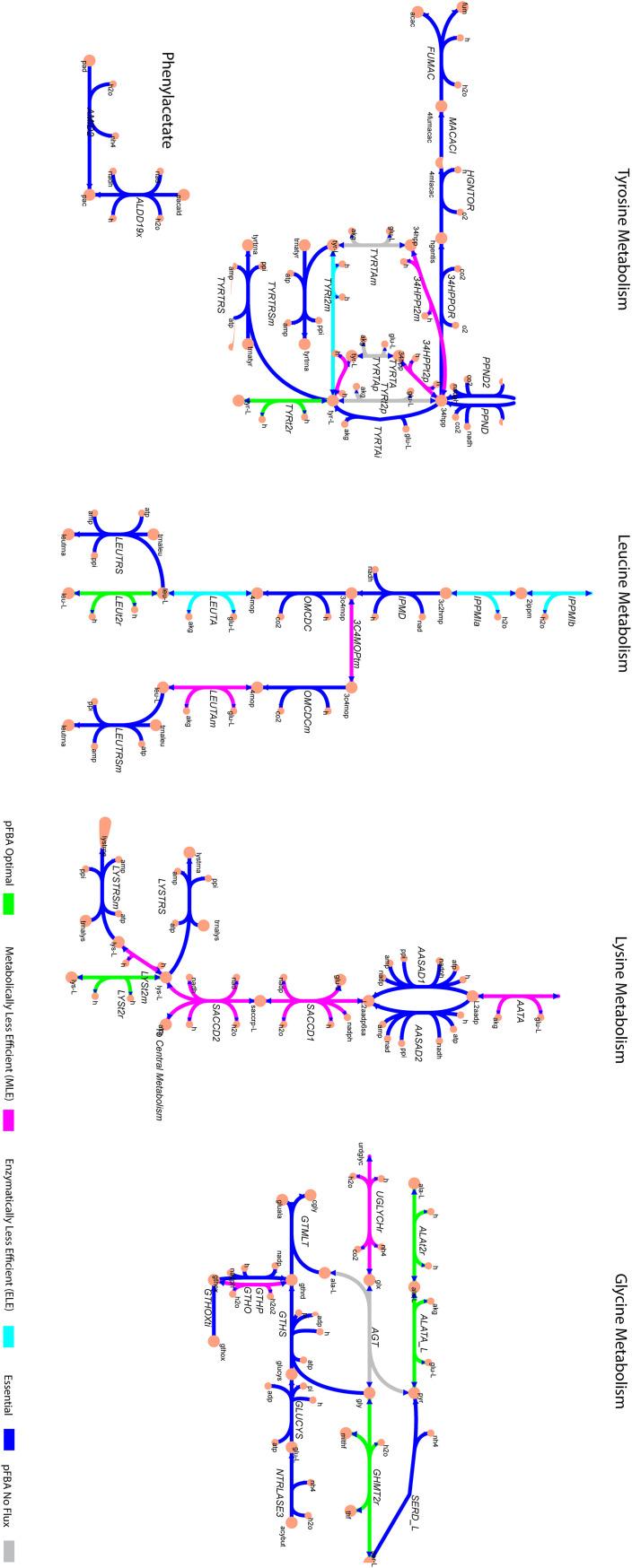
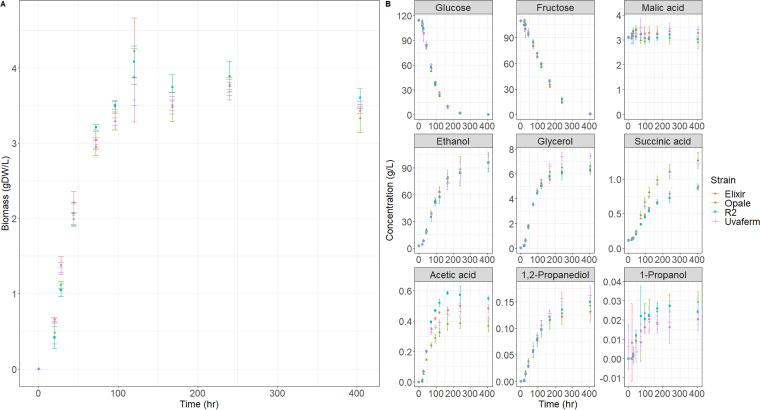
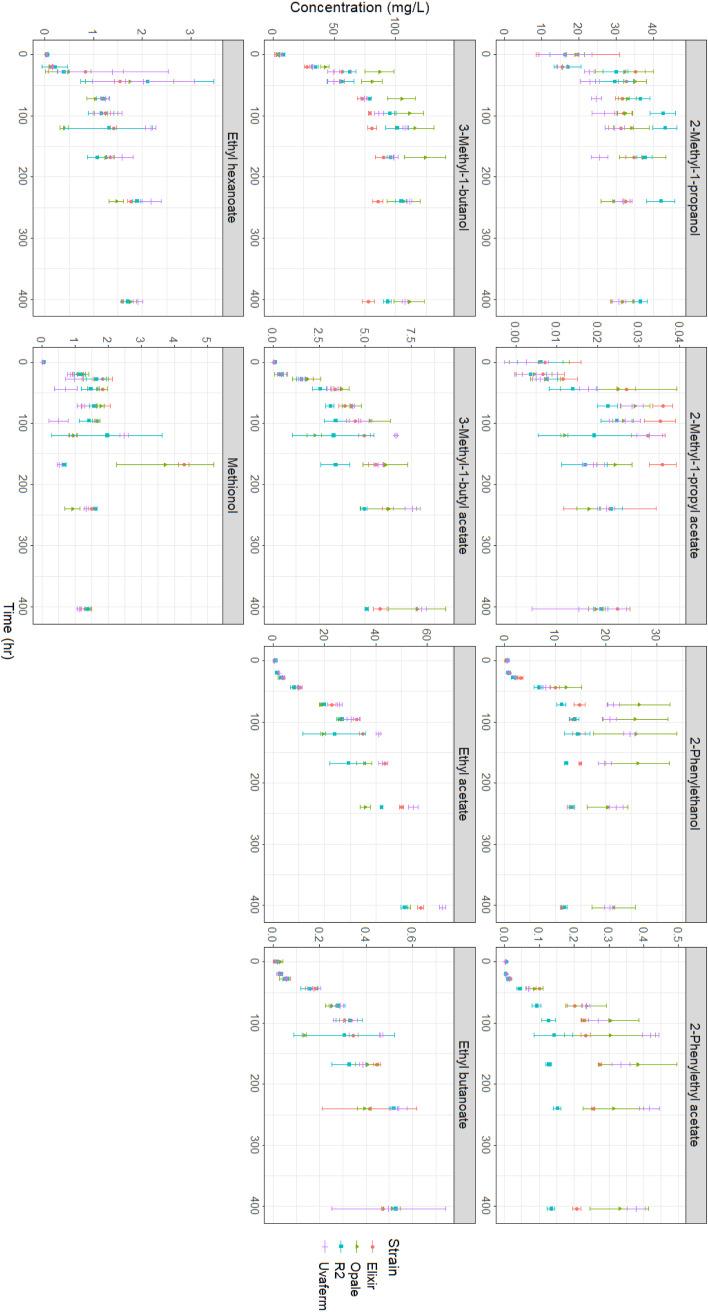
Genetic background and environmental conditions affect the production of sensory impact compounds by Saccharomyces cerevisiae. The relative importance of the strain-specific metabolic capabilities for the production of volatile organic compounds (VOCs) remains unclear. We investigated which amino acids contribute to VOC production and whether amino acid-VOC relations are conserved among yeast strains. Amino acid consumption and production of VOCs during grape juice fermentation was investigated using four commercial wine yeast strains: Elixir, Opale, R2, and Uvaferm. Principal component analysis of the VOC data demonstrated that Uvaferm correlated with ethyl acetate and ethyl hexanoate production, R2 negatively correlated with the acetate esters, and Opale positively correlated with fusel alcohols. Biomass formation was similar for all strains, pointing to metabolic differences in the utilization of nutrients to form VOCs. Partial least-squares linear regression showed that total aroma production is a function of nitrogen utilization ( = 0.87). We found that glycine, tyrosine, leucine, and lysine utilization were positively correlated with fusel alcohols and acetate esters. Mechanistic modeling of the yeast metabolic network via parsimonious flux balance analysis and flux enrichment analysis revealed enzymes with crucial roles, such as transaminases and decarboxylases. Our work provides insights in VOC production in wine yeasts. Saccharomyces cerevisiae is widely used in grape juice fermentation to produce wines. Along with the genetic background, the nitrogen in the environment in which S. cerevisiae grows impacts its regulation of metabolism. Also, commercial S. cerevisiae strains exhibit immense diversity in their formation of aromas, and a desirable aroma bouquet is an essential characteristic for wines. Since nitrogen affects aroma formation in wines, it is essential to know the extent of this connection and how it leads to strain-dependent aroma profiles in wines. We evaluated the differences in the production of key aroma compounds among four commercial wine strains. Moreover, we analyzed the role of nitrogen utilization on the formation of various aroma compounds. This work illustrates the unique aroma-producing differences among industrial yeast strains and suggests more intricate, nitrogen-associated routes influencing those aroma-producing differences.
遗传背景和环境条件会影响酿酒酵母产生感官冲击化合物。菌株特异性代谢能力对挥发性有机化合物(VOC)产生的相对重要性尚不清楚。我们研究了哪些氨基酸有助于 VOC 的产生,以及氨基酸-VOC 关系是否在酵母菌株中保持保守。使用四种商业葡萄酒酵母菌株(Elixir、Opale、R2 和 Uvaferm)研究了葡萄汁发酵过程中氨基酸的消耗和 VOC 的产生。对 VOC 数据进行主成分分析表明,Uvaferm 与乙酸乙酯和己酸乙酯的产生相关,R2 与乙酸酯呈负相关,Opale 与杂醇油呈正相关。所有菌株的生物量形成相似,这表明在利用营养物质形成 VOC 方面存在代谢差异。偏最小二乘线性回归表明,总香气产量是氮利用的函数( = 0.87)。我们发现,甘氨酸、酪氨酸、亮氨酸和赖氨酸的利用与杂醇油和乙酸酯呈正相关。通过简约通量平衡分析和通量富集分析对酵母代谢网络进行的机制建模揭示了具有关键作用的酶,如转氨酶和脱羧酶。我们的工作为葡萄酒酵母的 VOC 生产提供了深入的了解。酿酒酵母广泛用于葡萄汁发酵以生产葡萄酒。除了遗传背景外,酿酒酵母生长环境中的氮也会影响其代谢调控。此外,商业酿酒酵母菌株在香气形成方面表现出巨大的多样性,而理想的香气组合是葡萄酒的一个重要特征。由于氮会影响葡萄酒的香气形成,因此了解这种联系的程度以及它如何导致葡萄酒中菌株依赖性的香气特征是至关重要的。我们评估了四种商业葡萄酒菌株在关键香气化合物产生方面的差异。此外,我们分析了氮利用对各种香气化合物形成的作用。这项工作说明了工业酵母菌株之间独特的香气产生差异,并表明更复杂的、与氮相关的途径会影响这些香气产生差异。


 Zotero 插件