
阿尔茨海默病的单细胞水平的小胶质细胞。人类和小鼠有共同模式吗?
Microglia in Alzheimer's disease at single-cell level. Are there common patterns in humans and mice?
机构信息
Department of Pathology and Immunology, Washington University School of Medicine, St Louis, MO.
Department of Neurology, Washington University School of Medicine, St Louis, MO.
出版信息
J Exp Med. 2021 Sep 6;218(9). doi: 10.1084/jem.20202717. Epub 2021 Jul 22.
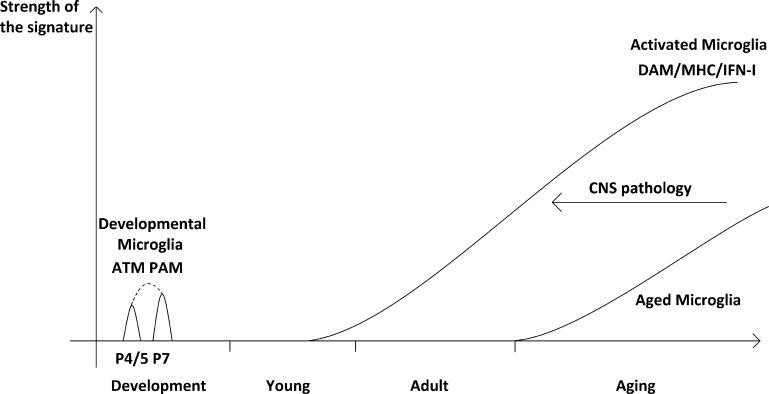
Alzheimer's disease (AD) is characterized by extracellular aggregates of amyloid β peptides, intraneuronal tau aggregates, and neuronal death. This pathology triggers activation of microglia. Because variants of genes expressed in microglia correlate with AD risk, microglial response to pathology plausibly impacts disease course. In mouse AD models, single-cell RNA sequencing (scRNA-seq) analyses delineated this response as progressive conversion of homeostatic microglia into disease-associated microglia (DAM); additional reactive microglial populations have been reported in other models of neurodegeneration and neuroinflammation. We review all of these microglial signatures, highlighting four fundamental patterns: DAM, IFN-microglia, MHC-II microglia, and proliferating microglia. We propose that all reported microglia populations are either just one or a combination, depending on the clustering strategy applied and the disease model. We further review single-nucleus RNA sequencing (snRNA-seq) data from human AD specimens and discuss reasons for parallels and discrepancies between human and mouse transcriptional profiles. Finally, we outline future directions for delineating the microglial impact in AD pathogenesis.
阿尔茨海默病(AD)的特征是细胞外淀粉样 β 肽聚集、神经元内 tau 聚集和神经元死亡。这种病理触发小胶质细胞的激活。由于小胶质细胞中表达的基因变异与 AD 风险相关,小胶质细胞对病理的反应可能影响疾病进程。在小鼠 AD 模型中,单细胞 RNA 测序(scRNA-seq)分析将这种反应描述为稳态小胶质细胞向疾病相关小胶质细胞(DAM)的渐进性转化;在其他神经退行性疾病和神经炎症模型中还报道了其他反应性小胶质细胞群体。我们回顾了所有这些小胶质细胞特征,强调了四种基本模式:DAM、IFN-小胶质细胞、MHC-II 小胶质细胞和增殖性小胶质细胞。我们提出,所有报告的小胶质细胞群体要么只是其中之一,要么是它们的组合,这取决于应用的聚类策略和疾病模型。我们进一步回顾了来自人类 AD 标本的单核 RNA 测序(snRNA-seq)数据,并讨论了人类和小鼠转录谱之间的相似和差异的原因。最后,我们概述了在 AD 发病机制中描绘小胶质细胞影响的未来方向。
 Zotero 插件