
吸入麻醉与丙泊酚静脉麻醉用于乳腺癌手术的结局比较:一项系统评价与Meta分析
Comparison of Outcomes After Breast Cancer Surgery Between Inhalational and Propofol-Based Intravenous Anaesthesia: A Systematic Review and Meta-Analysis.
作者信息
Pang Qian-Yun, Duan Li-Ping, Jiang Yan, Liu Hong-Liang
机构信息
Department of Anesthesiology, Chongqing University Cancer Hospital, Chongqing University, Chongqing, 400030, People's Republic of China.
出版信息
J Pain Res. 2021 Jul 16;14:2165-2177. doi: 10.2147/JPR.S315360. eCollection 2021.
BACKGROUND
General anaesthesia is the commonly provided for breast cancer surgery, but the effects of inhalational anaesthesia and propofol-based intravenous anaesthesia on short- and long-term outcomes after breast cancer surgery are not clear. In this study, we conduct a meta-analysis of randomized controlled trials (RCTs) to explore the superior anaesthetic for breast cancer surgery patients.
METHODS
We searched the Embase, Medline, Cochrane Library, Web of Science, CNKI, and Wanfang databases (up to January, 2021) for RCTs in which inhalational anaesthesia and propofol-based intravenous anaesthesia were compared and short- and long-term outcomes were assessed in breast cancer surgical patients. The meta-analysis was performed by Stata 12.0.
RESULTS
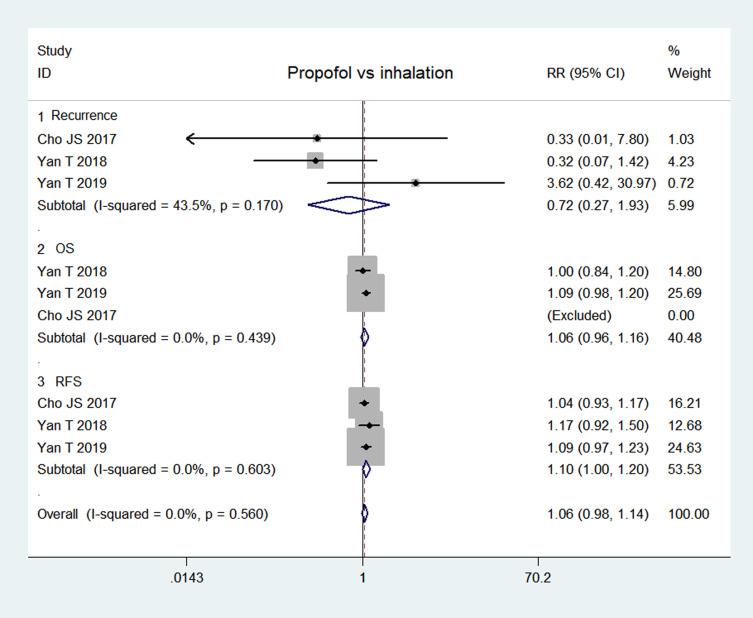
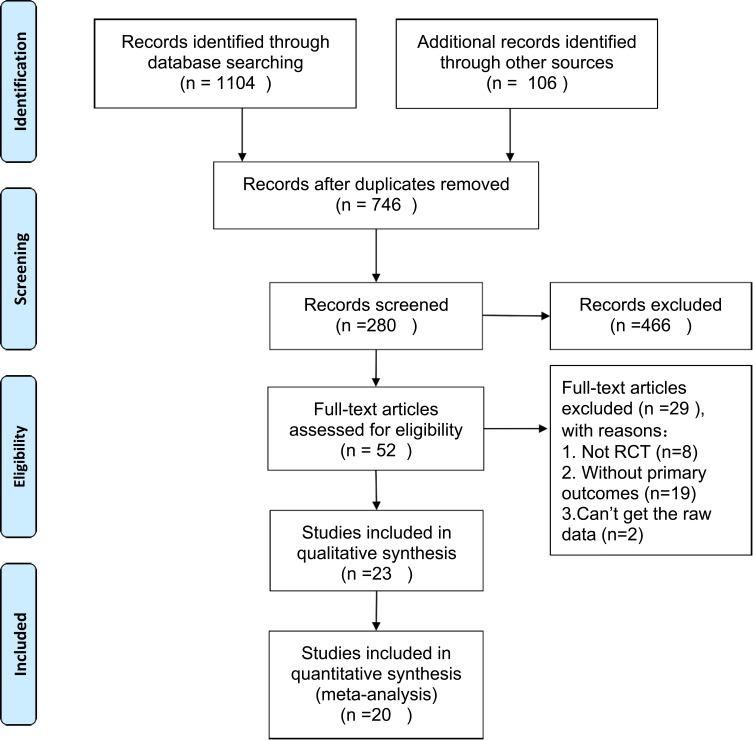
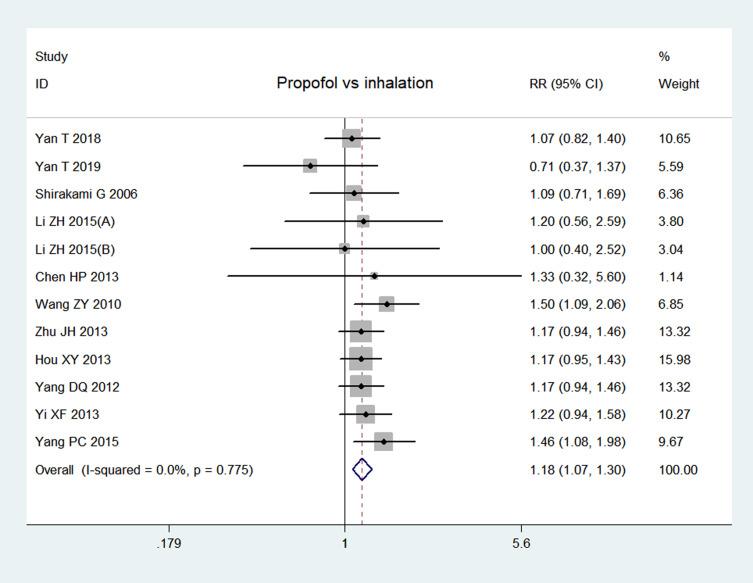
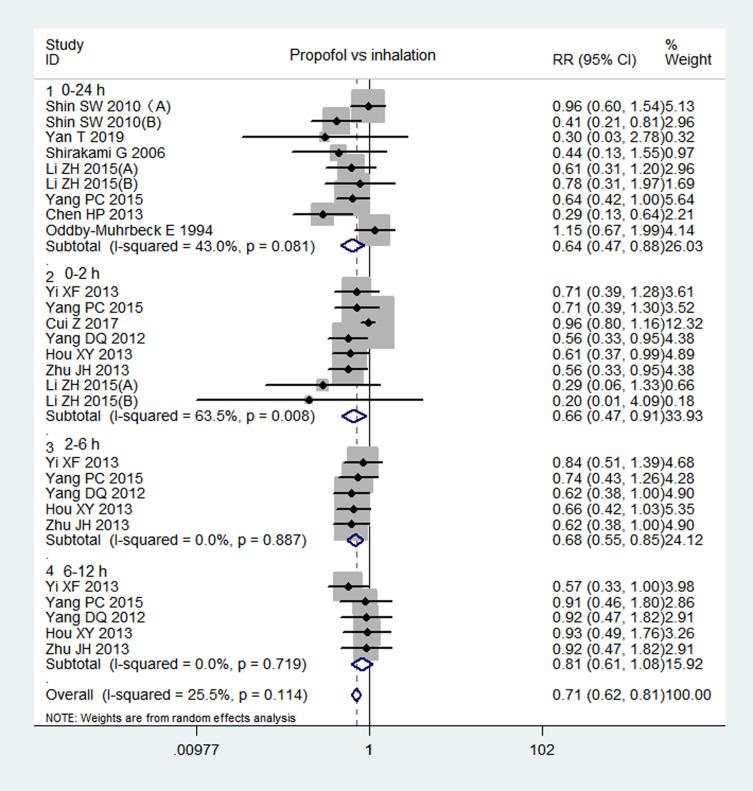
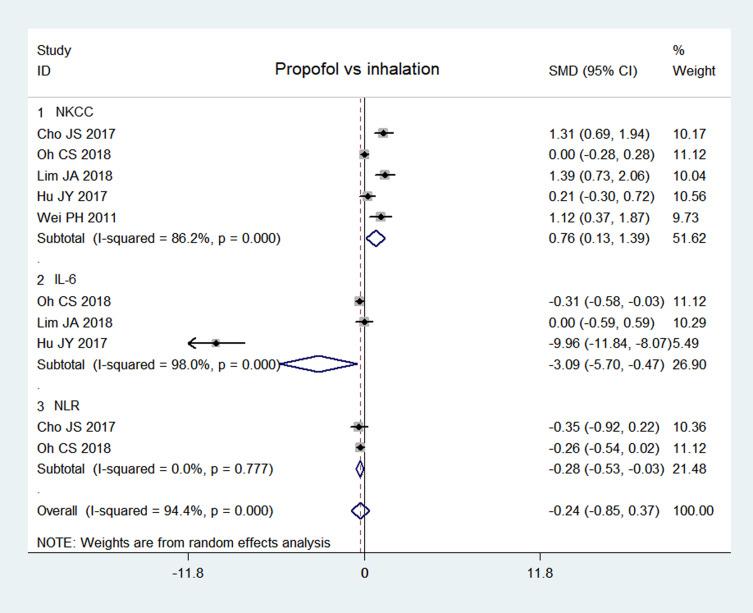
Twenty RCTs with a total of 2201 patients were included. Compared with inhalational anaesthesia, propofol-based intravenous anaesthesia was associated with more postoperative rescue analgesia ( =0%, RR: 1.18, 95% CI: 1.07-1.30, =0.001) but a lower incidence of postoperative nausea and vomiting (PONV) ( =25.5%, RR: 0.71, 95% CI: 0.62-0.81, <0.001) and postoperative rescue antiemetics ( =0%, RR: 0.69, 95% CI: 0.58-0.82, <0.001). Propofol-based intravenous anaesthesia preserved nature killer cell cytotoxicity ( =86.2%, SMD: 0.76, 95% CI: 0.13-1.39, =0.018), decreased IL-6 level ( =98.0%, SMD: -3.09, 95% CI: -5.70- -0.48, =0.021) and neutrophil-to-lymphocyte ratio ( =0%, SMD: -0.28, 95% CI: -0.53- -0.03, =0.030), and increased 2-year recurrence-free survival rate ( =0%, RR: 1.10, 95% CI: 1.00-1.20, =0.043) but did not affect recurrence or the overall survival rate (>0.05).
CONCLUSION
Propofol-based intravenous anaesthesia increases postoperative rescue analgesia but reduces PONV compared with inhalational anaesthesia in breast cancer surgery. The benefit of propofol over inhalational anaesthetics in the preservation of anti-cancer immunity is obvious, but it is difficult to conclude that propofol can exert long-term benefits due to the small sample size.
背景
全身麻醉是乳腺癌手术常用的麻醉方式,但吸入麻醉和丙泊酚静脉麻醉对乳腺癌手术后短期和长期预后的影响尚不清楚。在本研究中,我们对随机对照试验(RCT)进行荟萃分析,以探索乳腺癌手术患者的最佳麻醉方式。
方法
我们检索了Embase、Medline、Cochrane图书馆、Web of Science、中国知网和万方数据库(截至2021年1月),查找比较吸入麻醉和丙泊酚静脉麻醉并评估乳腺癌手术患者短期和长期预后的RCT。荟萃分析由Stata 12.0软件完成。
结果
共纳入20项RCT,涉及2201例患者。与吸入麻醉相比,丙泊酚静脉麻醉术后需要补救镇痛的情况更多(P=0%,RR:1.18,95%CI:1.07-1.30,P=0.001),但术后恶心呕吐(PONV)发生率较低(P=25.5%,RR:0.71,95%CI:0.62-0.81,P<0.001),术后需要补救使用止吐药的情况也较少(P=0%,RR:0.69,95%CI:0.58-0.82,P<0.001)。丙泊酚静脉麻醉可保留自然杀伤细胞的细胞毒性(P=86.2%,SMD:0.76,95%CI:0.13-1.39,P=0.018),降低白细胞介素-6水平(P=98.0%,SMD:-3.09,95%CI:-5.70--0.48,P=0.021)和中性粒细胞与淋巴细胞比值(P=0%,SMD:-0.28,95%CI:-0.53--0.03,P=0.030),并提高2年无复发生存率(P=0%,RR:1.10,95%CI:1.00-1.20,P=0.043),但不影响复发率或总生存率(P>0.05)。
结论
在乳腺癌手术中,与吸入麻醉相比,丙泊酚静脉麻醉增加了术后补救镇痛,但减少了PONV。丙泊酚在保留抗癌免疫方面优于吸入麻醉剂的益处明显,但由于样本量小,难以得出丙泊酚能产生长期益处的结论。

 Zotero 插件