
聚焦离子束辐照诱导异染色质中 DNA 双链断裂的凝聚,通过纳米分辨率电子显微镜观察到。
Focused Ion Microbeam Irradiation Induces Clustering of DNA Double-Strand Breaks in Heterochromatin Visualized by Nanoscale-Resolution Electron Microscopy.
机构信息
Department of Radiation Oncology, Saarland University Hospital, 66421 Homburg, Germany.
Institute for Applied Physic and Metrology, Universität der Bundeswehr München, 85577 Neubiberg, Germany.
出版信息
Int J Mol Sci. 2021 Jul 16;22(14):7638. doi: 10.3390/ijms22147638.
BACKGROUND
Charged-particle radiotherapy is an emerging treatment modality for radioresistant tumors. The enhanced effectiveness of high-energy particles (such as heavy ions) has been related to the spatial clustering of DNA lesions due to highly localized energy deposition. Here, DNA damage patterns induced by single and multiple carbon ions were analyzed in the nuclear chromatin environment by different high-resolution microscopy approaches.
MATERIAL AND METHODS
Using the heavy-ion microbeam SNAKE, fibroblast monolayers were irradiated with defined numbers of carbon ions (1/10/100 ions per pulse, ipp) focused to micrometer-sized stripes or spots. Radiation-induced lesions were visualized as DNA damage foci (γH2AX, 53BP1) by conventional fluorescence and stimulated emission depletion (STED) microscopy. At micro- and nanoscale level, DNA double-strand breaks (DSBs) were visualized within their chromatin context by labeling the Ku heterodimer. Single and clustered pKu70-labeled DSBs were quantified in euchromatic and heterochromatic regions at 0.1 h, 5 h and 24 h post-IR by transmission electron microscopy (TEM).
RESULTS
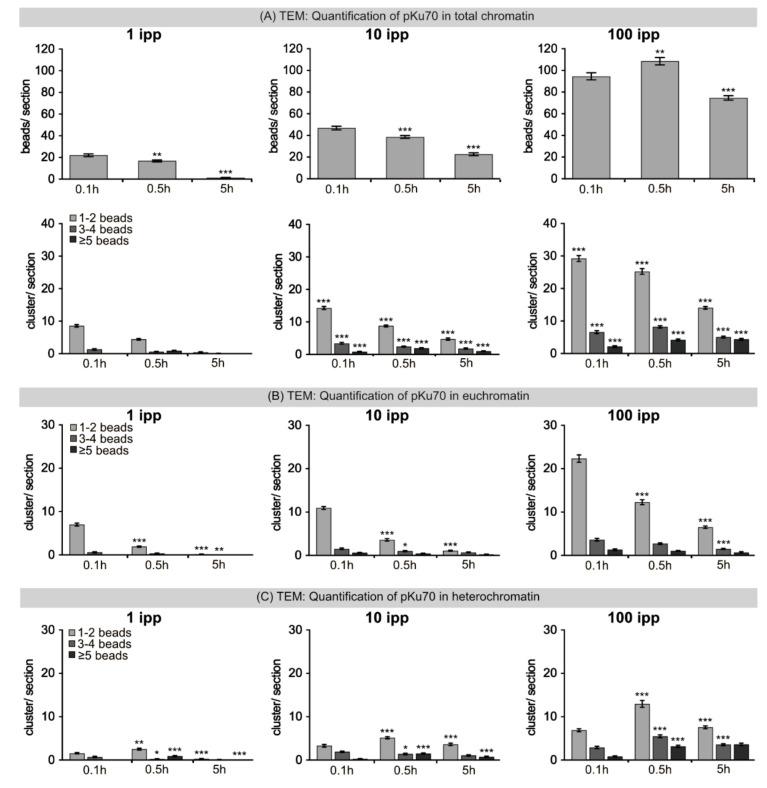
Increasing numbers of carbon ions per beam spot enhanced spatial clustering of DNA lesions and increased damage complexity with two or more DSBs in close proximity. This effect was detectable in euchromatin, but was much more pronounced in heterochromatin. Analyzing the dynamics of damage processing, our findings indicate that euchromatic DSBs were processed efficiently and repaired in a timely manner. In heterochromatin, by contrast, the number of clustered DSBs continuously increased further over the first hours following IR exposure, indicating the challenging task for the cell to process highly clustered DSBs appropriately.
CONCLUSION
Increasing numbers of carbon ions applied to sub-nuclear chromatin regions enhanced the spatial clustering of DSBs and increased damage complexity, this being more pronounced in heterochromatic regions. Inefficient processing of clustered DSBs may explain the enhanced therapeutic efficacy of particle-based radiotherapy in cancer treatment.
背景
带电粒子放疗是一种新兴的耐辐射肿瘤治疗方法。由于能量高度局域化沉积,高能粒子(如重离子)的有效性得到增强,这与 DNA 损伤的空间聚集有关。在这里,通过不同的高分辨率显微镜方法,在核染色质环境中分析了单个和多个碳离子诱导的 DNA 损伤模式。
材料和方法
使用重离子微束 SNAKE,将纤维母细胞单层用聚焦到微米大小条纹或斑点的一定数量的碳离子(每个脉冲 1/10/100 个离子,ipp)照射。通过常规荧光和受激发射损耗(STED)显微镜将辐射诱导的损伤可视化作为 DNA 损伤焦点(γH2AX、53BP1)。在微纳米尺度上,通过标记 Ku 异二聚体,在染色质背景下可视化 DNA 双链断裂(DSB)。在 0.1 h、5 h 和 24 h 后,通过透射电子显微镜(TEM)在常染色质和异染色质区域定量分析单个和簇状 pKu70 标记的 DSBs。
结果
每个射束点的碳离子数量增加增强了 DNA 损伤的空间聚集,并增加了损伤的复杂性,具有两个或更多紧密接近的 DSB。这种效应在常染色质中可检测到,但在异染色质中更为明显。分析损伤处理的动力学,我们的发现表明,常染色质中的 DSB 被有效地处理,并及时修复。相比之下,在异染色质中,在 IR 暴露后的头几个小时内,聚集的 DSB 数量不断增加,这表明细胞处理高度聚集的 DSB 的任务具有挑战性。
结论
应用于亚核染色质区域的碳离子数量增加增强了 DSB 的空间聚集并增加了损伤的复杂性,在异染色质区域更为明显。聚集的 DSB 处理效率低下可能解释了基于粒子的放射疗法在癌症治疗中增强的治疗效果。


 Zotero 插件