
通过语音作为生物标志物利用机器学习检测轻度和重度抑郁症。
Detection of Minor and Major Depression through Voice as a Biomarker Using Machine Learning.
作者信息
Shin Daun, Cho Won Ik, Park C Hyung Keun, Rhee Sang Jin, Kim Min Ji, Lee Hyunju, Kim Nam Soo, Ahn Yong Min
机构信息
Department of Psychiatry, Seoul National University College of Medicine, Seoul 03080, Korea.
Department of Neuropsychiatry, Seoul National University Hospital, Seoul 13620, Korea.
出版信息
J Clin Med. 2021 Jul 8;10(14):3046. doi: 10.3390/jcm10143046.
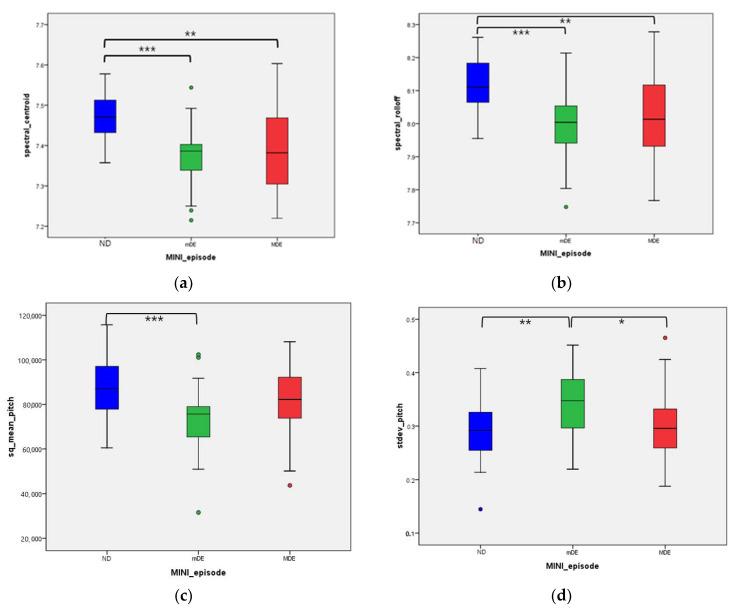
Both minor and major depression have high prevalence and are important causes of social burden worldwide; however, there is still no objective indicator to detect minor depression. This study aimed to examine if voice could be used as a biomarker to detect minor and major depression. Ninety-three subjects were classified into three groups: the not depressed group ( = 33), the minor depressive episode group ( = 26), and the major depressive episode group ( = 34), based on current depressive status as a dimension. Twenty-one voice features were extracted from semi-structured interview recordings. A three-group comparison was performed through analysis of variance. Seven voice indicators showed differences between the three groups, even after adjusting for age, BMI, and drugs taken for non-psychiatric disorders. Among the machine learning methods, the best performance was obtained using the multi-layer processing method, and an AUC of 65.9%, sensitivity of 65.6%, and specificity of 66.2% were shown. This study further revealed voice differences in depressive episodes and confirmed that not depressed groups and participants with minor and major depression could be accurately distinguished through machine learning. Although this study is limited by a small sample size, it is the first study on voice change in minor depression and suggests the possibility of detecting minor depression through voice.
轻度和重度抑郁症的患病率都很高,是全球社会负担的重要原因;然而,仍然没有检测轻度抑郁症的客观指标。本研究旨在探讨声音是否可作为检测轻度和重度抑郁症的生物标志物。根据当前抑郁状态这一维度,93名受试者被分为三组:非抑郁组(n = 33)、轻度抑郁发作组(n = 26)和重度抑郁发作组(n = 34)。从半结构化访谈录音中提取了21个声音特征。通过方差分析进行三组比较。即使在调整了年龄、体重指数和用于非精神疾病的药物后,七个声音指标在三组之间仍显示出差异。在机器学习方法中,使用多层处理方法获得了最佳性能,显示出曲线下面积为65.9%,灵敏度为65.6%,特异性为66.2%。本研究进一步揭示了抑郁发作中的声音差异,并证实通过机器学习可以准确区分非抑郁组以及轻度和重度抑郁症患者。尽管本研究受到样本量小的限制,但它是关于轻度抑郁症声音变化的首次研究,并表明了通过声音检测轻度抑郁症的可能性。

 Zotero 插件