
一种雾化型腺病毒 5 型载体新冠疫苗(Ad5-nCoV)在成年人中的安全性、耐受性和免疫原性:一项开放标签、随机 1 期临床试验的初步报告。
Safety, tolerability, and immunogenicity of an aerosolised adenovirus type-5 vector-based COVID-19 vaccine (Ad5-nCoV) in adults: preliminary report of an open-label and randomised phase 1 clinical trial.
机构信息
Beijing Institute of Biotechnology, Academy of Military Medical Sciences, Beijing, China.
Clinical Trial Center, Zhongnan Hospital of Wuhan University, Wuhan, China.
出版信息
Lancet Infect Dis. 2021 Dec;21(12):1654-1664. doi: 10.1016/S1473-3099(21)00396-0. Epub 2021 Jul 26.
BACKGROUND
SARS-CoV-2 has caused millions of deaths, and, since Aug 11, 2020, 20 intramuscular COVID-19 vaccines have been approved for use. We aimed to evaluate the safety and immunogenicity of an aerosolised adenovirus type-5 vector-based COVID-19 vaccine (Ad5-nCoV) in adults without COVID-19 from China.
METHOD
This was a randomised, single-centre, open-label, phase 1 trial done in Zhongnan Hospital (Wuhan, China), to evaluate the safety and immunogenicity of the Ad5-nCoV vaccine by aerosol inhalation in adults (≥18 years) seronegative for SARS-CoV-2. Breastfeeding or pregnant women and people with major chronic illnesses or history of allergies were excluded. Participants were enrolled and randomly assigned (1:1:1:1:1) into five groups to be vaccinated via intramuscular injection, aerosol inhalation, or both. Randomisation was stratified by sex and age (18-55 years or ≥56 years) using computer-generated randomisation sequences (block sizes of five). Only laboratory staff were masked to group assignment. The participants in the two aerosol groups received an initial high dose (2 × 10 viral particles; HDmu group) or low dose (1 × 10 viral particles; LDmu group) of Ad5-nCoV vaccine on day 0, followed by a booster on day 28. The mixed vaccination group received an initial intramuscular (5 × 10 viral particles) vaccine on day 0, followed by an aerosolised booster (2 × 10 viral particles) vaccine on day 28 (MIX group). The intramuscular groups received one dose (5 × 10 viral particles; 1Dim group) or two doses (10 × 10 viral particles; 2Dim group) of Ad5-nCoV on day 0. The primary safety outcome was adverse events 7 days after each vaccination, and the primary immunogenicity outcome was anti-SARS-CoV-2 spike receptor IgG antibody and SARS-CoV-2 neutralising antibody geometric mean titres at day 28 after last vaccination. This trial is registered with ClinicalTrials.gov, number NCT04552366.
FINDINGS
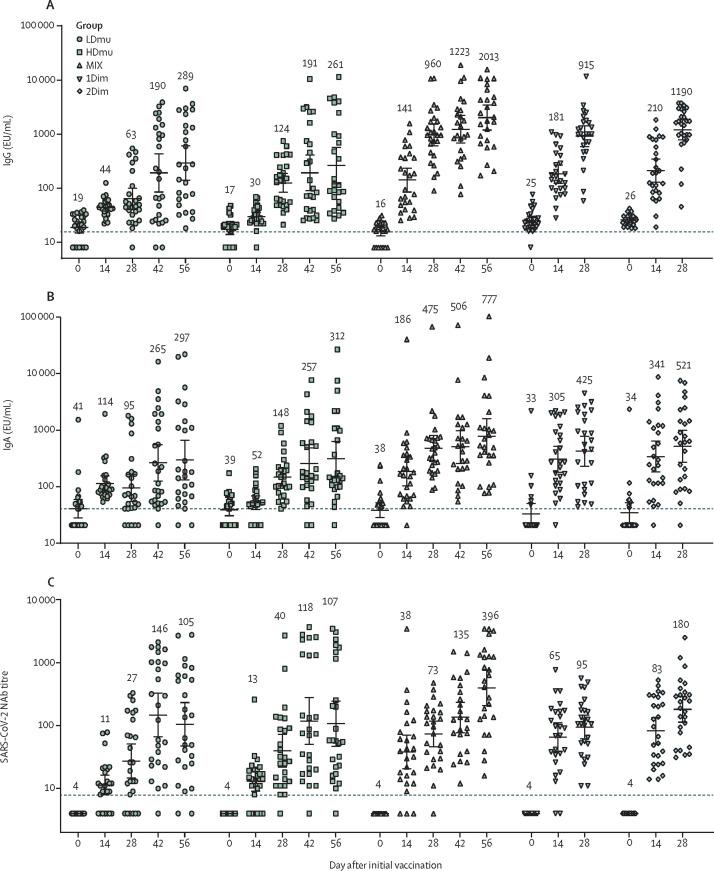
Between Sept 28, 2020, and Sept 30, 2020, 230 individuals were screened for inclusion, of whom 130 (56%) participants were enrolled into the trial and randomly assigned into one of the five groups (26 participants per group). Within 7 days after vaccination, adverse events occurred in 18 (69%) in the HDmu group, 19 (73%) in the LDmu group, 19 (73%) in the MIX group, 19 (73%) in the 1Dim group, and 15 (58%) in the 2Dim group. The most common adverse events reported 7 days after the first or booster vaccine were fever (62 [48%] of 130 participants), fatigue (40 [31%] participants), and headache (46 [35%] participants). More adverse events were reported in participants who received intramuscular vaccination, including participants in the MIX group (49 [63%] of 78 participants), than those who received aerosol vaccine (13 [25%] of 52 participants) after the first vaccine vaccination. No serious adverse events were noted within 56 days after the first vaccine. At days 28 after last vaccination, geometric mean titres of SARS-CoV-2 neutralising antibody was 107 (95% CI 47-245) in the HDmu group, 105 (47-232) in the LDmu group, 396 (207-758) in the MIX group, 95 (61-147) in the 1Dim group, and 180 (113-288) in the 2Dim group. The geometric mean concentrations of receptor binding domain-binding IgG was 261 EU/mL (95% CI 121-563) in the HDmu group, 289 EU/mL (138-606) in the LDmu group, 2013 EU/mL (1180-3435) in the MIX group, 915 EU/mL (588-1423) in the 1Dim group, and 1190 EU/mL (776-1824) in the 2Dim group.
INTERPRETATION
Aerosolised Ad5-nCoV is well tolerated, and two doses of aerosolised Ad5-nCoV elicited neutralising antibody responses, similar to one dose of intramuscular injection. An aerosolised booster vaccination at 28 days after first intramuscular injection induced strong IgG and neutralising antibody responses. The efficacy and cost-effectiveness of aerosol vaccination should be evaluated in future studies.
FUNDING
National Key Research and Development Programme of China and National Science and Technology Major Project.
TRANSLATION
For the Chinese translation of the Summary see Supplementary Material.
背景
SARS-CoV-2 已导致数百万人死亡,自 2020 年 8 月 11 日以来,已有 20 种肌肉内 COVID-19 疫苗获得批准使用。我们旨在评估一种基于腺病毒 5 型载体的气溶胶 COVID-19 疫苗(Ad5-nCoV)在来自中国的未感染 SARS-CoV-2 的成年人中的安全性和免疫原性。
方法
这是一项在武汉中南医院进行的随机、单中心、开放性、1 期试验,旨在通过气溶胶吸入评估 Ad5-nCoV 疫苗在 18 岁以上(≥18 岁)SARS-CoV-2 血清阴性的成年人中的安全性和免疫原性。排除哺乳期或妊娠妇女以及有重大慢性疾病或过敏史的人。将参与者纳入并随机分配(1:1:1:1:1)至 5 组,通过肌肉注射、气溶胶吸入或两者联合接种疫苗。使用计算机生成的随机数序列(块大小为 5)按性别和年龄(18-55 岁或≥56 岁)分层随机分组。只有实验室工作人员对分组分配进行了掩蔽。两组气溶胶组在第 0 天接受高剂量(2×10 病毒颗粒;HDmu 组)或低剂量(1×10 病毒颗粒;LDmu 组)的 Ad5-nCoV 疫苗初始接种,然后在第 28 天进行加强接种。混合接种组在第 0 天接受肌肉内(5×10 病毒颗粒)疫苗初始接种,然后在第 28 天接受气溶胶加强接种(2×10 病毒颗粒)(MIX 组)。肌肉内组在第 0 天接受 1 剂(5×10 病毒颗粒;1Dim 组)或 2 剂(10×10 病毒颗粒;2Dim 组)的 Ad5-nCoV 疫苗接种。主要安全性结局是每次接种后 7 天的不良事件,主要免疫原性结局是第 28 天末次接种后抗 SARS-CoV-2 刺突受体 IgG 抗体和 SARS-CoV-2 中和抗体几何平均滴度。这项试验在 ClinicalTrials.gov 注册,编号为 NCT04552366。
结果
2020 年 9 月 28 日至 2020 年 9 月 30 日,对 230 名符合纳入标准的人进行了筛查,其中 130 名(56%)参与者被纳入试验并随机分配至 5 组中的一组(每组 26 名参与者)。接种后 7 天内,18 名(69%)HDmu 组、19 名(73%)LDmu 组、19 名(73%)MIX 组、19 名(73%)1Dim 组和 15 名(58%)2Dim 组出现不良事件。第 1 次或加强疫苗接种后 7 天报告的最常见不良事件为发热(130 名参与者中有 62 名[48%])、疲劳(40 名参与者中有 40 名[31%])和头痛(46 名参与者中有 46 名[35%])。接受肌肉内接种的参与者(MIX 组 78 名参与者中有 49 名[63%])报告的不良事件多于接受气溶胶疫苗接种的参与者(52 名参与者中有 13 名[25%])。第 1 次疫苗接种后 56 天内未观察到严重不良事件。末次接种后第 28 天,SARS-CoV-2 中和抗体的几何平均滴度在 HDmu 组中为 107(95%CI 47-245),在 LDmu 组中为 105(47-232),在 MIX 组中为 396(207-758),在 1Dim 组中为 95(61-147),在 2Dim 组中为 180(113-288)。HDmu 组中受体结合域结合 IgG 的几何平均浓度为 261 EU/mL(95%CI 121-563),LDmu 组中为 289 EU/mL(138-606),MIX 组中为 2013 EU/mL(1180-3435),1Dim 组中为 915 EU/mL(588-1423),2Dim 组中为 1190 EU/mL(776-1824)。
结论
气溶胶接种 Ad5-nCoV 耐受性良好,两剂气溶胶接种 Ad5-nCoV 可诱导中和抗体反应,与一剂肌肉内接种相当。在第 1 次肌肉内接种后 28 天进行气溶胶加强接种可诱导强烈的 IgG 和中和抗体反应。气溶胶接种的疗效和成本效益应在未来的研究中进行评估。
资金
国家重点研发计划和国家重大科技专项。


 Zotero 插件