
欧洲泌尿外科学会的生化复发风险分组预测了根治性前列腺切除术后生化复发前列腺癌患者 PSMA PET 的发现。
The European Association of Urology Biochemical Recurrence Risk Groups Predict Findings on PSMA PET in Patients with Biochemically Recurrent Prostate Cancer After Radical Prostatectomy.
机构信息
James Buchanan Brady Urological Institute and Department of Urology, Johns Hopkins University School of Medicine, Baltimore, Maryland.
Department of Urology, Renji Hospital, Shanghai Jiao Tong University School of Medicine, Shanghai, China.
出版信息
J Nucl Med. 2022 Feb;63(2):248-252. doi: 10.2967/jnumed.121.262411. Epub 2021 Jul 29.
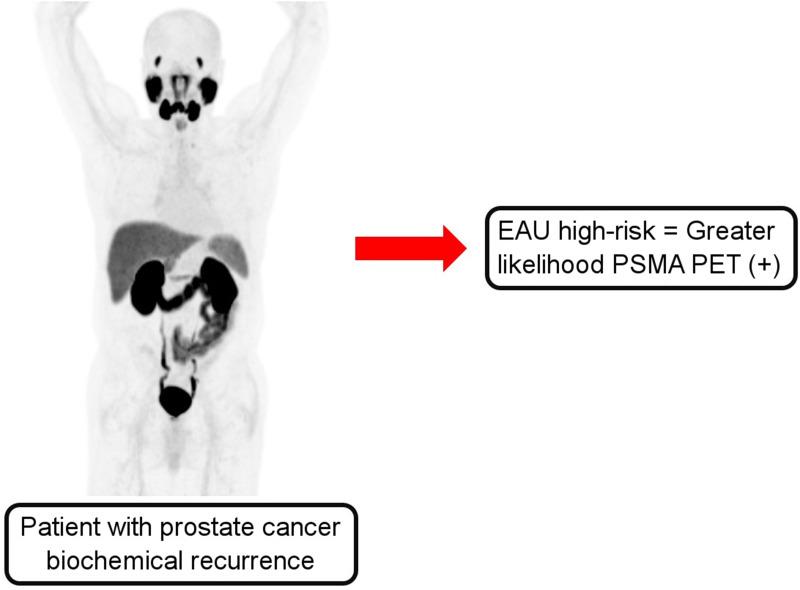
Our purpose was to evaluate the association of a new biochemical recurrence (BCR) risk stratification system with PSMA-targeted PET/CT findings. Two prospective studies that included patients with BCR were pooled. Findings on PSMA PET were catalogued. Patients were characterized according to the European Association of Urology BCR risk categories. Univariable and multivariable analyses were performed by logistic regression. In total, 145 patients were included (45 low-risk and 100 high-risk). High-risk BCR patients had a higher positive rate than low-risk patients (82.0% vs. 48.9%; < 0.001) and reached independent predictor status for positive PSMA PET/CT scan results on multivariable logistic regression (odds ratio, 6.73; 95% CI, 2.41-18.76; < 0.001). The area under the curve using the combination of BCR risk group and prostate-specific antigen was higher than that using prostate-specific antigen alone (0.834 vs. 0.759, = 0.015). The European Association of Urology BCR risk groups define the candidates who can most benefit from a PSMA PET/CT scan when BCR occurs.
我们的目的是评估新的生化复发(BCR)风险分层系统与 PSMA 靶向 PET/CT 结果的相关性。我们汇集了两项包含 BCR 患者的前瞻性研究。对 PSMA PET 的发现进行了分类。根据欧洲泌尿外科学会(EAU)的 BCR 风险类别对患者进行特征描述。采用逻辑回归进行单变量和多变量分析。共纳入 145 例患者(低危组 45 例,高危组 100 例)。高危 BCR 患者的阳性率高于低危患者(82.0% vs. 48.9%;<0.001),在多变量逻辑回归中独立预测 PSMA PET/CT 扫描阳性结果(比值比,6.73;95%置信区间,2.41-18.76;<0.001)。使用 BCR 风险组和前列腺特异性抗原(PSA)联合的曲线下面积高于仅使用 PSA 的曲线下面积(0.834 比 0.759,=0.015)。当发生 BCR 时,EAU 的 BCR 风险组定义了最能从 PSMA PET/CT 扫描中获益的患者。
 Zotero 插件