
结直肠癌肝转移切除术后循环肿瘤 DNA 与病理反应及无复发生存相关。
Postoperative circulating tumour DNA is associated with pathologic response and recurrence-free survival after resection of colorectal cancer liver metastases.
机构信息
Department of Medical Oncology, Amsterdam UMC, Cancer Center Amsterdam, University of Amsterdam, the Netherlands.
Department of Pathology, The Netherlands Cancer Institute, Plesmanlaan 121, Amsterdam 1066CX, the Netherlands.
出版信息
EBioMedicine. 2021 Aug;70:103498. doi: 10.1016/j.ebiom.2021.103498. Epub 2021 Jul 29.
BACKGROUND
Recurrence rates after resection of colorectal cancer liver metastases (CRLM) are high and correlate with worse survival. Postoperative circulating tumour DNA (ctDNA) is a promising prognostic biomarker. Focusing on patients with resected CRLM, this study aimed to evaluate the association between the detection of postoperative ctDNA, pathologic response and recurrence-free survival (RFS).
METHODS
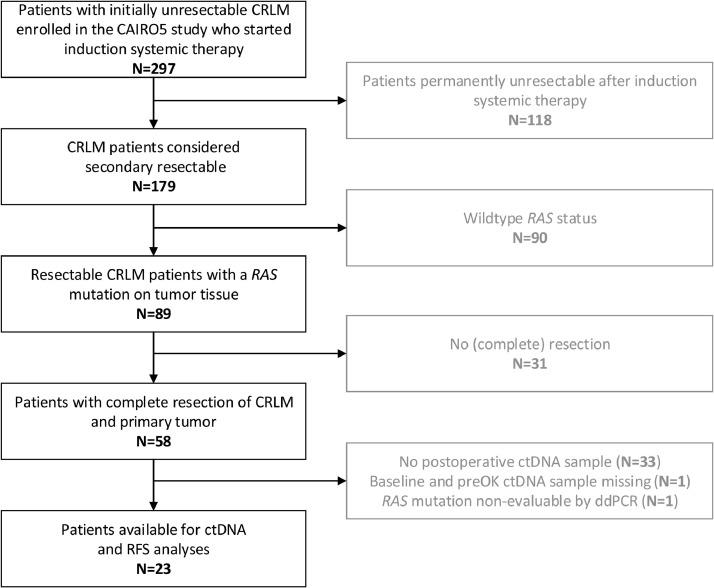
Twenty-three patients were selected from an ongoing phase-3 trial who underwent resection of RAS-mutant CRLM after induction systemic treatment. CtDNA analysis was performed by droplet digital PCR using blood samples collected at baseline, before and after resection. Pathologic response of CRLM was determined via the Tumour Regression Grading system.
FINDINGS
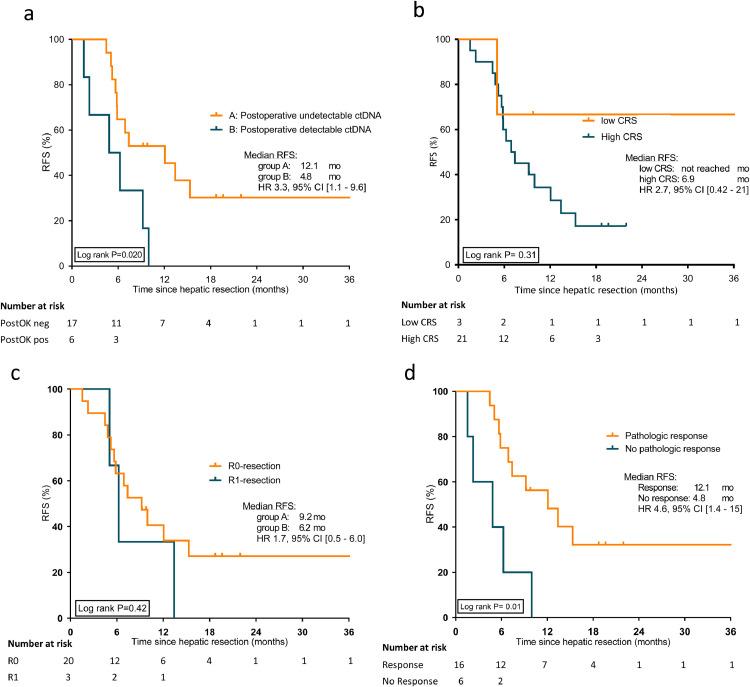
With a median follow-up of 19.6 months, the median RFS for patients with detectable (N = 6, [26%]) and undetectable (N = 17, [74%]) postoperative ctDNA was 4.8 versus 12.1 months, respectively. Among 21 patients with available tumour tissue, pathologic response in patients with detectable compared to undetectable postoperative ctDNA was found in one of six (17%) and 15 of 15 (100%) patients, respectively (p < 0.001). In univariable Cox regression analyses both postoperative detectable ctDNA (HR = 3.3, 95%CI = 1.1-9.6, p = 0.03) and pathologic non-response (HR = 4.6, 95%CI = 1.4-15, p = 0.01) were associated with poorer RFS and were strongly correlated (r = 0.88, p < 0.001). After adjusting for clinical characteristics in pairwise multivariable analyses, postoperative ctDNA status remained associated with RFS.
INTERPRETATION
The detection of postoperative ctDNA after secondary resection of CRLM is a promising prognostic factor for RFS and appeared to be highly correlated with pathologic response.
FUNDING
None.
背景
结直肠癌肝转移(CRLM)切除术后的复发率较高,与生存预后较差相关。术后循环肿瘤 DNA(ctDNA)是一种很有前途的预后生物标志物。本研究聚焦于接受过 CRLM 切除术的患者,旨在评估术后 ctDNA 检测、病理缓解与无复发生存(RFS)之间的关联。
方法
从正在进行的一项三期临床试验中选择了 23 名接受诱导性全身治疗后行 RAS 突变型 CRLM 切除术的患者。通过使用血液样本在基线时、手术前和手术后进行液滴数字 PCR 分析,检测 ctDNA。通过肿瘤回归分级系统来确定 CRLM 的病理缓解情况。
结果
在中位随访 19.6 个月后,ctDNA 可检测(N=6,[26%])和不可检测(N=17,[74%])患者的中位 RFS 分别为 4.8 个月和 12.1 个月。在 21 名有可用肿瘤组织的患者中,在术后 ctDNA 可检测的患者中,病理缓解的比例为 6 例中的 1 例(17%),而在术后 ctDNA 不可检测的患者中,15 例中的 15 例(100%),两者差异有统计学意义(p<0.001)。在单变量 Cox 回归分析中,术后可检测 ctDNA(HR=3.3,95%CI=1.1-9.6,p=0.03)和病理无缓解(HR=4.6,95%CI=1.4-15,p=0.01)均与 RFS 较差相关,且两者呈强相关(r=0.88,p<0.001)。在两两多变量分析中调整临床特征后,术后 ctDNA 状态仍与 RFS 相关。
结论
CRLM 二次切除术后 ctDNA 的检测是 RFS 的一个很有前途的预后因素,并且与病理缓解高度相关。
资金来源
无。

 Zotero 插件