
美国严重急性呼吸综合征冠状病毒 2 检测环节的改进:来自连续横断面评估的数据。
Improvements in Severe Acute Respiratory Syndrome Coronavirus 2 Testing Cascade in the United States: Data From Serial Cross-sectional Assessments.
机构信息
Department of Medicine, Division of Infectious Diseases, Johns Hopkins University School of Medicine, Baltimore, Maryland, USA.
Department of Epidemiology, Johns Hopkins Bloomberg School of Public Health, Baltimore, Maryland, USA.
出版信息
Clin Infect Dis. 2022 May 3;74(9):1534-1542. doi: 10.1093/cid/ciab683.
BACKGROUND
Severe acute respiratory syndrome coronavirus 2 (SARS-CoV-2) testing is critical for monitoring case counts, early detection and containment of infection, clinical management, and surveillance of variants. However, community-based data on the access, uptake, and barriers to testing have been lacking.
METHODS
We conducted serial cross-sectional online surveys covering demographics, coronavirus disease 2019 symptoms, and experiences around SARS-CoV-2 diagnostic testing to characterize the SARS-CoV-2 testing cascade and associated barriers across 10 US states (California, Florida, Illinois, Maryland, Massachusetts, Nebraska, North Dakota, South Dakota, Texas, and Wisconsin), from July 2020 to February 2021.
RESULTS
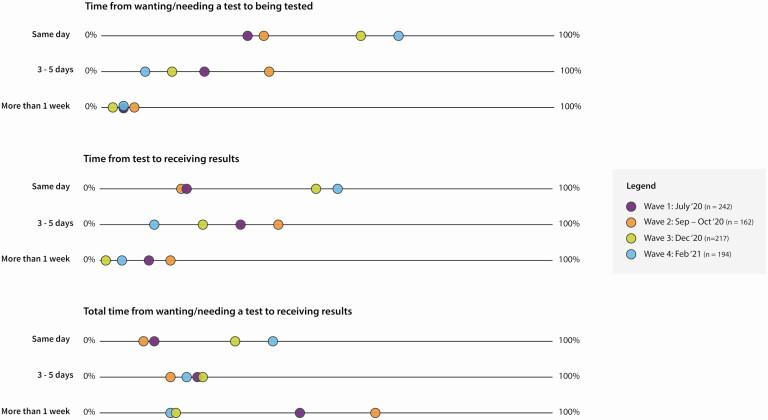
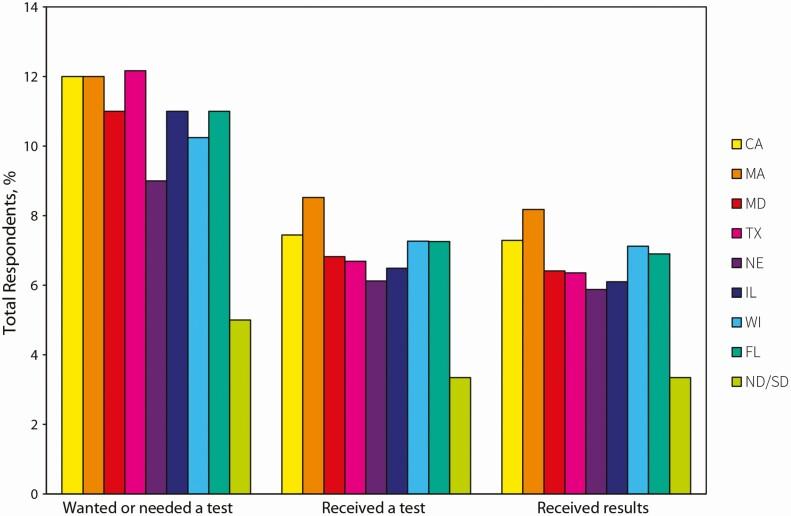
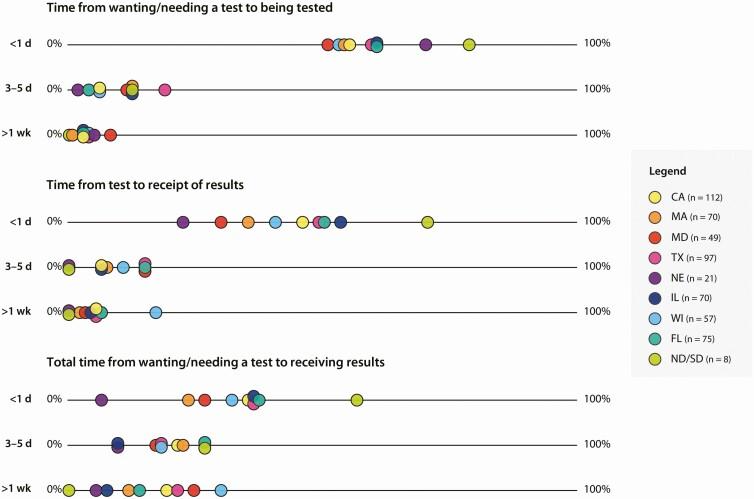
In February 2021, across 10 US states, 895 respondents (11%) reported wanting a diagnostic test in the prior 2 weeks, 63% of whom were tested, with limited variability across states. Almost all (97%) who were tested received their results; 56% received their results within 2 days. In Maryland, Florida, and Illinois, where serial data were available at 4 time points, 56% were tested the same day they wanted or needed a test in February 2021, compared with 28% in July 2020, and 45% received results the same day, compared with 17% in July 2020. Wanting a test was significantly more common among younger, nonwhite respondents and participants with a history of symptoms or exposure. Logistical challenges, including not knowing where to go, were the most frequently cited barriers.
CONCLUSIONS
There were significant improvements in access and turnaround times across US states, yet barriers to testing remained consistent across states, underscoring the importance of a continued focus on testing, even amidst mass vaccination campaigns.
背景
严重急性呼吸系统综合症冠状病毒 2(SARS-CoV-2)检测对于监测病例数量、早期发现和控制感染、临床管理以及监测变异体至关重要。然而,缺乏基于社区的关于检测的获取、接受程度和障碍的数据。
方法
我们从 2020 年 7 月至 2021 年 2 月在 10 个美国州(加利福尼亚州、佛罗里达州、伊利诺伊州、马里兰州、马萨诸塞州、内布拉斯加州、北达科他州、南达科他州、得克萨斯州和威斯康星州)进行了一系列连续的横断面在线调查,涵盖人口统计学、2019 年冠状病毒病症状以及围绕 SARS-CoV-2 诊断检测的经验,以描述 10 个美国州的 SARS-CoV-2 检测级联及其相关障碍。
结果
2021 年 2 月,在 10 个美国州,895 名受访者(11%)报告在过去 2 周内想要进行诊断检测,其中 63%接受了检测,各州之间的差异有限。几乎所有(97%)接受检测的人都收到了结果;56%在 2 天内收到结果。在马里兰州、佛罗里达州和伊利诺伊州,在 4 个时间点有连续数据,2021 年 2 月,有 56%的人在当天提出或需要检测时接受了检测,而 2020 年 7 月为 28%,45%的人在当天收到了结果,而 2020 年 7 月为 17%。想要进行检测的人在年轻、非白人受访者和有症状或接触史的参与者中更为常见。逻辑上的挑战,包括不知道去哪里,是最常被提到的障碍。
结论
美国各州在获得检测和周转时间方面有了显著的改善,但检测障碍在各州仍然一致存在,这强调了即使在大规模疫苗接种运动中,也应继续关注检测的重要性。
 Zotero 插件