
基于深度学习的肺部超声影像 COVID-19 检测。
Deep-learning based detection of COVID-19 using lung ultrasound imagery.
机构信息
CICESE Research Center, Ensenada, Baja California, México.
Faculty of Science, UABC, Ensenada, Baja California, México.
出版信息
PLoS One. 2021 Aug 13;16(8):e0255886. doi: 10.1371/journal.pone.0255886. eCollection 2021.
BACKGROUND
The COVID-19 pandemic has exposed the vulnerability of healthcare services worldwide, especially in underdeveloped countries. There is a clear need to develop novel computer-assisted diagnosis tools to provide rapid and cost-effective screening in places where massive traditional testing is not feasible. Lung ultrasound is a portable, easy to disinfect, low cost and non-invasive tool that can be used to identify lung diseases. Computer-assisted analysis of lung ultrasound imagery is a relatively recent approach that has shown great potential for diagnosing pulmonary conditions, being a viable alternative for screening and diagnosing COVID-19.
OBJECTIVE
To evaluate and compare the performance of deep-learning techniques for detecting COVID-19 infections from lung ultrasound imagery.
METHODS
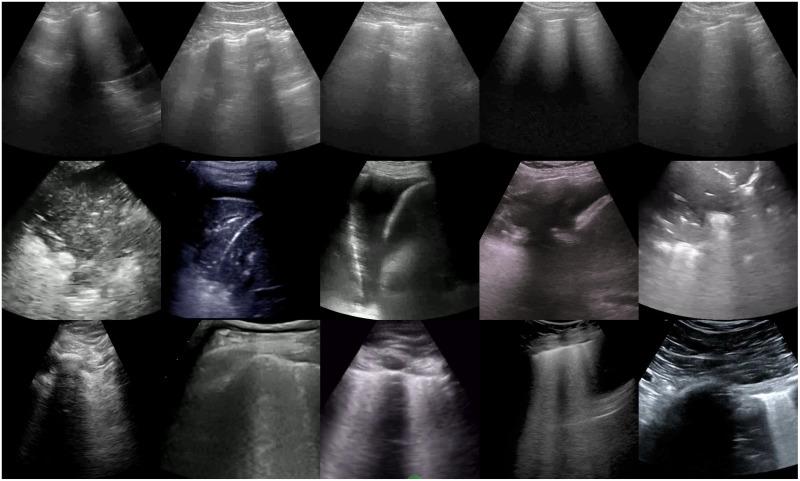
We adapted different pre-trained deep learning architectures, including VGG19, InceptionV3, Xception, and ResNet50. We used the publicly available POCUS dataset comprising 3326 lung ultrasound frames of healthy, COVID-19, and pneumonia patients for training and fine-tuning. We conducted two experiments considering three classes (COVID-19, pneumonia, and healthy) and two classes (COVID-19 versus pneumonia and COVID-19 versus non-COVID-19) of predictive models. The obtained results were also compared with the POCOVID-net model. For performance evaluation, we calculated per-class classification metrics (Precision, Recall, and F1-score) and overall metrics (Accuracy, Balanced Accuracy, and Area Under the Receiver Operating Characteristic Curve). Lastly, we performed a statistical analysis of performance results using ANOVA and Friedman tests followed by post-hoc analysis using the Wilcoxon signed-rank test with the Holm's step-down correction.
RESULTS
InceptionV3 network achieved the best average accuracy (89.1%), balanced accuracy (89.3%), and area under the receiver operating curve (97.1%) for COVID-19 detection from bacterial pneumonia and healthy lung ultrasound data. The ANOVA and Friedman tests found statistically significant performance differences between models for accuracy, balanced accuracy and area under the receiver operating curve. Post-hoc analysis showed statistically significant differences between the performance obtained with the InceptionV3-based model and POCOVID-net, VGG19-, and ResNet50-based models. No statistically significant differences were found in the performance obtained with InceptionV3- and Xception-based models.
CONCLUSIONS
Deep learning techniques for computer-assisted analysis of lung ultrasound imagery provide a promising avenue for COVID-19 screening and diagnosis. Particularly, we found that the InceptionV3 network provides the most promising predictive results from all AI-based techniques evaluated in this work. InceptionV3- and Xception-based models can be used to further develop a viable computer-assisted screening tool for COVID-19 based on ultrasound imagery.
背景
COVID-19 大流行暴露了全球医疗服务的脆弱性,尤其是在欠发达国家。显然需要开发新的计算机辅助诊断工具,以便在大规模传统检测不可行的地方提供快速且具有成本效益的筛查。肺部超声是一种便携式、易于消毒、低成本和非侵入性的工具,可用于识别肺部疾病。计算机辅助分析肺部超声图像是一种相对较新的方法,已经显示出在诊断肺部疾病方面具有很大的潜力,是筛查和诊断 COVID-19 的一种可行替代方法。
目的
评估和比较深度学习技术在从肺部超声图像中检测 COVID-19 感染方面的性能。
方法
我们改编了不同的预训练深度学习架构,包括 VGG19、InceptionV3、Xception 和 ResNet50。我们使用了公开的 POCUS 数据集,其中包含 3326 个健康、COVID-19 和肺炎患者的肺部超声图像,用于训练和微调。我们进行了两项实验,考虑了三个类别(COVID-19、肺炎和健康)和两个类别(COVID-19 与肺炎和 COVID-19 与非 COVID-19)的预测模型。获得的结果还与 POCOVID-net 模型进行了比较。对于性能评估,我们计算了每个类别的分类指标(精度、召回率和 F1 分数)和整体指标(准确性、平衡准确性和接收器操作特征曲线下的面积)。最后,我们使用方差分析和 Friedman 检验对性能结果进行了统计分析,然后使用 Wilcoxon 符号秩检验和 Holm 逐步校正进行事后分析。
结果
在从细菌性肺炎和健康肺部超声数据中检测 COVID-19 方面,InceptionV3 网络实现了最佳的平均准确性(89.1%)、平衡准确性(89.3%)和接收器操作曲线下的面积(97.1%)。方差分析和 Friedman 检验发现模型在准确性、平衡准确性和接收器操作曲线下的面积方面的性能存在统计学上的显著差异。事后分析表明,基于 InceptionV3 的模型与 POCOVID-net、VGG19 和 ResNet50 基于模型的性能存在统计学显著差异。基于 InceptionV3 和 Xception 的模型之间的性能没有发现统计学显著差异。
结论
计算机辅助肺部超声图像分析的深度学习技术为 COVID-19 筛查和诊断提供了一个很有前途的途径。特别是,我们发现 InceptionV3 网络在这项工作中评估的所有基于人工智能的技术中提供了最有希望的预测结果。基于 InceptionV3 和 Xception 的模型可用于进一步开发基于超声图像的 COVID-19 可行的计算机辅助筛查工具。

 Zotero 插件