
利用免疫肿瘤学中的 NKG2D 配体。
Leveraging NKG2D Ligands in Immuno-Oncology.
机构信息
Laboratorio de Fisiopatología de la Inmunidad Innata, Instituto de Biología y Medicina Experimental (IBYME-CONICET), Buenos Aires, Argentina.
Facultad de Ciencias Exactas y Naturales, Departamento de Química Biológica, Universidad de Buenos Aires, Buenos Aires, Argentina.
出版信息
Front Immunol. 2021 Jul 29;12:713158. doi: 10.3389/fimmu.2021.713158. eCollection 2021.
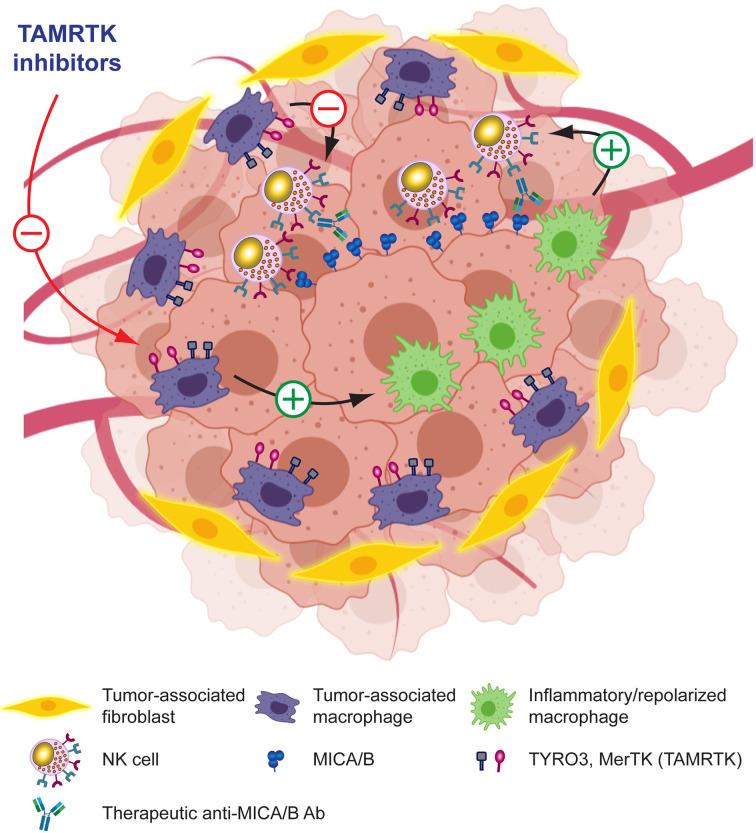
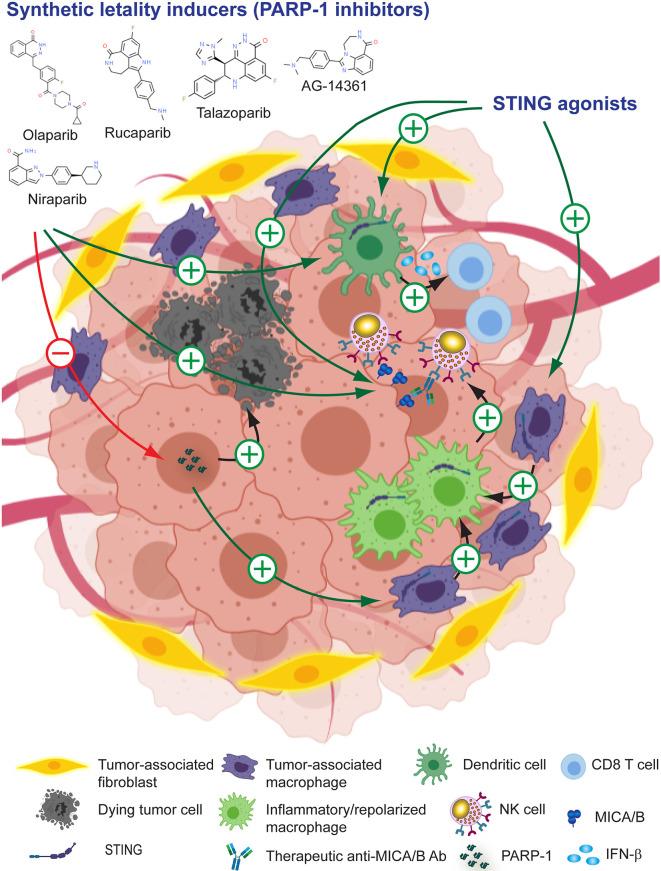
Immune checkpoint inhibitors (ICI) revolutionized the field of immuno-oncology and opened new avenues towards the development of novel assets to achieve durable immune control of cancer. Yet, the presence of tumor immune evasion mechanisms represents a challenge for the development of efficient treatment options. Therefore, combination therapies are taking the center of the stage in immuno-oncology. Such combination therapies should boost anti-tumor immune responses and/or target tumor immune escape mechanisms, especially those created by major players in the tumor microenvironment (TME) such as tumor-associated macrophages (TAM). Natural killer (NK) cells were recently positioned at the forefront of many immunotherapy strategies, and several new approaches are being designed to fully exploit NK cell antitumor potential. One of the most relevant NK cell-activating receptors is NKG2D, a receptor that recognizes 8 different NKG2D ligands (NKG2DL), including MICA and MICB. MICA and MICB are poorly expressed on normal cells but become upregulated on the surface of damaged, transformed or infected cells as a result of post-transcriptional or post-translational mechanisms and intracellular pathways. Their engagement of NKG2D triggers NK cell effector functions. Also, MICA/B are polymorphic and such polymorphism affects functional responses through regulation of their cell-surface expression, intracellular trafficking, shedding of soluble immunosuppressive isoforms, or the affinity of NKG2D interaction. Although immunotherapeutic approaches that target the NKG2D-NKG2DL axis are under investigation, several tumor immune escape mechanisms account for reduced cell surface expression of NKG2DL and contribute to tumor immune escape. Also, NKG2DL polymorphism determines functional NKG2D-dependent responses, thus representing an additional challenge for leveraging NKG2DL in immuno-oncology. In this review, we discuss strategies to boost MICA/B expression and/or inhibit their shedding and propose that combination strategies that target MICA/B with antibodies and strategies aimed at promoting their upregulation on tumor cells or at reprograming TAM into pro-inflammatory macrophages and remodeling of the TME, emerge as frontrunners in immuno-oncology because they may unleash the antitumor effector functions of NK cells and cytotoxic CD8 T cells (CTL). Pursuing several of these pipelines might lead to innovative modalities of immunotherapy for the treatment of a wide range of cancer patients.
免疫检查点抑制剂(ICI)彻底改变了肿瘤免疫学领域,为开发新型资产以实现对癌症的持久免疫控制开辟了新途径。然而,肿瘤免疫逃逸机制的存在给高效治疗方案的发展带来了挑战。因此,联合治疗正在成为肿瘤免疫学的焦点。这种联合治疗应该增强抗肿瘤免疫反应和/或靶向肿瘤免疫逃逸机制,特别是那些由肿瘤微环境(TME)中的主要参与者如肿瘤相关巨噬细胞(TAM)产生的机制。自然杀伤(NK)细胞最近被置于许多免疫治疗策略的前沿,并且正在设计几种新方法来充分利用 NK 细胞的抗肿瘤潜力。最相关的 NK 细胞激活受体之一是 NKG2D,它识别 8 种不同的 NKG2D 配体(NKG2DL),包括 MICA 和 MICB。MICA 和 MICB 在正常细胞上表达水平较低,但由于转录后或翻译后机制和细胞内途径,在受损、转化或感染细胞的表面上调。它们与 NKG2D 的结合触发 NK 细胞效应功能。此外,MICA/B 是多态的,这种多态性通过调节其细胞表面表达、细胞内运输、可溶性免疫抑制性同种型的脱落或 NKG2D 相互作用的亲和力来影响功能反应。尽管针对 NKG2D-NKG2DL 轴的免疫治疗方法正在研究中,但几种肿瘤免疫逃逸机制导致 NKG2DL 细胞表面表达减少,并有助于肿瘤免疫逃逸。此外,NKG2DL 多态性决定了功能上依赖于 NKG2D 的反应,因此在肿瘤免疫学中利用 NKG2DL 是一个额外的挑战。在这篇综述中,我们讨论了增强 MICA/B 表达和/或抑制其脱落的策略,并提出了靶向 MICA/B 的抗体联合策略和旨在促进其在肿瘤细胞上上调或将 TAM 重编程为促炎巨噬细胞以及重塑 TME 的策略,这些策略成为肿瘤免疫学的前沿,因为它们可能释放 NK 细胞和细胞毒性 CD8 T 细胞(CTL)的抗肿瘤效应功能。追求这些途径中的几个可能会为治疗广泛的癌症患者带来创新的免疫治疗模式。



 Zotero 插件