
将氧化应激和DNA损伤与细胞外基质成分表达的变化相联系。
Linking Oxidative Stress and DNA Damage to Changes in the Expression of Extracellular Matrix Components.
作者信息
Martins Susana G, Zilhão Rita, Thorsteinsdóttir Sólveig, Carlos Ana Rita
机构信息
Centro de Ecologia, Evolução e Alterações Ambientais, Faculdade de Ciências, Universidade de Lisboa, Lisboa, Portugal.
Departamento de Biologia Animal, Faculdade de Ciências, Universidade de Lisboa, Lisboa, Portugal.
出版信息
Front Genet. 2021 Jul 29;12:673002. doi: 10.3389/fgene.2021.673002. eCollection 2021.
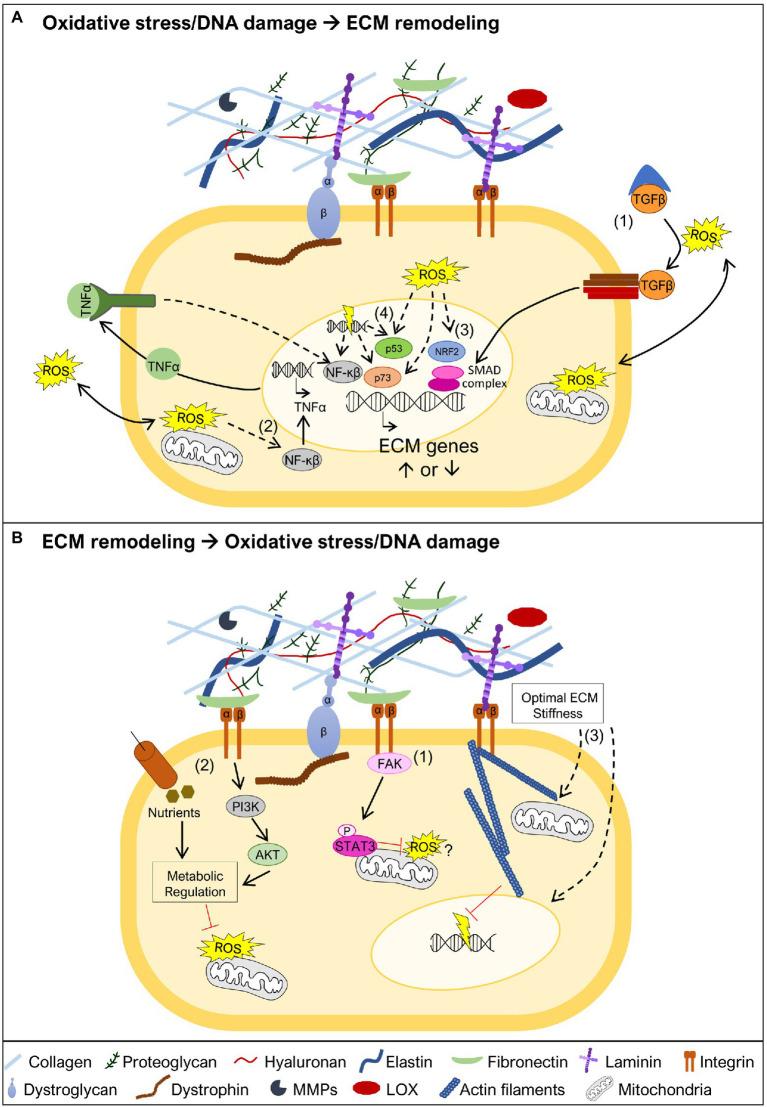
Cells are subjected to endogenous [e.g., reactive oxygen species (ROS), replication stress] and exogenous insults (e.g., UV light, ionizing radiation, and certain chemicals), which can affect the synthesis and/or stability of different macromolecules required for cell and tissue function. Oxidative stress, caused by excess ROS, and DNA damage, triggered in response to different sources, are countered and resolved by specific mechanisms, allowing the normal physiological equilibrium of cells and tissues to be restored. One process that is affected by oxidative stress and DNA damage is extracellular matrix (ECM) remodeling, which is a continuous and highly controlled mechanism that allows tissues to readjust in reaction to different challenges. The crosstalk between oxidative stress/DNA damage and ECM remodeling is not unidirectional. Quite on the contrary, mutations in ECM genes have a strong impact on tissue homeostasis and are characterized by increased oxidative stress and potentially also accumulation of DNA damage. In this review, we will discuss how oxidative stress and DNA damage affect the expression and deposition of ECM molecules and conversely how mutations in genes encoding ECM components trigger accumulation of oxidative stress and DNA damage. Both situations hamper the reestablishment of cell and tissue homeostasis, with negative impacts on tissue and organ function, which can be a driver for severe pathological conditions.
细胞会受到内源性因素(如活性氧物质(ROS)、复制应激)和外源性损伤(如紫外线、电离辐射及某些化学物质)的影响,这些因素会影响细胞和组织功能所需的不同大分子的合成和/或稳定性。由过量ROS引起的氧化应激以及对不同来源做出反应而引发的DNA损伤,会通过特定机制进行对抗和解决,从而使细胞和组织恢复正常的生理平衡。受氧化应激和DNA损伤影响的一个过程是细胞外基质(ECM)重塑,这是一种持续且高度受控的机制,使组织能够对不同挑战做出反应进行重新调整。氧化应激/DNA损伤与ECM重塑之间的相互作用并非单向的。恰恰相反,ECM基因的突变对组织稳态有强烈影响,其特征是氧化应激增加,并且可能还存在DNA损伤的积累。在本综述中,我们将讨论氧化应激和DNA损伤如何影响ECM分子的表达和沉积,以及相反地,编码ECM成分的基因突变如何引发氧化应激和DNA损伤的积累。这两种情况都会阻碍细胞和组织稳态的重建,对组织和器官功能产生负面影响,这可能是严重病理状况的一个驱动因素。


 Zotero 插件