
基于网络药理学分析结合分子对接验证的肺纤方治疗肺纤维化的机制研究
Mechanism of Fei-Xian Formula in the Treatment of Pulmonary Fibrosis on the Basis of Network Pharmacology Analysis Combined with Molecular Docking Validation.
作者信息
Chen Xiao-Li, Tang Cheng, Xiao Qing-Ling, Pang Zhong-Hua, Zhou Dan-Dan, Xu Jin, Wang Qi, Zhao Ya-Xi, Zhu Qi-Yong
机构信息
Department of Respiratory Medicine, Affiliated Hospital of Integrated Traditional Chinese and Western Medicine, Nanjing University of Chinese Medicine, Nanjing 210028, Jiangsu Province, China.
Laboratory of Cellular and Molecular Biology, Jiangsu Province Academy of Traditional Chinese Medicine, Nanjing 210028, Jiangsu Province, China.
出版信息
Evid Based Complement Alternat Med. 2021 Aug 3;2021:6658395. doi: 10.1155/2021/6658395. eCollection 2021.
OBJECTIVE
This study aimed to clarify the mechanism of Fei-Xian formula (FXF) in the treatment of pulmonary fibrosis based on network pharmacology analysis combined with molecular docking validation.
METHODS
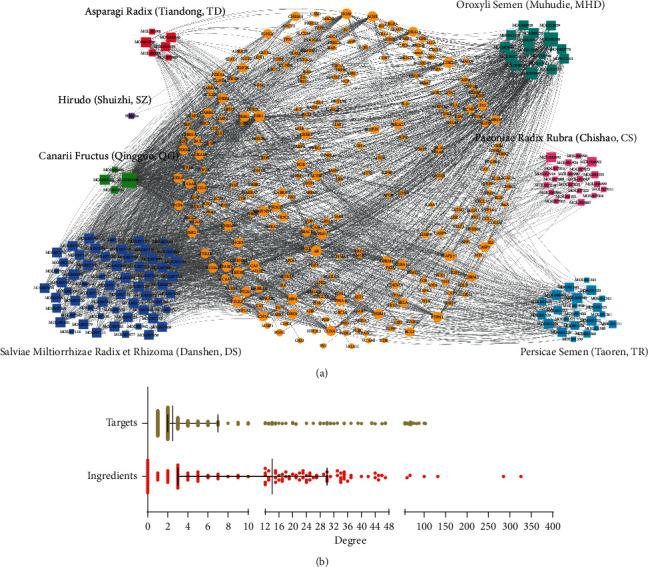
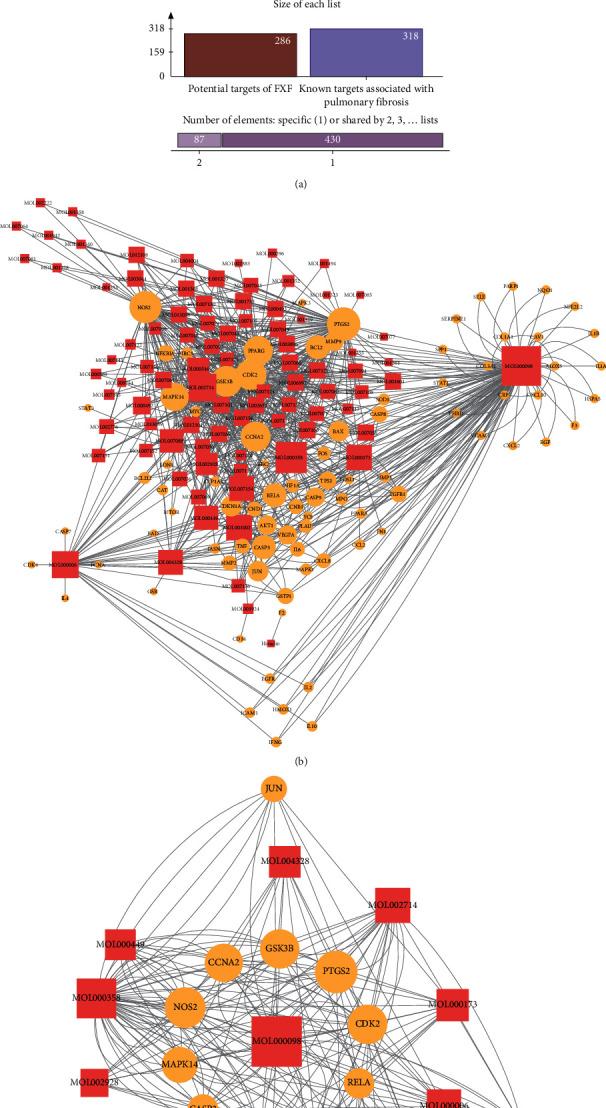
Firstly, ingredients in FXF with pharmacological activities, together with specific targets, were identified based on the BATMA-TCM and TCMSP databases. Then, targets associated with pulmonary fibrosis, which included pathogenic targets as well as those known therapeutic targets, were screened against the CTD, TTD, GeneCards, and DisGeNet databases. Later, Cytoscape was employed to construct a candidate component-target network of FXF for treating pulmonary fibrosis. In addition, for nodes within the as-constructed network, topological parameters were calculated using CytoHubba plug-in, and the degree value (twice as high as the median degree value for all the nodes) was adopted to select core components as well as core targets of FXF for treating pulmonary fibrosis, which were subsequently utilized for constructing the core network. Furthermore, molecular docking study was carried out on those core active ingredients together with the core targets using AutoDock Vina for verifying results of network pharmacology analysis. At last, OmicShare was employed for enrichment analysis of the core targets.
RESULTS
Altogether 12 active ingredients along with 13 core targets were identified from our constructed core component-target network of FXF for the treatment of pulmonary fibrosis. As revealed by enrichment analysis, the 13 core targets mostly concentrated in regulating biological functions, like response to external stimulus (from oxidative stress, radiation, UV, chemical substances, and virus infection), apoptosis, cell cycle, aging, immune process, and protein metabolism. In addition, several pathways, like IL-17, AGE-RAGE, TNF, HIF-1, PI3K-AKT, NOD-like receptor, T/B cell receptor, and virus infection-related pathways, exerted vital parts in FXF in the treatment of pulmonary fibrosis.
CONCLUSIONS
FXF can treat pulmonary fibrosis through a "multicomponent, multitarget, and multipathway" mean. Findings in this work lay foundation for further exploration of the FXF mechanism in the treatment of pulmonary fibrosis.
目的
本研究旨在基于网络药理学分析并结合分子对接验证,阐明肺纤方(FXF)治疗肺纤维化的机制。
方法
首先,基于BATMA-TCM和TCMSP数据库,确定肺纤方中具有药理活性的成分及其特定靶点。然后,针对CTD、TTD、GeneCards和DisGeNet数据库,筛选与肺纤维化相关的靶点,包括致病靶点和已知的治疗靶点。随后,使用Cytoscape构建肺纤方治疗肺纤维化的候选成分-靶点网络。此外,对于构建好的网络中的节点,使用CytoHubba插件计算拓扑参数,并采用度值(为所有节点中位数度值的两倍)来选择肺纤方治疗肺纤维化的核心成分和核心靶点,随后用于构建核心网络。进一步地,使用AutoDock Vina对这些核心活性成分和核心靶点进行分子对接研究,以验证网络药理学分析结果。最后,利用OmicShare对核心靶点进行富集分析。
结果
从构建的肺纤方治疗肺纤维化的核心成分-靶点网络中,共鉴定出12种活性成分和13个核心靶点。富集分析显示,这13个核心靶点主要集中在调节生物学功能,如对外部刺激(来自氧化应激、辐射、紫外线、化学物质和病毒感染)的反应、细胞凋亡、细胞周期、衰老、免疫过程和蛋白质代谢。此外,一些信号通路,如IL-17、AGE-RAGE、TNF、HIF-1、PI3K-AKT、NOD样受体、T/B细胞受体以及病毒感染相关通路,在肺纤方治疗肺纤维化中发挥着重要作用。
结论
肺纤方可通过“多成分、多靶点、多途径”的方式治疗肺纤维化。本研究结果为进一步探索肺纤方治疗肺纤维化的机制奠定了基础。


 Zotero 插件