
全面分析活动性肺结核的潜在关键基因:系统综述。
Comprehensive analyses of potential key genes in active tuberculosis: A systematic review.
机构信息
Spine and Osteopathy Ward, The First Affiliated Hospital of Guangxi Medical University, Nanning, Guangxi, People's Republic of China.
Respiratory Medicine, The First Affiliated Hospital of Guangxi Medical University, Nanning, Guangxi, People's Republic of China.
出版信息
Medicine (Baltimore). 2021 Jul 30;100(30):e26582. doi: 10.1097/MD.0000000000026582.
BACKGROUND
Tuberculosis (TB) is a global health problem that brings us numerous difficulties. Diverse genetic factors play a significant role in the progress of TB disease. However, still no key genes for TB susceptibility have been reported. This study aimed to identify the key genes of TB through comprehensive bioinformatics analysis.
METHODS
The series microarray datasets from the gene expression omnibus (GEO) database were analyzed. We used the online tool GEO2R to filtrate differentially expressed genes (DEGs) between TB and health control. Database for annotation can complete gene ontology function analysis as well as Kyoto Encyclopedia of Genes and Genomes pathway enrichment analysis. Protein-protein interaction (PPI) networks of DEGs were established by STRING online tool and visualized by Cytoscape software. Molecular Complex Detection can complete the analysis of modules in the PPI networks. Finally, the significant hub genes were confirmed by plug-in Genemania of Cytoscape, and verified by the verification cohort and protein test.
RESULTS
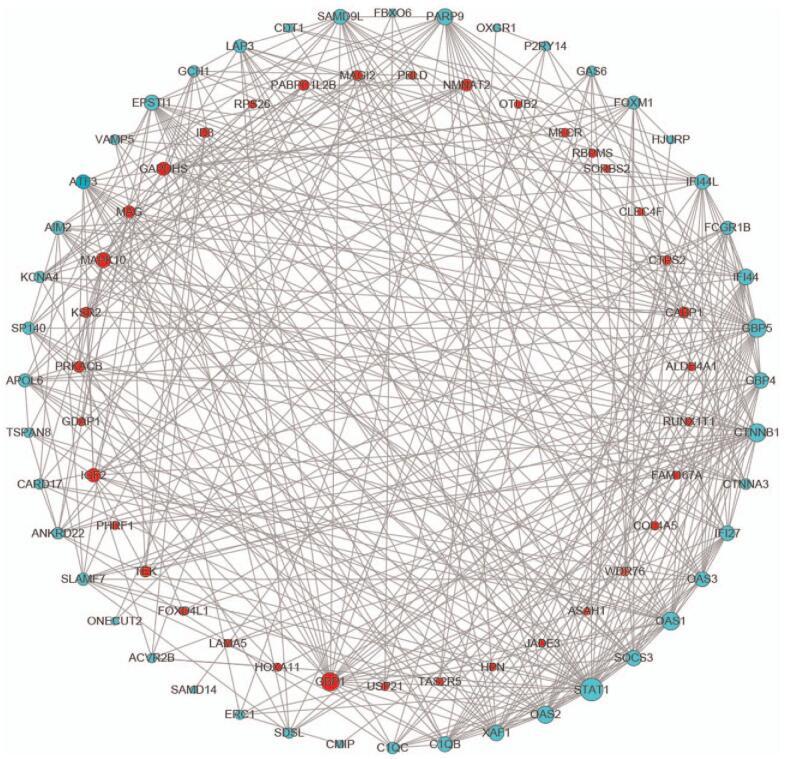
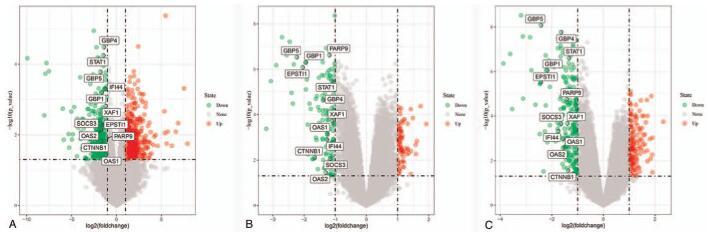
There are a total of 143 genes were confirmed as DEGs, containing 48 up-regulated genes and 50 down-regulated genes. The gene ontology and Kyoto Encyclopedia of Genes and Genomes analysis show that upregulated DEGs were associated with cancer and phylogenetic, whereas downregulated DEGs mainly concentrate on inflammatory immunity. PPI networks show that signal transducer and activator of transcription 1 (STAT1), guanylate binding protein 5 (GBP5), 2'-5'-oligoadenylate synthetase 1 (OAS1), catenin beta 1 (CTNNB1), and guanylate binding protein 1 (GBP1) were identified as significantly different hub genes.
CONCLUSION
We conclude that these genes, including TAT1, GBP5, OAS1, CTNNB1, GBP1 are a candidate as potential core genes in TB and treatment of TB in the future.
背景
结核病(TB)是一个全球性的健康问题,给我们带来了诸多困难。多种遗传因素在结核病的发展中起着重要作用。然而,目前尚未报道结核病易感性的关键基因。本研究旨在通过综合生物信息学分析来鉴定结核病的关键基因。
方法
我们分析了基因表达综合数据库(GEO)中的系列微阵列数据集。使用在线工具 GEO2R 筛选 TB 与健康对照之间的差异表达基因(DEGs)。数据库注释完成基因本体论功能分析以及京都基因与基因组百科全书通路富集分析。通过 STRING 在线工具建立 DEGs 的蛋白质-蛋白质相互作用(PPI)网络,并使用 Cytoscape 软件可视化。分子复合物检测可以完成 PPI 网络中的模块分析。最后,通过 Cytoscape 的插件 Genemania 确认显著的枢纽基因,并通过验证队列和蛋白质测试进行验证。
结果
共鉴定出 143 个 DEGs,其中包括 48 个上调基因和 50 个下调基因。基因本体论和京都基因与基因组百科全书分析表明,上调的 DEGs 与癌症和系统发生有关,而下调的 DEGs 主要集中在炎症免疫上。PPI 网络显示,信号转导和转录激活因子 1(STAT1)、鸟苷酸结合蛋白 5(GBP5)、2'-5'-寡腺苷酸合成酶 1(OAS1)、连环蛋白 β 1(CTNNB1)和鸟苷酸结合蛋白 1(GBP1)被鉴定为显著差异的枢纽基因。
结论
我们得出结论,这些基因包括 TAT1、GBP5、OAS1、CTNNB1 和 GBP1,可能是结核病和未来结核病治疗的潜在核心基因。



 Zotero 插件