
唾液样本与鼻咽拭子在 SARS-CoV-2 的分子检测中具有可比性。
Saliva is Comparable to Nasopharyngeal Swabs for Molecular Detection of SARS-CoV-2.
机构信息
Department of Radiology, Beth Israel Deaconess Medical Centergrid.239395.7, Boston, Massachusetts, USA.
Department of Pathology, Beth Israel Deaconess Medical Centergrid.239395.7, Boston, Massachusetts, USA.
出版信息
Microbiol Spectr. 2021 Sep 3;9(1):e0016221. doi: 10.1128/Spectrum.00162-21. Epub 2021 Aug 18.
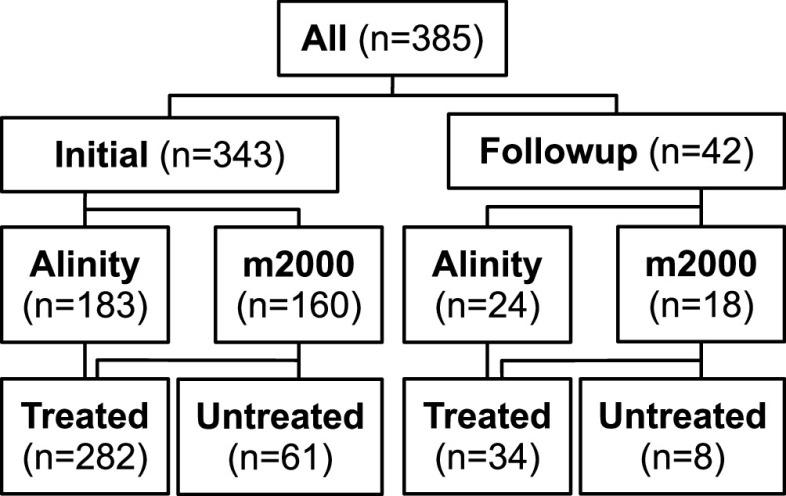
The continued need for molecular testing for severe acute respiratory syndrome coronavirus 2 (SARS-CoV-2) and the potential for self-collected saliva as an alternative to nasopharyngeal (NP) swabs for sample acquisition led us to compare saliva to NP swabs in an outpatient setting without restrictions to avoid food, drink, smoking, or tooth-brushing. A total of 385 pairs of NP and saliva specimens were obtained, the majority from individuals presenting for initial evaluation, and were tested on two high-sensitivity reverse transcriptase PCR (RT-PCR) platforms, the Abbott m2000 and Abbott Alinity m (both with limits of detection [LoD] of 100 copies of viral RNA/ml). Concordance between saliva and NP swabs was excellent overall (Cohen's κ = 0.93) for both initial and follow-up testing, for both platforms, and for specimens treated with guanidinium transport medium as preservative as well as for untreated saliva (κ = 0.88 to 0.95). Viral loads were on average 16× higher in NP specimens than saliva specimens, suggesting that only the relatively small fraction of outpatients (∼8% in this study) who present with very low viral loads (<1,600 copies/ml from NP swabs) would be missed by testing saliva instead of NP swabs when using sensitive testing platforms. Special attention was necessary to ensure leak-resistant specimen collection and transport. The advantages of self-collection of saliva, without behavioral restrictions, will likely outweigh a minor potential decrease in clinical sensitivity in individuals less likely to pose an infectious risk to others for many real-world scenarios, especially for initial testing. In general, the most accurate COVID-19 testing is hands-on and uncomfortable, requiring trained staff and a "brain-tickling" nasopharyngeal swab. Saliva would be much easier on both fronts, since patients could collect it themselves, and it is after all just spit. However, despite much interest, it remains unclear how well saliva performs in real-world settings when just using it in place of an NP swab without elaborate or cumbersome restrictions about not eating/drinking before testing, etc. Also, almost all studies of COVID-19 testing, whether of NP swabs, saliva, or otherwise, have been restricted to reporting results in the abstruse units of " values," which only mean something in the context of a specific assay and testing platform. Here, we compared saliva versus NP swabs in a real-world setting without restriction and report all results in natural units-the amount of virus being shed-showing that saliva is essentially just as good as NP swabs.
我们需要继续对严重急性呼吸综合征冠状病毒 2(SARS-CoV-2)进行分子检测,并且有可能使用自我采集的唾液替代鼻咽(NP)拭子作为样本采集方法。这促使我们在没有任何限制的情况下,包括避免进食、饮水、吸烟或刷牙,在门诊环境中比较唾液和 NP 拭子。共获得了 385 对 NP 和唾液样本,其中大多数来自初次就诊的个体,并使用两种高灵敏度逆转录酶 PCR(RT-PCR)平台(Abbott m2000 和 Abbott Alinity m,检测下限均为 100 拷贝/ml 病毒 RNA)进行了检测。对于两种平台以及使用胍基运输介质作为防腐剂的样本和未处理的唾液,总体上唾液和 NP 拭子的一致性非常好(Cohen's κ=0.93),无论是初次检测还是随访检测,均具有良好的一致性(κ=0.88 至 0.95)。NP 样本中的病毒载量平均比唾液样本高 16 倍,这表明只有少数(在本研究中约为 8%)门诊患者的病毒载量非常低(来自 NP 拭子的病毒载量<1600 拷贝/ml),如果使用敏感的检测平台,通过检测唾液而非 NP 拭子,可能会错过这些患者。需要特别注意确保样本采集和运输的防漏性。对于许多现实场景,自我采集唾液具有无需行为限制的优势,不太可能对他人构成感染风险的个体的临床敏感性可能会略有下降,但这种优势很可能会超过这一劣势。一般来说,最准确的 COVID-19 检测需要动手且令人不适,需要经过培训的工作人员以及具有“刺激性”的鼻咽拭子。唾液在这两方面都要容易得多,因为患者可以自行采集,而且毕竟只是唾液。然而,尽管人们对此非常感兴趣,但当仅仅使用唾液替代 NP 拭子时,它在现实环境中的性能仍不清楚,而没有关于检测前不进食/饮水等复杂或繁琐的限制。此外,几乎所有 COVID-19 检测的研究,无论是 NP 拭子、唾液还是其他检测,都仅限于以晦涩难懂的“值”为单位报告结果,而只有在特定检测和测试平台的背景下才有意义。在这里,我们在没有任何限制的真实环境中比较了唾液和 NP 拭子,并以自然单位-病毒脱落量报告了所有结果,表明唾液与 NP 拭子基本一样好。



 Zotero 插件